

Losing your job at a major tech company like Amazon Studios or Apple TV+ in Culver City can feel abrupt and unfair, especially when the real reason is hidden behind terms like “restructuring” or “performance concerns.” Understanding your rights is crucial because California law protects workers from illegal terminations and retaliation, including those disguised as routine layoffs or contract issues. This guide clarifies how wrongful termination laws apply in the tech sector, helping you spot unlawful practices and safeguard your career.
Table of Contents
- Defining Wrongful Termination In California Tech
- Types Of Termination And Common Legal Grounds
- California Laws Governing Tech Industry Terminations
- Employee Rights, Severance, And Legal Recourse
- Risks, Mistakes, And How To Protect Yourself
Key Takeaways
| Point | Details |
|---|---|
| Understanding Wrongful Termination | Wrongful termination claims arise in California when an employee is fired for illegal reasons, such as discrimination or retaliation, despite the at-will employment doctrine. |
| Critical Documentation | Preserve all communications and documentation immediately after termination, as they are vital for supporting any wrongful termination claim. |
| Severance Agreement Awareness | Carefully review severance agreements to ensure they do not include waivers of rights you may need to protect before signing. |
| Legal Recourse Options | Explore your legal options promptly, as California has specific deadlines for filing claims related to wrongful termination that must be met. |
Defining wrongful termination in California tech
Wrongful termination means your employer fired you in violation of California law or a valid employment contract. This isn’t just about being let go—it’s about being let go illegally. Tech companies in Culver City and throughout Los Angeles must follow the same employment laws as every other business.
California operates under what’s called at-will employment. This means employers can fire you for almost any reason—or no reason at all. But there are critical exceptions. Your employer cannot terminate you for reasons that violate public policy, discriminate based on protected characteristics, or retaliate against you for legally protected activities.
Wrongful termination claims typically fall into three main categories:
- Contract violations: Your employer breached an employment agreement or implied contract
- Public policy violations: You were fired for refusing to break the law, reporting illegal activity, or exercising legal rights
- Discriminatory or retaliatory termination: You were fired based on protected status or in response to protected conduct
In the tech sector, wrongful termination often involves subtle patterns rather than overt statements. A manager might claim “reorganization” when the real reason is your pregnancy disclosure. Performance reviews might suddenly turn negative after you request reasonable accommodations for a disability. Code layoffs may target employees who raised safety concerns about product ethics.
Wrongful termination in California isn’t limited to obvious cases—it includes situations where the stated reason masks an illegal motivation.
Here’s what makes California different from many states: courts and the state labor commissioner actively protect worker rights. California doesn’t require you to have an employment contract to claim wrongful termination. The law assumes certain protections exist for all employees.
Tech companies often use sophisticated language to justify terminations. “Not a cultural fit” might hide discrimination. “Performance issues” might follow your request for time off due to health conditions. “Redundancy” might target workers who negotiated higher salaries or questioned management decisions.
Your documented communications matter significantly. Emails, chat messages, performance reviews, and meeting notes all become evidence. If your termination happened shortly after you raised concerns, reported misconduct, or disclosed a protected status, the timing itself can support a wrongful termination claim.
Understanding whether you have a valid claim requires examining the actual reason for your termination versus the stated reason. California law protects you even when employers try to hide unlawful motivation behind neutral-sounding explanations.
Pro tip: Preserve all documentation immediately after your termination—emails, Slack messages, performance reviews, and any written communication with management. Screenshots count. Don’t wait; data can disappear from company servers.
Types of termination and common legal grounds
Termination falls into two basic categories: voluntary and involuntary. Understanding which type applies to your situation helps determine whether you have grounds for a wrongful termination claim. Tech companies use both types, but only involuntary terminations can potentially be wrongful.
Voluntary termination occurs when you choose to leave. This includes resignation, retirement, or job abandonment. When you voluntarily leave, you generally have fewer legal claims against your employer, though exceptions exist if you were forced out through harassment or hostile conditions.
Involuntary termination happens when your employer initiates the separation. This is where wrongful termination claims arise. Involuntary terminations split into two critical categories:
The following table compares voluntary and involuntary termination types and their potential legal consequences:
| Termination Type | Initiator | Common Reason | Potential for Legal Claim |
|---|---|---|---|
| Voluntary | Employee | Resignation or retirement | Usually limited |
| Involuntary | Employer | Layoff or firing | Can trigger claims |
- For-cause termination: Employer fires you for misconduct, poor performance, or violating company policy
- Without-cause termination: Employer lets you go through layoffs, restructuring, or “elimination” of your role
Here’s the problem: employers often disguise the real reason for termination. A for-cause termination may actually hide discrimination or retaliation. Performance issues suddenly appear after you request accommodations or disclose a protected status.
Employers can terminate at-will employees for almost any reason—except unlawful ones. The challenge is proving the real reason differs from the stated reason.
In California tech, “for-cause” terminations frequently target protected conduct. You refuse an unethical coding requirement and get fired for “performance issues.” You report safety concerns about product ethics and receive a layoff notice. You request flexible work after a health diagnosis and management documents fabricated performance problems.

Without-cause terminations also require legal grounds. Mass layoffs cannot selectively target protected workers. Restructuring cannot disproportionately affect employees based on age, gender, race, or disability status. If layoffs eliminate your role but identical positions remain, timing and selection patterns matter.
Common unlawful grounds for termination include:
- Discrimination based on protected characteristics (age, race, gender, disability, pregnancy, religion)
- Retaliation for whistleblowing or reporting illegal activity
- Refusal to commit illegal acts
- Exercise of legal rights (jury duty, voting, medical leave)
- Violation of public policy or established contracts
Tech companies operating in Culver City face the same California protections as any industry. Amazon Studios, Apple TV+, and other major employers cannot use for-cause or at-will justifications to mask unlawful motivation.
Pro tip: Document the timeline obsessively—when you raised concerns, when performance reviews changed, when termination occurred. Temporal proximity between protected activity and firing is powerful evidence of retaliation.
California laws governing tech industry terminations
California’s employment laws are among the strongest in the nation. They override the basic at-will employment doctrine by imposing strict limits on when and how employers can terminate workers. Tech companies operating in Culver City must comply with these rules regardless of industry custom or company size.
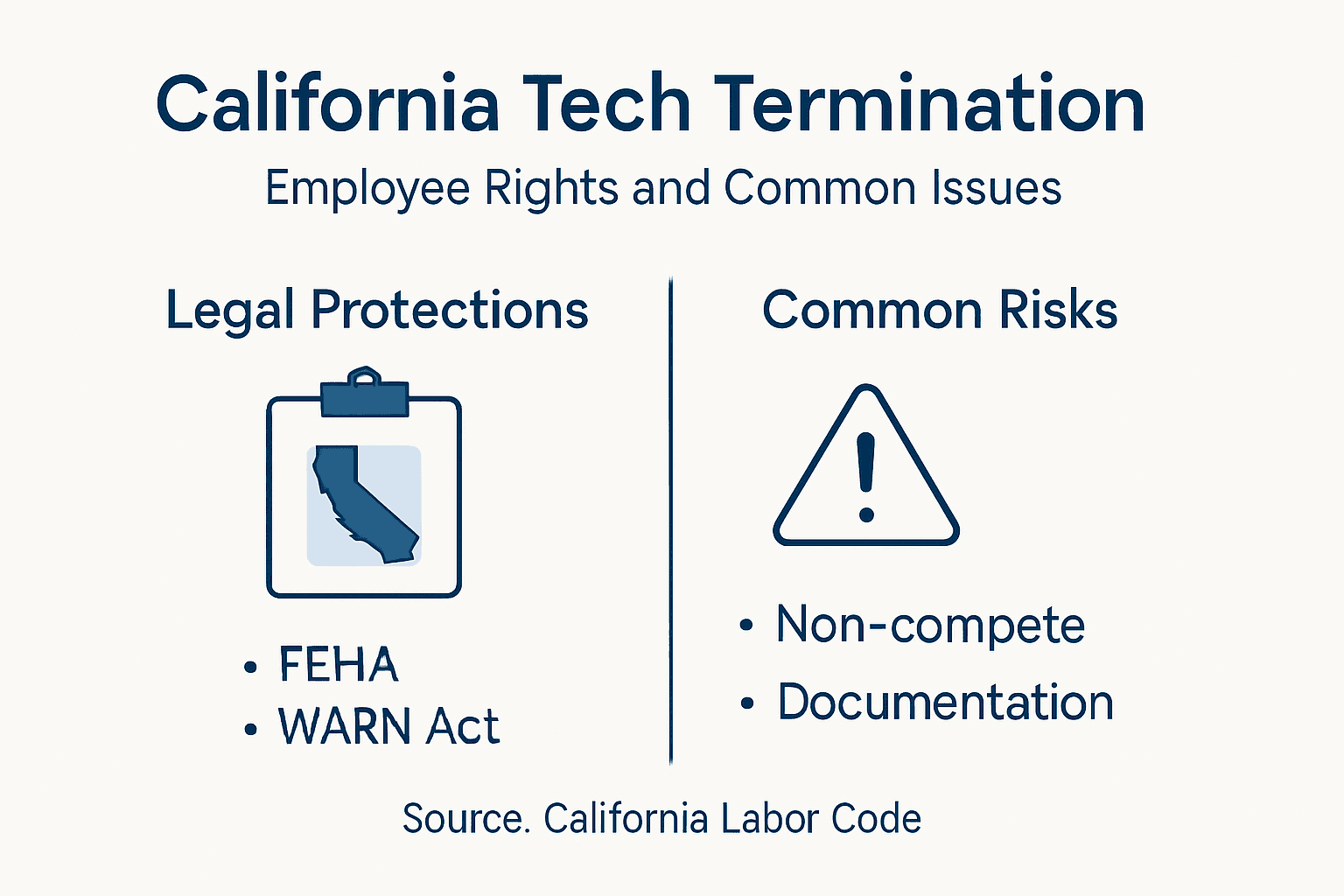
The foundation is the California Fair Employment and Housing Act (FEHA). This law prohibits employers from terminating employees based on protected characteristics: race, color, religion, sex, gender identity, sexual orientation, age, disability, genetic information, or military status. FEHA applies to all employers with five or more employees, including every major tech firm.
Unlawful retaliation protections extend to employees who report violations, refuse illegal conduct, or exercise legal rights. Report unsafe working conditions, and you cannot be fired for that report. Request reasonable accommodations for a disability, and termination is illegal. Serve on a jury, and retaliation is prohibited.
California’s public policy doctrine prevents termination for reasons that violate established law. You cannot be fired for refusing to commit fraud, reporting crimes, or exercising constitutional rights. This protection exists even without a written employment contract.
California law assumes employees have certain rights that employers cannot strip away, even in at-will employment relationships.
For mass layoffs, the California WARN Act requires employers to provide 60 days’ advance notice to affected workers. Failure to provide notice can result in penalties and wage claims. Tech companies that conduct surprise reductions without proper notice violate this requirement.
Proper documentation is critical. Employers must maintain accurate performance records, contemporaneous notes about conduct issues, and clear explanations for termination decisions. Fabricated or backdated documentation strengthens wrongful termination claims against employers.
Final pay requirements are strict. California law mandates employers pay all earned wages by the final day of employment, including accrued paid time off in many situations. Withheld final pay is illegal.
Here is a summary table outlining the major laws that impact wrongful termination in California tech:
| Law/Protection | Who Is Covered | What It Prohibits | Unique Features |
|---|---|---|---|
| FEHA | Employers with 5+ staff | Termination based on protected traits | Covers wide range of statuses |
| Public Policy Doctrine | All employees | Firing for refusal to break laws | No contract required |
| WARN Act | Larger employers | Mass layoffs without advance notice | 60 days notice required |
| Wage Payment Laws | All terminated staff | Withholding final pay or accrued time off | Immediate payment needed |
| Retaliation Protections | All workers | Firing after reporting or exercising rights | Applies even to at-will jobs |
Key California protections include:
- No termination based on protected characteristics or status
- No retaliation for reporting violations or exercising legal rights
- No termination violating public policy
- Proper notice requirements for mass layoffs
- Final wage payment obligations
- Right to inspect personnel records
Tech companies cannot circumvent these protections through contract language, arbitration clauses, or sophisticated termination procedures. California courts consistently protect employee rights even when employment agreements attempt to waive them.
Pro tip: Request your complete personnel file immediately after termination. California law allows this, and documents often reveal the real reason for your firing versus stated justifications.
Employee rights, severance, and legal recourse
Being terminated wrongfully gives you specific legal rights—even if your employer hands you a severance agreement. California protects your ability to challenge unlawful termination, and severance packages cannot strip away these protections if they’re offered improperly.
Severance is not legally required in California unless an employment contract, union agreement, or company policy guarantees it. This surprises many tech workers who assume severance is automatic. When employers do offer severance, they often tie it to signing a waiver of legal claims.
Here’s the catch: waivers of wrongful termination claims are enforceable only if they meet strict California requirements. The agreement must be clear, knowing, and voluntary. You must have time to review it—signing a waiver minutes before losing access to company systems raises enforceability questions.
Understanding severance terms carefully protects your ability to pursue claims later. Read every clause. Look for language that waives discrimination claims, retaliation claims, or public policy violations. Some waivers are overly broad and unenforceable.
Severance agreements often contain hidden costs—you trade money today for the right to sue your employer later. Know exactly what you’re giving up.
You have immediate steps to protect yourself after wrongful termination:
- Document everything now—emails, messages, performance reviews, and termination communications
- Request your personnel file—California law allows this; you’ll see what management documented about you
- Review the severance agreement carefully—don’t sign under time pressure
- Understand legal deadlines—some claims have tight filing windows
Wrongful termination claims provide multiple remedies. You can recover back wages, lost benefits, damages for emotional distress, and attorney’s fees. Punitive damages apply when employers act with malice or oppression—common in retaliation cases.
Your legal recourse options include:
- File a claim with California’s Division of Labor Standards Enforcement (DLSE)
- Pursue administrative complaints through the California Civil Rights Department
- File a civil lawsuit in court for breach of contract or statutory violations
- Demand arbitration if your employment agreement requires it
Timing matters critically. California has different deadlines for different claims. Discrimination claims under FEHA have specific notice requirements. Wage claims have statute of limitations periods. Missing deadlines eliminates your ability to recover.
Tech companies in Culver City sometimes pressure workers to sign releases without legal review. Resist this pressure. You have the right to consult an attorney before signing away claims. Many severance offers include language allowing consultation with counsel.
Don’t assume severance is final. If the termination violated California law, severance may not bar your claims depending on how it’s drafted. Broad waivers sometimes fail legal scrutiny, especially when employees sign under duress or without adequate review time.
Pro tip: Never sign a severance agreement the same day you’re terminated. Request time to have an attorney review it—most employers legally cannot refuse this request. What you sign today determines whether you can pursue claims for months or years ahead.
Risks, mistakes, and how to protect yourself
Wrongful termination claims fail regularly because employees make critical mistakes immediately after being fired. These errors can destroy your ability to recover damages or prove your case. Understanding the risks helps you avoid them.
The biggest mistake is signing documents without legal review. Severance agreements, non-disparagement clauses, and separation documents often contain hidden waivers. You sign away your right to sue before understanding what you’ve lost. Tech companies count on your shock and panic to rush you into these decisions.
Another fatal error is failing to document evidence. Once you lose company system access, you lose emails, chat messages, and digital records. Screenshots taken immediately after termination become critical evidence months later. Companies often delete records from terminated employees’ accounts within days.
Consulting an employment attorney immediately protects your ability to pursue claims effectively. An attorney can review severance agreements, identify legal deadlines, and preserve evidence before it disappears. Many employment lawyers work on contingency—you pay nothing unless you win.
The first 48 hours after termination determine whether you’ll succeed or fail in pursuing claims. Use this window strategically.
Common mistakes that destroy cases include:
- Signing anything without legal review
- Deleting communications or digital records
- Missing filing deadlines with administrative agencies
- Making statements to management about your termination reasons
- Waiting months before consulting an attorney
- Failing to request your personnel file immediately
Do not discuss your termination with coworkers in detail. Avoid posting on social media about the situation. Don’t accept the employer’s narrative about “mutual agreement” or “resignation.” Every statement you make can be used against you later.
Protect yourself with immediate action steps:
- Preserve all evidence today—screenshot emails, messages, and documents before access ends
- Request personnel file immediately—this is your right; do it in writing
- Consult an attorney before signing anything—don’t wait
- Note the termination timeline—when you were told, what was said, who was present
- Understand your industry deadlines—tech layoffs have different timelines than individual terminations
Risks escalate when you delay action. California has strict deadlines for filing discrimination claims and wage disputes. Missing these windows eliminates your ability to recover entirely. Some claims must be filed within 180 days; others within three years. The variation creates confusion that costs employees their rights.
Tech companies often use non-disparagement agreements to silence you. You cannot discuss the termination or company performance publicly. Violating these agreements triggers legal action against you. However, overly broad non-disparagement clauses may be unenforceable—another reason to consult counsel.
Another risk involves non-compete agreements and intellectual property disputes. Some tech employers claim you stole code or violate non-competes after termination. These counterclaims pressure you to abandon your wrongful termination claim. Understanding your rights here prevents employers from flipping the script.
Pro tip: The moment you’re terminated, assume you have 48 hours before evidence disappears and legal deadlines start running. Take a paid lunch break, find an employment attorney, and have them review everything before you make any decisions or sign anything.
Protect Your Rights After Wrongful Termination in Culver City Tech
Facing termination that feels unfair or retaliatory in the tech industry can be overwhelming. You might be struggling with unclear termination reasons, disguised performance issues, or timing that hints at discrimination or retaliation. These are serious challenges that threaten your career and financial security in ways that only a skilled advocate can help you navigate. Terms like “at-will employment” and “public policy violations” are complicated, but you should never face these battles alone.
At Shirazi Law Office we specialize in fighting wrongful termination and enforcing the employee protections guaranteed by California law. Our experience with tech professionals in Culver City and across Los Angeles means we understand how employers use subtle justifications like “not a cultural fit” or “restructuring” to mask illegal motives. We help you preserve critical evidence, review severance offers carefully, and pursue the damages and justice you deserve.
Do not wait until crucial legal deadlines pass or until you sign away your rights. Contact us today at Shirazi Law Office to schedule a consultation. Let us protect your rights and hold your employer accountable so you can focus on your future without fear. Remember that timing is vital and immediate action can make all the difference.
Frequently Asked Questions
What constitutes wrongful termination in California’s tech industry?
Wrongful termination occurs when an employer fires an employee in violation of California law or a valid employment contract, such as discrimination, retaliation, or failing to adhere to public policy.
What should I do immediately after being wrongfully terminated?
Immediately document all communications, request your personnel file, and consult an employment attorney before signing any documents to protect your rights.
How can I prove my wrongful termination claim?
To prove a wrongful termination claim, gather evidence like emails, performance reviews, and any documented communications that show discrepancies between the stated reason for your termination and the actual reason.
Are severance agreements legally binding in cases of wrongful termination?
Severance agreements can be legally binding, but claims can be challenged if they do not meet California’s strict requirements or if you sign under duress. Always consult a lawyer before signing such agreements.