
Major studios in Culver City are not immune to wage violations. HBO faced a lawsuit from a crew member alleging late payments and missed meal and rest breaks, and Amazon Studios has faced class action claims over overtime miscalculation. These are not isolated incidents. Many entertainment workers assume their pay is handled correctly, or that union protections cover everyone. Neither assumption is always true. This guide breaks down what is really happening in Culver City studios, what your rights are under California law, and what steps you can take right now to protect your wages and your livelihood.
Table of Contents
- Wage disputes in Culver City’s entertainment industry: The real story
- Core wage disputes: Overtime, breaks, late pay, and off-the-clock work
- How to take action: Filing claims, PAGA, and key remedies for workers
- When employers push back: Defenses, union contracts, and the reality for plaintiffs
- What most entertainment workers miss about wage disputes in Culver City
- Get experienced legal support for your entertainment wage dispute
- Frequently asked questions
Key Takeaways
| Point | Details |
|---|---|
| Frequent industry disputes | Wage and hour lawsuits are common at Amazon Studios, HBO, and similar Culver City employers. |
| Complex wage rules | California law requires careful calculation of overtime and strict observance of break and pay timing. |
| Multiple claim options | Employees can pursue DLSE claims, PAGA actions, or discrimination charges through the CRD. |
| Employer defenses exist | Studios may claim union or procedural exemptions, but courts often let workers amend claims. |
| Documentation is critical | Keeping detailed work records and reporting violations quickly maximizes the chance of resolution. |
Wage disputes in Culver City’s entertainment industry: The real story
Culver City has become one of the most active production hubs in Los Angeles, home to Amazon Studios’ major operations and HBO production facilities. With that concentration of high-budget productions comes a recurring pattern of wage violations that affect crew members, background talent, and non-union workers alike.
The disputes are not random. They follow predictable patterns rooted in how studios schedule productions, classify workers, and calculate pay. A class action filed in Los Angeles County against Amazon Studios alleged unpaid overtime and miscalculated compensation, particularly affecting background and non-union talent. HBO’s case involved late pay and missed breaks under California’s strict labor standards.
Here is a snapshot of the most common dispute types seen at major studios:
| Dispute type | Common cause | Who is most affected |
|---|---|---|
| Unpaid overtime | Miscalculated regular rate | Non-union crew, background actors |
| Missed meal/rest breaks | Long production days | All hourly workers |
| Late final paycheck | Administrative delays | Terminated or project-end workers |
| Off-the-clock work | Pre-call prep, post-wrap tasks | Background talent, junior crew |
A few myths are worth correcting here:
- Myth: Union membership protects you from all wage violations. Reality: Union contracts can actually complicate claims, and non-union workers have no such structural safety net at all.
- Myth: Studios always pay correctly because they are large corporations. Reality: Size does not equal compliance. Complex production schedules create systematic errors.
- Myth: You have to accept late pay because it is “how the industry works.” Reality: California law imposes strict deadlines and penalties on late wages.
“The entertainment industry’s irregular scheduling and layered production hierarchies create conditions where wage errors are not just possible, they are predictable.”
If you have experienced any of these issues, learning more about Hollywood freelance wage theft can help you understand whether what happened to you is legally actionable. A Culver City employment lawyer can evaluate your specific situation with the context this industry demands.
Now that the prevalence of disputes is clear, let’s look at the mechanics of wage and hour claims affecting entertainment workers.
Core wage disputes: Overtime, breaks, late pay, and off-the-clock work
California has some of the strongest wage protections in the country. But those protections only work if you know how to use them. Here are the four main categories of wage violations that affect entertainment workers.
Overtime miscalculation
California requires overtime pay for hours worked beyond 8 in a day or 40 in a week. The tricky part is the regular rate of pay. This rate must include all non-discretionary compensation, such as production bonuses and flat-rate payments. Studios sometimes calculate overtime based on a base hourly wage alone, which understates what you are actually owed. The Amazon Studios class action centered on exactly this type of miscalculation.
Meal and rest break violations
California law requires a 30-minute unpaid meal break for shifts over 5 hours and a 10-minute paid rest break for every 4 hours worked. If your employer fails to provide these breaks, you are entitled to one additional hour of pay at your regular rate for each missed break. On a 12-hour production day, that adds up fast.
Late or missing final paychecks
When you are fired or laid off, California requires your final paycheck immediately. If you resign with 72 hours notice, the check is due on your last day. Every day the check is late triggers a waiting time penalty equal to your daily wage, up to 30 days.
Off-the-clock work
Background talent and junior crew are especially vulnerable here. Pre-call costume prep, post-wrap equipment returns, and mandatory briefings before the official call time are all compensable if the employer controls or benefits from that time.
Pro Tip: Keep a personal log of your actual start and end times, every break taken or missed, and any instructions given before or after your official call. This documentation is often the difference between a strong claim and a dismissed one. You can also review unpaid overtime violations to understand what recovery looks like in practice.
Statistic: California’s meal break premium pay alone can generate hundreds of dollars in additional compensation per week for workers on long production schedules.
Understanding these wage dispute categories is key, but what systems are in place for entertainment workers to actually enforce their rights?
How to take action: Filing claims, PAGA, and key remedies for workers
Knowing your rights is step one. Taking action is step two. California gives workers multiple pathways to recover unpaid wages and penalties.
Step-by-step process for asserting your rights:
- Document everything. Gather pay stubs, call sheets, time records, and any written communications about your schedule or pay.
- Calculate what you are owed. Add up unpaid overtime, missed break premiums, and any late pay penalties.
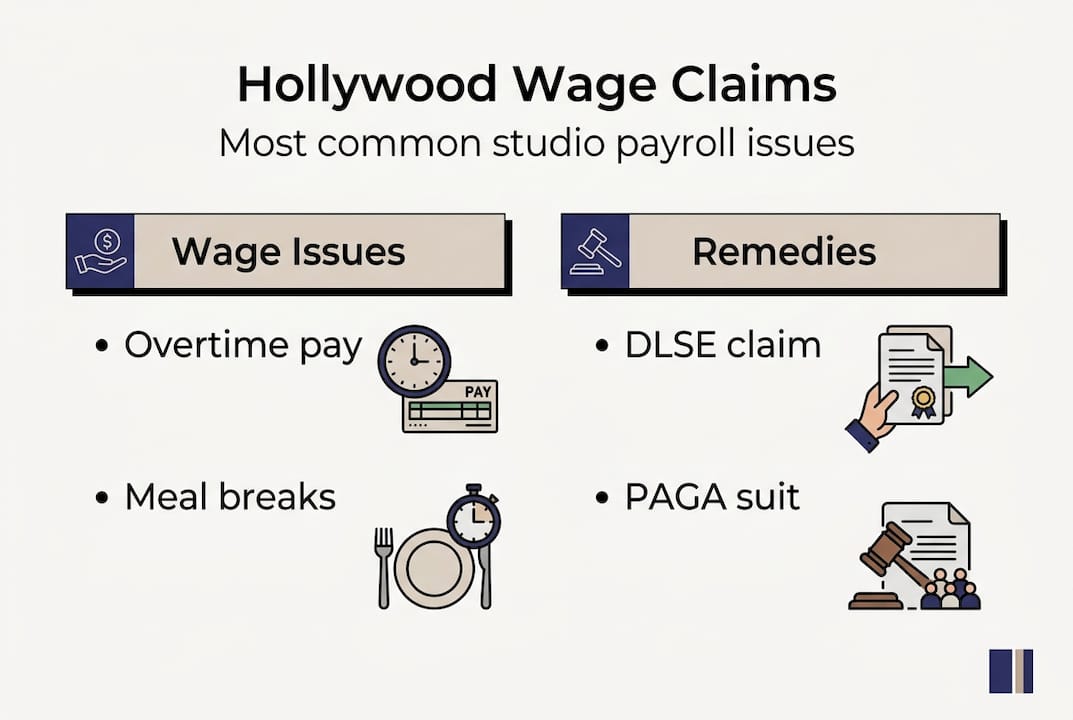
- Choose your filing path. For claims under $10,000, the California Division of Labor Standards Enforcement (DLSE) offers a free administrative process. For larger claims, you can go directly to court.
- Consider a PAGA action. The Private Attorneys General Act allows you to file on behalf of yourself and other aggrieved workers. Penalties are typically $100 per pay period per worker for initial violations.
- Report discrimination or harassment separately. These claims must go to the California Civil Rights Department (CRD) before you can sue in court. Culver City wrongful termination remedies outlines how this process works in practice.
Here is a comparison of your main filing options:
| Filing option | Best for | Key benefit |
|---|---|---|
| DLSE wage claim | Claims under $10,000 | Free, no attorney required |
| Civil court lawsuit | Claims over $10,000 | Full damages and penalties |
| PAGA action | Group violations | Penalties for all affected workers |
| CRD complaint | Discrimination/harassment | Required before civil suit |
Pro Tip: You do not need to exhaust the DLSE process before filing a civil lawsuit for larger wage claims. If your unpaid wages exceed $10,000, going directly to court is often faster and more effective. Workers in other parts of Los Angeles face similar choices, and Downtown LA wage violations cases show how these strategies play out.
California’s pay transparency reforms have also created new leverage for workers to identify pay inequities before disputes escalate.
With a process for asserting rights established, let’s examine factors that can complicate or strengthen a worker’s case.
When employers push back: Defenses, union contracts, and the reality for plaintiffs
Studios do not simply accept wage claims. They fight back, and understanding their playbook helps you prepare.
The most common employer defenses in entertainment wage cases:
- Union preemption: Employers argue that collective bargaining agreements (CBAs) govern pay terms, preempting California state law claims. Courts examine these arguments carefully and do not always accept them, especially for non-union workers or for claims not specifically addressed in the CBA.
- Misclassification defenses: Studios sometimes argue that workers were independent contractors, not employees, and therefore not entitled to California wage protections. California’s ABC test makes this defense harder to win than in most states.
- Technical pleading challenges: Employers file demurrers (formal objections) to dismiss cases on procedural grounds. Courts often sustain these but grant workers the right to amend their complaints and refile.
In the Amazon Studios class action, procedural challenges were raised, but the case continued, illustrating that technical hurdles rarely end a well-supported claim permanently.
| Defense strategy | How courts typically respond | Worker’s best counter |
|---|---|---|
| Union preemption | Scrutinized closely, not automatic | Show claim falls outside CBA scope |
| Independent contractor | Hard to win under CA ABC test | Document employer control |
| Technical pleading flaws | Leave to amend usually granted | Refile with stronger specifics |
The HBO case moved forward without strong employer defenses prevailing, which reflects a broader trend: California courts take wage violations seriously. Warner Bros. wage class actions show that even the largest studios face real accountability.
“Persistence matters. Many workers abandon valid claims after an initial setback, not realizing that a demurrer is often just a speed bump, not a dead end.”
For workers navigating studio disputes, understanding Culver City tech and employment disputes can also provide useful context on how Los Angeles courts approach employer defenses in high-profile cases.
Let’s step back for some insider perspective on what really makes cases succeed or fail in this space.
What most entertainment workers miss about wage disputes in Culver City
Here is the uncomfortable truth: the workers most vulnerable to wage theft are the ones least likely to pursue a claim. Non-union background talent and junior crew often assume they have no leverage. They do.
What actually drives outcomes in these cases is not the size of the studio or the complexity of the law. It is documentation and persistence. Workers who keep detailed records of their hours, breaks, and communications consistently achieve better results than those who rely on memory alone.
Many workers also give up after an initial employer pushback, believing the system is designed to protect studios. That belief is understandable but incorrect. California’s wage laws are among the most worker-friendly in the country, and PAGA gives individuals real power to act on behalf of entire crews.
We have seen cases involving Sony Pictures retaliation and other major studios where workers who stayed the course secured meaningful settlements and, in some cases, drove policy changes at the studio level. Your case is not just about your paycheck. It is about holding powerful institutions accountable.
Get experienced legal support for your entertainment wage dispute
Navigating a wage dispute against a major studio is not something you should do alone. Shirazi Law Office provides focused wage and hour legal help for entertainment workers in Culver City and across Los Angeles. Whether you are dealing with unpaid overtime, missed breaks, or a late final paycheck, the firm offers strategic representation tailored to your situation. If your dispute involves discrimination or harassment, you can also explore your employee discrimination rights before taking action. Contact a Los Angeles employment lawyer at Shirazi Law Office to schedule a consultation and get a clear picture of what your claim is worth.
Frequently asked questions
What should I do if I am paid late or miss meal breaks at a studio like HBO?
File a wage claim with the California DLSE or consult an employment lawyer, as you may be entitled to penalties and premium pay. HBO faced a PAGA lawsuit for exactly these violations under California law.
Can I bring a wage claim if I am non-union background talent working for a studio?
Yes, non-union workers can file wage claims or join class actions if their pay is miscalculated or labor laws are violated. Amazon Studios faced a class action for unpaid overtime affecting non-union background talent.
How do PAGA lawsuits work for California entertainment workers?
Eligible employees can file on behalf of themselves and other aggrieved workers for civil penalties, often $100 per pay period per worker. PAGA has been used in multiple entertainment industry wage cases to drive accountability at the studio level.
Who do I report workplace discrimination or harassment to in California?
Report discrimination or harassment to the California Civil Rights Department (CRD) first, then you can proceed to civil court. The CRD handles these complaints before any lawsuit can be filed.
Recommended
- Culver City Workplace Retaliation At Sony Pictures 2026 – Law Office of Brian Y. Shirazi, PC
- Employment Disputes in Culver City Tech Firms
- Non-Compete Disputes in Culver City: Impact on Creatives – Law Office of Brian Y. Shirazi, PC
- Hollywood Non-Compete Disputes: Writer and Producer Rights – Law Office of Brian Y. Shirazi, PC