

Sexual harassment remains pervasive in Culver City’s advertising industry, yet most incidents go unreported despite strong legal protections. Employees at agencies like TBWA\Chiat\Day face unique challenges stemming from high-pressure creative environments and power imbalances. Understanding California’s legal framework empowers victims to recognize harassment, document incidents effectively, and pursue justice through state and federal channels while protecting against retaliation.
Table of Contents
- Introduction To Sexual Harassment In Culver City Advertising Agencies
- Legal Framework And Protections Under California Law
- Types And Manifestations Of Sexual Harassment In Agencies
- Prevalence, Impact, And Barriers To Reporting
- Practical Steps For Victims And Legal Recourse
- How Shirazi Law Office Supports Culver City Professionals
Key takeaways
| Point | Details |
|---|---|
| Legal protections | California FEHA and federal Title VII laws safeguard all employees against sexual harassment regardless of gender. |
| Two harassment types | Quid pro quo involves trading favors for sexual compliance; hostile work environment stems from pervasive unwelcome conduct. |
| Reporting barriers | Fear of retaliation and wrongful termination prevents most victims from filing complaints despite legal safeguards. |
| Documentation matters | Detailed written records with dates, times, and witnesses significantly strengthen harassment claims and legal outcomes. |
| Expert counsel essential | Experienced employment attorneys navigate complex filing processes and maximize chances of successful resolution. |
Introduction to sexual harassment in Culver City advertising agencies
California law defines sexual harassment broadly under the Fair Employment and Housing Act. Sexual harassment includes unwelcome advances and hostile environments connected to gender perception, not just sexual desire. This expansive definition protects employees from verbal abuse, physical touching, visual displays, and other unwelcome conduct that creates intimidating or offensive workplaces.
Culver City’s advertising sector presents unique harassment risks. Close-knit creative teams work long hours under intense pressure to deliver campaigns. These environments blur professional boundaries and create opportunities for inappropriate behavior. Power imbalances between senior creatives, account directors, and junior staff amplify vulnerability.
TBWA\Chiat\Day embodies typical agency dynamics where hierarchical structures and collaborative culture can foster conditions susceptible to harassment. Major agencies employ hundreds of professionals across creative, account management, and production departments. This scale creates multiple reporting relationships and potential blind spots in oversight.
Recognizing harassment in your workplace requires understanding these industry-specific contexts:
- Creative critique sessions that devolve into personal attacks or sexualized comments
- Client entertainment events where alcohol consumption lowers inhibitions
- Mentor relationships that cross professional boundaries
- Pitch processes where junior staff feel pressured to tolerate inappropriate behavior
- Open office layouts that expose employees to unwelcome conversations or imagery
The advertising industry’s competitive nature sometimes normalizes toxic behavior as part of creative culture. Victims hesitate to report incidents, fearing damage to their reputations or career prospects. Understanding that legal protections exist specifically to combat this silence represents the first step toward recourse.
Legal framework and protections under California law
California employees enjoy some of the nation’s strongest harassment protections. The Fair Employment and Housing Act prohibits sexual harassment more broadly than federal law. Title VII of the Civil Rights Act of 1964 provides additional federal protections. Together, these laws create comprehensive safeguards for workers.
Two distinct harassment categories exist under law. Quid pro quo harassment occurs when supervisors or managers condition employment benefits on sexual compliance. Hostile work environment harassment involves pervasive unwelcome conduct that creates intimidating, hostile, or offensive workplaces. Both violate your rights.
California law protects reporting employees from retaliation including termination, demotion, or further harassment. Employers cannot legally punish workers for filing internal complaints or external charges. These anti-retaliation provisions recognize that fear of reprisal silences many victims.
The California Civil Rights Department investigates workplace harassment claims. Formerly called the Department of Fair Employment and Housing, this state agency receives complaints, conducts investigations, and facilitates resolutions. The Equal Employment Opportunity Commission handles federal claims under Title VII.
Your legal rights include multiple reporting pathways:
- Filing internal complaints with human resources or designated company officials
- Submitting charges to the California Civil Rights Department within three years of the last incident
- Filing EEOC complaints within 300 days in California due to dual filing agreements
- Pursuing civil lawsuits after receiving right-to-sue letters from agencies
- Seeking injunctive relief to stop ongoing harassment immediately
Understanding sexual harassment protections in LA helps employees recognize when their rights are violated. California courts have consistently upheld broad interpretations favoring employee protection. Agencies must maintain harassment-free workplaces regardless of industry norms or creative culture claims.
Types and manifestations of sexual harassment in agencies
Advertising agency harassment takes many forms. Recognizing these patterns helps victims identify violations and build stronger cases. Understanding how harassment manifests in creative environments proves essential for documentation and reporting.
| Quid Pro Quo | Hostile Work Environment |
|---|---|
| Supervisor promises promotion for sexual favors | Repeated sexual jokes during creative meetings |
| Manager threatens termination unless employee complies | Display of pornographic images in shared workspaces |
| Account director conditions client assignments on dates | Persistent unwanted touching or invasion of personal space |
| Senior creative exchanges mentorship for sexual relationship | Gender-based insults that demean employees regularly |
| Executive links salary increases to sexual compliance | Sexual favoritism creating intimidating atmosphere |
Quid pro quo cases involve clear exchanges. A supervisor explicitly or implicitly conditions employment decisions on sexual compliance. These cases often involve direct power relationships between managers and subordinates. The harassment typically occurs in private conversations or messages, making documentation crucial.
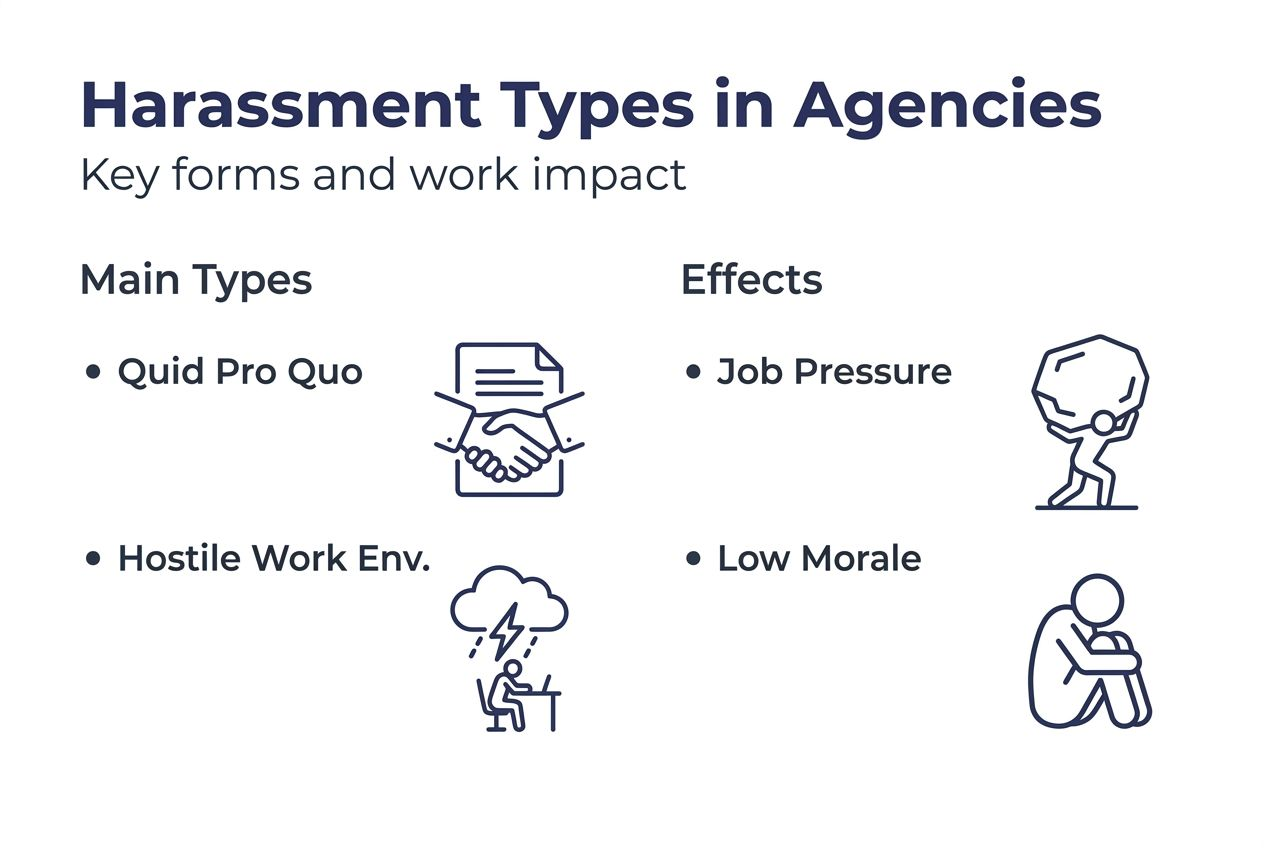
Hostile work environment claims require showing pervasive conduct. Single incidents rarely qualify unless extremely severe. Courts examine the totality of circumstances including frequency, severity, physical threat, and interference with work performance. Agency environments where sexual banter becomes normalized can cross legal thresholds.
Advertising-specific harassment examples include:
- Creative directors making sexualized comments about employees’ appearance during presentations
- Account teams tolerating client sexual advances to preserve business relationships
- Senior staff sharing explicit content in Slack channels or group chats
- Pitch teams pressuring junior employees to dress provocatively for client meetings
- Supervisors showing favoritism to employees who accept unwanted social invitations
Sexual favoritism creates hostile environments even when you’re not the favored employee. Courts recognize that widespread perception of advancement through sexual relationships damages workplace fairness. This dynamic appears frequently in competitive agency settings where promotions seem arbitrary.
Pro Tip: Document every incident immediately in a personal journal kept outside the workplace. Include dates, times, locations, exact quotes when possible, witnesses present, and your emotional response. This contemporaneous record becomes invaluable evidence later.
Understanding employment law fundamentals helps contextualize harassment within broader workplace rights. Power imbalances inherent in advertising agencies demand heightened awareness. Creative collaboration should never excuse inappropriate conduct.
Prevalence, impact, and barriers to reporting
Sexual harassment statistics reveal disturbing patterns. Women file 78% of harassment claims, yet research suggests most incidents go unreported. This gap between actual harassment and formal complaints reflects serious systemic barriers preventing victims from seeking justice.

| Statistic | Impact |
|---|---|
| 78% | Percentage of harassment claims filed by women |
| 75% | Victims who never report incidents formally |
| 68% | Employees who fear retaliation after reporting |
| 45% | Workers who change jobs due to harassment |
Fear of retaliation tops the list of reporting barriers. Victims worry about wrongful termination, hostile treatment from colleagues, damage to professional reputations, and career stagnation. These concerns prove especially acute in tight-knit industries like advertising where reputation matters immensely.
Psychological impacts on victims include anxiety, depression, post-traumatic stress, and decreased job performance. Harassment destroys workplace confidence and professional satisfaction. Many victims experience physical symptoms like insomnia, headaches, and digestive problems stemming from workplace stress.
Career consequences extend beyond immediate emotional harm:
- Missed promotions due to avoiding harassers who control advancement
- Reduced performance reviews following reporting that triggers subtle retaliation
- Forced resignations when employers fail to address complaints adequately
- Industry blacklisting in competitive fields where senior leaders share networks
- Long-term earning losses from interrupted career trajectories
Workplace culture significantly influences reporting rates. Agencies that minimize complaints as misunderstandings or blame victims for being oversensitive discourage reports. Lack of clear reporting procedures and weak enforcement of policies signal that complaints won’t be taken seriously.
Despite strong legal protections against retaliation, many employees correctly perceive that reporting harassment carries professional risks. This reality reflects enforcement gaps and workplace cultures that prioritize reputation over accountability.
Understanding retaliation after reporting harassment helps victims recognize illegal employer responses. California law prohibits adverse employment actions motivated by complaints. Documenting post-report treatment proves essential for retaliation claims.
Victims who face wrongful termination after reporting misconduct have legal recourse through state and federal agencies. Termination following harassment complaints often violates anti-retaliation laws even when employers claim legitimate business reasons.
Practical steps for victims and legal recourse
Taking action against harassment requires strategic planning and thorough documentation. Following these steps maximizes your legal protections and improves claim outcomes.
- Recognize the harassment and trust your instincts about inappropriate behavior.
- Document every incident immediately with detailed written records.
- Report harassment through internal company channels if safe to do so.
- File formal complaints with the California Civil Rights Department or EEOC.
- Consult an experienced employment attorney before making critical decisions.
- Preserve all relevant evidence including emails, texts, and witness information.
- Continue performing your job duties professionally despite ongoing harassment.
Detailed documentation significantly increases claim success by providing concrete evidence of patterns and severity. Your records should include specific dates, exact times, precise locations, verbatim quotes when possible, names of witnesses present, and descriptions of your emotional state.
Effective documentation practices include:
- Writing contemporaneous notes immediately after incidents occur
- Saving harassing emails, texts, Slack messages, or voicemails
- Photographing inappropriate images or materials displayed in workplaces
- Recording details of witnesses who observed harassment
- Tracking any changes in job duties or performance reviews following reports
Filing complaints activates legal protections and investigation processes. The California Civil Rights Department accepts online complaints through their website. The EEOC similarly offers online filing options. Both agencies investigate claims, attempt conciliation, and issue right-to-sue letters enabling civil lawsuits.
Internal reporting deserves careful consideration. Company human resources departments should investigate complaints, but their primary loyalty lies with employers. Document your internal report in writing through email to create evidence of notice. Some employers respond appropriately, while others engage in cover-ups.
Legal safeguards against retaliation become active once you report harassment. Employers cannot legally terminate, demote, transfer, reduce pay, or otherwise punish employees for filing good-faith complaints. Track any negative treatment following your report as potential retaliation evidence.
Pro Tip: Consult a specialized employment attorney experienced in Culver City harassment cases before filing formal complaints. Legal counsel guides you through complex procedures, protects your rights, and develops strategic approaches maximizing successful outcomes.
Understanding your rights under sexual harassment laws in LA helps you navigate reporting processes confidently. Expert attorneys evaluate your case strength, advise on optimal filing strategies, and represent your interests through investigations and litigation.
Protecting yourself from retaliation after reporting requires awareness of illegal employer responses. Document performance reviews, job assignments, and supervisor communications following your complaint. These records prove causation if retaliation occurs.
Accessing employment law resources provides comprehensive information about workplace rights beyond harassment. California employment law offers extensive protections that empower workers facing various forms of mistreatment.
How Shirazi Law Office supports Culver City professionals
Shirazi Law Office specializes in employment law throughout Los Angeles, including Culver City’s advertising sector. The firm represents employees facing sexual harassment, hostile work environments, and retaliation at major agencies and creative companies.
Experienced attorneys understand advertising industry dynamics and power structures that enable harassment. This specialized knowledge proves invaluable when building cases involving creative workplaces. The firm provides confidential consultations exploring your legal options without obligation.
Personalized legal representation addresses your unique circumstances. Every harassment case differs in facts, evidence, and optimal resolution strategies. Shirazi Law Office develops customized approaches maximizing recovery while protecting your professional reputation.
Staying current with employee rights under 2026 discrimination laws ensures comprehensive protection. Legal standards evolve, and experienced counsel applies the latest precedents to your advantage.
Finding the right employment lawyer in Los Angeles significantly impacts case outcomes. Shirazi Law Office’s focus on employee rights and proven track record in harassment cases provides the expertise Culver City professionals need when confronting workplace violations.
FAQ
What is sexual harassment under California law?
Sexual harassment includes unwelcome verbal, physical, and visual conduct creating hostile work environments or involving quid pro quo exchanges. California law covers behaviors related to sex, gender, sexual orientation, and gender identity. Protection extends beyond explicit sexual advances to gender-based hostility and discrimination.
How can employees document sexual harassment effectively?
Maintain detailed written records including dates, times, locations, descriptions, and witnesses present for every incident. Keep copies of harassing emails, texts, messages, or other communications in secure personal storage. Contemporaneous documentation created immediately after incidents carries significant evidentiary weight.
What protections exist against retaliation after reporting harassment?
FEHA and Title VII prohibit retaliation including termination, demotion, pay reduction, or hostile treatment following harassment reports. Employers cannot legally punish employees for filing good-faith complaints internally or with government agencies. Victims can challenge retaliatory actions and seek remedies including reinstatement and damages. Wrongful termination after reporting violates anti-retaliation laws.
Where can harassment claims be filed in Culver City?
Victims file complaints with the California Civil Rights Department or the EEOC to initiate investigations and legal processes. California allows three years from the last incident for state claims, while EEOC complaints must be filed within 300 days. Many employers maintain internal reporting mechanisms through human resources departments.