

Speaking up about workplace violations at firms like CAA in Century City can put even senior executives at real risk. Retaliation claims among executives involve complex legal protections and nuanced employer conduct, with California law offering strong safeguards for those engaging in protected activities such as reporting misconduct or opposing unlawful practices. This guide breaks down what constitutes retaliation, the kinds of adverse actions that matter, and what executives need to document for effective legal representation.
Table of Contents
- Retaliation Claims Among Century City Executives
- Forms and Examples of Retaliatory Conduct
- California Legal Protections for Executives
- Filing and Proving a Retaliation Claim
- Risks for Employers and Common Executive Mistakes
Key Takeaways
| Point | Details |
|---|---|
| Understanding Retaliation | Retaliation occurs when an employer takes adverse action after an employee engages in protected activities like reporting misconduct. Knowing this is crucial for executives in Century City. |
| Document Everything | Keep thorough records of all protected activities and any changes in treatment afterwards, as this documentation serves as critical evidence in retaliation claims. |
| Know Your Legal Protections | California law, including the Fair Employment and Housing Act and Labor Code Section 1102.5, offers strong protections against retaliation for executives participating in protected activities. |
| Act Quickly | If you suspect retaliation, address it promptly, as California law allows for remedies such as reinstatement and damages but operates within specific timelines. |
Retaliation Claims Among Century City Executives
Executives in Century City face unique risks when they speak up about workplace violations, support employee rights, or oppose unlawful practices. Understanding what constitutes retaliation and your legal protections is critical to protecting your career and reputation.
Retaliation occurs when an employer takes adverse action against you because you engaged in protected activity. Protected activities include reporting illegal conduct, opposing discriminatory practices, filing complaints with government agencies, or participating in investigations. The key is showing a connection between your protected activity and the employer’s negative action.
What qualifies as adverse action?
- Termination or forced resignation
- Demotion or removal from leadership roles
- Reduced compensation, bonuses, or benefits
- Exclusion from meetings, projects, or advancement opportunities
- Negative performance reviews unrelated to actual job performance
- Loss of office space, resources, or professional autonomy
- Reassignment to less desirable positions
- Hostile treatment from management or colleagues
Century City executives often face subtle retaliation. It might look like being passed over for promotions after raising concerns, receiving sudden performance criticism after reporting misconduct, or being isolated from strategic decisions. These patterns matter legally.
California law provides strong protections against retaliation. When you’ve engaged in protected activity, your employer cannot punish you for it. Adverse actions motivated by protected speech require showing the employer was substantially motivated by your protected activity, with courts examining both the timing and circumstances.
The burden shifts once you show a causal connection. You present evidence that you engaged in protected activity and suffered an adverse action. Then the employer must prove they would have taken the same action anyway, for legitimate business reasons unrelated to your protected activity. This is hard to do when the timing is suspicious or when similarly situated employees weren’t treated the same way.
Executives should know that retaliation risks create electoral and reputational consequences for companies engaging in retaliatory conduct. Public awareness and legal liability make most sophisticated employers reluctant to openly retaliate, but it still happens through subtle, documented patterns.
You don’t need to prove intent or malice. You just need to show the employer’s decision was substantially motivated by your protected activity. That distinction matters. A manager might genuinely dislike you, but if they’re motivated to terminate you because you reported harassment, that’s illegal retaliation.
Documentation is your defense. Keep records of protected activities you engaged in, dates, who you reported to, and what happened afterward. Save emails, meeting notes, and performance reviews. Track changes in treatment or opportunity access.
Retaliation claims hinge on proving a causal connection between protected activity and adverse employment action—timing and circumstances matter more than proving intent.
Century City executives should act quickly if they believe retaliation is occurring. California law provides remedies including reinstatement, back pay, front pay, damages for emotional distress, and attorney’s fees. The window for taking action is limited, so documenting evidence and seeking legal advice promptly protects your rights.

Pro tip: Create a contemporaneous record immediately after each protected activity—date, what you reported, who you told, and any witnesses. This documentation becomes critical evidence if retaliation follows and strengthens your legal position significantly.
Here’s a summary comparing direct and subtle forms of workplace retaliation:
| Retaliation Type | Typical Executive Experience | Legal Challenge | Evidence Tips |
|---|---|---|---|
| Direct Retaliation | Immediate firing or demotion | Easier to identify | Document timing and stated reasons |
| Subtle Retaliation | Exclusion, role reduction, hostile reviews | Harder to prove, often disguised | Track gradual changes and compare to peers |
Forms and Examples of Retaliatory Conduct
Retaliatory conduct rarely announces itself. It often hides behind legitimate-sounding business decisions, performance issues that suddenly appear, or subtle shifts in how you’re treated. Recognizing these forms helps you build a strong case.
Retaliation takes many shapes in Century City executive environments. The most obvious form is termination, but that’s rarely how retaliation actually works for senior-level professionals. Employers know that firing someone immediately after they report misconduct looks suspicious. Instead, they use subtler tactics that are harder to prove but equally damaging to your career.
Common forms of retaliatory conduct include:
- Termination or forced resignation without valid performance reasons
- Demotion, removal from leadership, or reassignment to less prestigious roles
- Exclusion from meetings, projects, or strategic decisions you previously participated in
- Reduced compensation, bonuses, stock options, or benefits cuts
- Negative or unfair performance reviews suddenly appearing after protected activity
- Denial of promotions, raises, or advancement opportunities
- Harassment, hostile treatment, or social isolation from colleagues
- Loss of office space, resources, or professional autonomy
- Changes to job duties that demean or diminish your role
- Threats, intimidation, or warnings about your job security
- Spreading false rumors or damaging your professional reputation
Adverse actions in employment contexts range from termination to harassment, with many executives experiencing the subtle form where working conditions become increasingly difficult rather than outright dismissal.
Timing is your evidence. If you reported harassment on Monday and received a surprise negative performance review on Wednesday, that timing matters. Courts call this “temporal proximity”—the closer the adverse action follows protected activity, the stronger your inference of retaliation.
Pattern and practice matters too. Did a manager suddenly document minor issues you’ve done for years without complaint? Did they treat you differently than similarly situated colleagues who didn’t report misconduct? Did performance standards shift after you spoke up?
The most insidious form is constructive discharge—creating working conditions so intolerable that you’re forced to resign. This might involve removing your authority, publicly questioning your competence, giving you impossible assignments, or making your role untenable. It looks like you quit, but the employer engineered your departure.
False accusations often accompany retaliation. An employer might suddenly accuse you of misconduct, violating company policy, or interpersonal conflicts that never existed before. These accusations serve as justification for adverse action, even though they’re pretextual.
Retaliatory conduct often disguises itself as legitimate business decisions—timing, patterns, and comparisons to similarly situated colleagues reveal the truth.
Century City executives should watch for coordinated retaliation. This occurs when multiple managers or departments suddenly take action against you, or when communication patterns suggest orchestrated conduct. Document who’s involved, what communications occur, and whether decisions seem coordinated rather than independent.
Remember that your employer doesn’t need to prove their stated reason is actually true. You prove it’s false by showing the reason is pretextual—that the real motivation was retaliation for protected activity. Inconsistent application of policies, changes in standards, or different treatment of other employees proves pretextuality.
Pro tip: Record the exact timeline of protected activities and subsequent adverse actions with specific dates, who was involved, and any witnesses present—this chronology is often the most compelling evidence of retaliatory intent.
California Legal Protections for Executives
California offers some of the strongest workplace protections in the nation, and they apply fully to executives and senior management. Understanding these protections gives you concrete legal ground to stand on when facing retaliation.
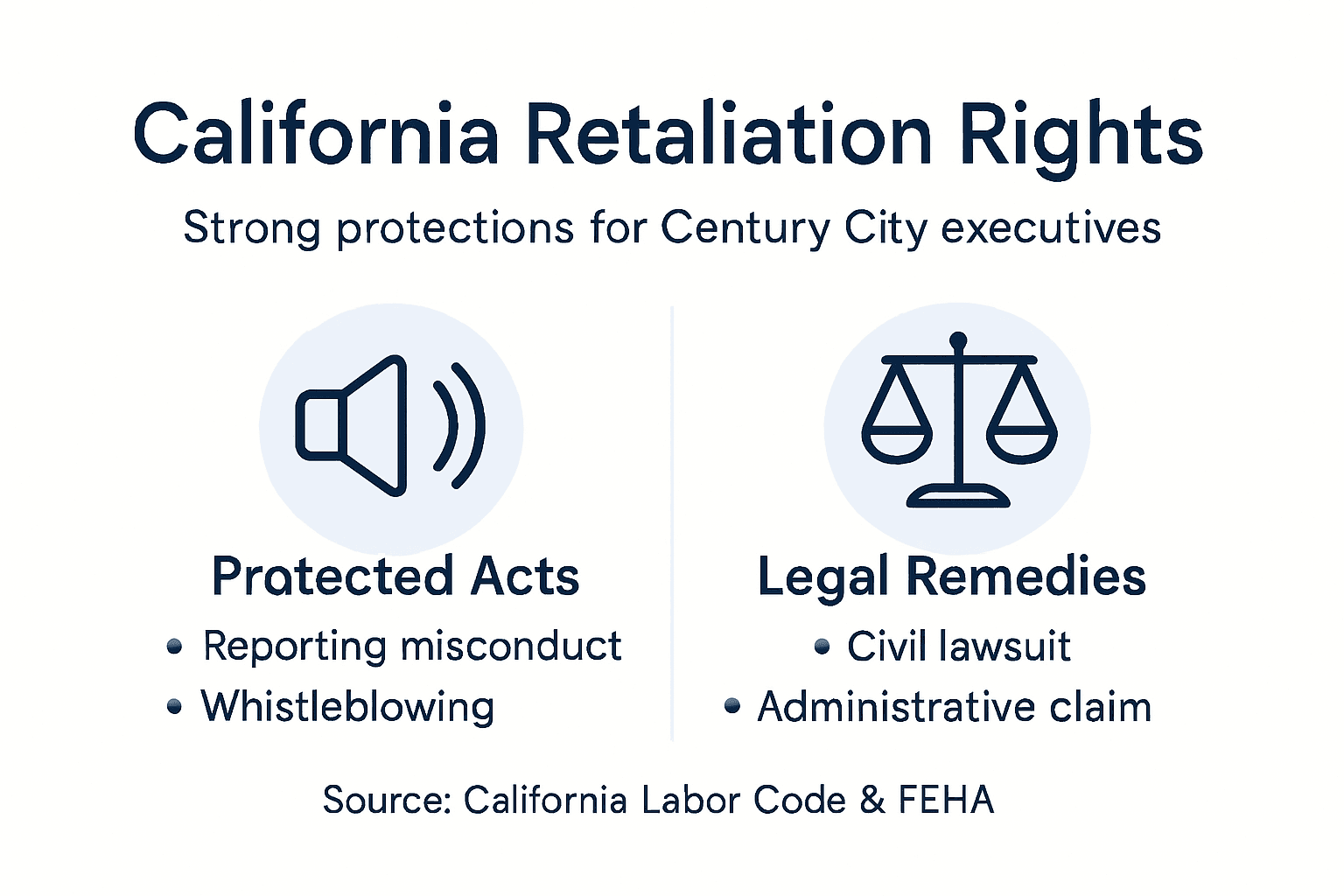
The California Fair Employment and Housing Act (FEHA) is your primary shield. It prohibits retaliation against any employee—including executives—for engaging in protected activities. Protected activities are broad and include reporting violations, refusing illegal orders, participating in investigations, and complaining about discrimination or harassment.
The FEHA covers far more than discrimination cases. Legal protections in California extend to whistleblowing and participating in investigations, creating a wide net of safeguards that executives can rely on when reporting misconduct.
California Labor Code Section 1102.5 provides additional protection specifically for whistleblowers. If you report what you reasonably believe is a violation of law, rule, or regulation to a government agency, you’re protected. This includes reporting financial fraud, safety violations, discrimination, or any unlawful conduct.
The key protection is this: your employer cannot take adverse action against you because you engaged in protected activity. Adverse actions include demotion, pay reduction, hostile work environments, exclusion from opportunities, or termination.
What California law protects:
- Reporting illegal conduct to internal compliance or external agencies
- Opposing discriminatory, harassing, or unlawful employment practices
- Refusing to participate in illegal activities
- Participating in investigations or legal proceedings
- Requesting reasonable accommodations for disability or religious beliefs
- Complaining about wage and hour violations
- Reporting safety violations or environmental concerns
- Taking protected leave (medical, family, military)
Retaliation doesn’t require provable intent. Retaliation broadly includes any adverse action that discourages protected activity, meaning your employer’s motive matters less than the effect their conduct has on you.
The burden-shifting framework protects you. Once you show protected activity occurred and you suffered an adverse action, the employer must prove they would have taken the same action anyway for legitimate, non-retaliatory reasons. This is hard to do, especially with suspicious timing.
California also recognizes claims for retaliation under common law principles beyond FEHA. You can sue for wrongful termination in violation of public policy, which covers retaliation for protected activities.
California law creates a presumption against retaliation—once you show the connection between protected activity and adverse action, the burden shifts to your employer to prove otherwise.
Century City executives benefit from additional protections under California’s Private Attorneys General Act (PAGA). You can recover civil penalties for wage and hour violations, discrimination, and retaliation on behalf of yourself and other affected employees.
Statute of limitations matters. You generally have three years from the retaliatory action to file a civil lawsuit, though some claims have shorter windows. Administrative complaints through the Civil Rights Department have different deadlines.
Pro tip: File an administrative complaint with the California Civil Rights Department (CCRD) before or alongside your lawsuit—this preserves your legal claims and sometimes leads to faster resolution than litigation alone.
Use this table to reference key California legal protections relevant to executive retaliation claims:
| Law/Statute | Protected Activity Examples | Main Remedy |
|---|---|---|
| FEHA | Reporting discrimination, harassment, retaliation | Reinstatement, damages, attorney’s fees |
| Labor Code 1102.5 | Whistleblowing to authorities, refusing illegal acts | Civil penalties, back pay |
| PAGA | Wage/hour, safety, and discrimination violations | Civil penalties for you and others |
Filing and Proving a Retaliation Claim
Filing a retaliation claim requires strategy and documentation. You’re essentially building a case piece by piece, showing the employer’s conduct violated your legal rights. Understanding the process gives you clarity on what comes next.
You have multiple venues for filing. You can submit a complaint to the California Civil Rights Department (CCRD), formerly known as the Department of Fair Employment and Housing. You can also file with the Labor Commissioner’s office for wage and hour retaliation claims. You have the right to pursue civil litigation directly, often simultaneously with administrative complaints.
The three-part test you must establish:
- You engaged in protected activity (reporting misconduct, opposing illegal conduct, refusing illegal orders)
- You suffered an adverse employment action (termination, demotion, reduced pay, exclusion from opportunities)
- There is a causal connection between the two (timing, circumstances, pattern showing the employer’s motivation)
Timing is your strongest evidence. Protected activity and adverse action require demonstrating a causal link between the two, with close temporal proximity suggesting the employer’s retaliatory motive. If you reported misconduct on Monday and received a negative performance review Wednesday, that proximity matters.
Once you establish these three elements, the burden shifts entirely to your employer. They must prove they would have taken the same action anyway for a legitimate, non-retaliatory business reason. This is their burden, not yours.
Your employer’s stated reason doesn’t have to be true. You prove it’s false by showing inconsistency—they didn’t apply the same policy to others, they changed standards suddenly, or their stated reason doesn’t match the documented facts. This is called proving pretext.
Documentation wins cases. Gather emails, meeting notes, performance reviews, witness statements, and any communications showing the timeline. Collect evidence of how similarly situated employees were treated differently. Show patterns of conduct, not isolated incidents.
Proving retaliation involves direct or circumstantial evidence including temporal proximity between protected activity and adverse action, allowing you to build a compelling case even without direct statements from your employer about their retaliatory intent.
You don’t need your employer’s confession. Circumstantial evidence works. Suspicious timing, inconsistent application of policy, negative treatment after protected activity, and coordinated conduct by multiple managers all point to retaliation.
Executives should know that even reasonable belief in protected activity receives protection. You don’t have to be right about illegality—you just have to reasonably believe the conduct violated law. This standard favors employees and executives reporting genuine concerns.
Proving retaliation hinges on showing the connection between protected activity and adverse action, then forcing your employer to disprove their stated reason as pretextual.
The administrative process moves slower than litigation but costs less. CCRD investigations take months to years. The Labor Commissioner’s office may be faster for certain wage claims. Litigation can proceed in parallel.
Pro tip: File your administrative complaint within applicable deadlines while simultaneously gathering evidence and consulting with an employment attorney—this maximizes your options and ensures no deadline passes unmet.
Risks for Employers and Common Executive Mistakes
Understanding what employers fear about retaliation claims helps you recognize the vulnerabilities in your case. When executives make mistakes handling workplace concerns, they inadvertently create liability that strengthens your position.
Executives often underestimate the legal and financial exposure retaliation creates. Litigation is expensive. Settlements are costly. Regulatory investigations drain resources and damage reputation. Beyond the dollars, retaliation claims tarnish a company’s ability to attract talent and harm client relationships.
The biggest employer mistake is ignoring complaints entirely. When you report misconduct and management does nothing, that silence becomes evidence. It shows they received notice and chose inaction. That inaction, combined with later adverse action, creates a strong inference of pretext.
Another critical error is inconsistent discipline. Employers punish one employee harshly for minor policy violations while giving others warnings or second chances. This inconsistency proves they’re applying standards selectively, which destroys their legitimate reason defense.
Common executive mistakes that strengthen retaliation claims:
- Failing to document investigations or decisions thoroughly
- Retaliating with subtle adverse actions instead of addressing concerns
- Ignoring protected activity or dismissing legitimate complaints
- Changing performance standards suddenly after protected activity
- Applying policies inconsistently to different employees
- Refusing reasonable accommodations without legitimate justification
- Failing to train managers on retaliation policies
- Creating paper trails that contradict their stated reasons
- Coordinating adverse actions among multiple managers
- Making comments suggesting retaliatory motive
Employers face costly litigation, reputation damage, and regulatory sanctions from retaliation claims, particularly when they lack clear anti-retaliation policies and fail to investigate complaints thoroughly.
Executives sometimes create their own evidence against themselves. They send emails documenting their true motive, make comments in front of witnesses about punishing reporters, or fail to document the legitimate reasons they claim. These mistakes are gold in litigation.
Many executives also misunderstand California law. They believe they can retaliate if they’re “right” about the underlying issue, or that retaliation is acceptable as long as it’s subtle. Both assumptions are wrong. California protects even employees who are mistaken about illegality, and subtle retaliation is still retaliation.
Executives often fail to recognize protected activities and ignore complaints, which increases liability exposure by creating evidence of pretext and indifference to legal obligations.
The power imbalance executives sometimes weaponize actually protects you legally. When an executive retaliates against a junior employee, courts recognize the intimidation factor. That power differential makes the retaliation more obvious and more damaging.
Employers strengthen your case every time they ignore complaints, apply policies inconsistently, or fail to document legitimate reasons for adverse actions.
Century City executives should understand that sophisticated employers know better. They have compliance officers, legal counsel, and anti-retaliation policies. When they still retaliate, courts see deliberate violation, not mistake. Punitive damages become possible.
Pro tip: Document every employer mistake—ignored complaints, inconsistent discipline, contradictory statements, or failure to investigate—because these missteps become your evidence of pretext and intentional retaliation.
Protect Your Rights as a Century City Executive Facing Retaliation
If you are an executive experiencing adverse actions after reporting misconduct or opposing unlawful workplace practices in Century City, you are not alone and help is available. Retaliation can take many subtle forms like exclusion from key projects, sudden negative reviews, or demotion without clear cause. Understanding your legal rights under California law is critical to safeguarding your career and reputation.
At Shirazi Law Office, we specialize in Workplace Retaliation and Senior Management Representation. Our experienced attorneys provide strategic guidance tailored to executives in Century City and surrounding Los Angeles areas. Do not wait until the window for legal action closes. Take control of your situation now by consulting with trusted advocates who know how to prove retaliation claims and hold employers accountable.
Visit our Century City page to learn more and start protecting your rights today. When facing retaliation, every moment counts. Contact Shirazi Law Office at https://www.shirazilawoffice.com/ for your personalized consultation.
Frequently Asked Questions
What constitutes retaliation for executives in Century City?
Retaliation occurs when an employer takes adverse action against an executive because they have engaged in protected activities, such as reporting misconduct or opposing unlawful practices.
What are some common forms of adverse action that may indicate retaliation?
Common forms of adverse action include termination, demotion, exclusion from projects, negative performance reviews, reduced compensation, or harassment from management or colleagues.
How can executives document evidence of retaliation?
Executives should keep detailed records of protected activities, including dates, who they reported to, and any changes in treatment or job duties afterward. Documentation such as emails, meeting notes, and performance reviews is critical.
What legal protections do executives have against retaliation in California?
California law provides strong protections against retaliation, prohibiting adverse actions for engaging in protected activities under the Fair Employment and Housing Act (FEHA) and the Labor Code, including whistleblowing and complaining about discrimination.