

TL;DR:
- Employees in West Hollywood often mistakenly believe that wanting to work from home provides automatic legal protection. The law only prevents discrimination based on protected characteristics like disability, gender, or sexual orientation when specific legal processes are followed. Proper documentation, understanding of legal standards, and early legal consultation are crucial to effectively addressing remote work discrimination and retaliation claims.
Many employees in West Hollywood assume that wanting to work from home gives them automatic legal protection. That assumption is wrong, and it can be costly. California has some of the strongest worker protections in the country, but those protections are specific, conditional, and require you to follow a precise legal process to enforce them. Whether you are dealing with a denied remote work request, a sudden return-to-office mandate that seems to target certain employees, or outright retaliation for asking to work from home, understanding exactly what the law covers is the first step toward protecting yourself.
Table of Contents
- Understanding remote work discrimination in West Hollywood
- Legal process: How to file a complaint and what to expect
- Disability accommodations and limits of remote work rights
- Risks of retaliation and additional workplace protections
- What most employees misunderstand about remote work discrimination
- Next steps: Legal help for remote work discrimination and retaliation
- Frequently asked questions
Key Takeaways
| Point | Details |
|---|---|
| No blanket remote work right | Employers are only obligated to approve remote work as an accommodation for a qualifying disability. |
| CRD complaint required | Filing with the California Civil Rights Department is a necessary first step before suing for discrimination. |
| Caregiving alone is not enough | Family or health fears alone do not legally require remote work—there must be a qualifying disability. |
| Retaliation is a risk | Filing a complaint can expose you to retaliation, like demotion or termination, so documenting everything is essential. |
| Expert legal help matters | Success in discrimination claims is more likely when you understand the procedural steps and get local legal support. |
Understanding remote work discrimination in West Hollywood
Now that you know why remote work discrimination is not straightforward, let’s dig into what the law actually protects in West Hollywood.
California’s Fair Employment and Housing Act (FEHA), which is the state’s main anti-discrimination statute, prohibits employers from treating employees differently because of a protected characteristic. Those protected characteristics include race, gender, disability, age, sexual orientation, gender identity, pregnancy, and religion, among others. Remote work discrimination, then, is not about whether your employer denied your work-from-home request. It is about why they denied it.
Here is what that distinction looks like in practice:
- A qualifying disability requires reasonable accommodation. If you have a physical or mental impairment that substantially limits a major life activity, your employer must engage in an interactive process (a good-faith conversation about accommodation options) and provide reasonable accommodation unless doing so creates undue hardship.
- Remote work preference alone is not protected. If you simply prefer working from home for convenience or general comfort, your employer is legally free to say no.
- Fear of illness is not enough. Courts have ruled that fear of illness or caregiving obligations alone do not entitle an employee to remote work. The Allos v. Poway case is a notable example where the court found those justifications insufficient.
- Caregiving is not a standalone protected class. While gender discrimination sometimes intersects with caregiving (for example, if a female employee is denied flexibility that male employees receive), caregiving by itself is not a protected characteristic under FEHA.
- LGBTQ+ employees face intersecting risks. If your employer denies remote work in a pattern that disproportionately affects LGBTQ+ employees, that pattern could support a LGBTQ+ discrimination claim under California law.
“Not every unfair workplace decision is an illegal one. The law protects against discrimination based on who you are, not simply against decisions you disagree with.”
This distinction catches many employees off guard. They feel wronged, and their feelings are valid. But feeling wronged and having a legally actionable claim are two different things. If your employer denies remote work because of your disability, gender, or sexual orientation, that is where the law steps in. If they deny it because they have a blanket return-to-office policy applied equally to everyone, the legal picture becomes much harder.
Gender-based workplace bias sometimes surfaces in remote work decisions when, for instance, working mothers are denied the same scheduling flexibility given to fathers or childless employees. These scenarios can form the foundation of a real discrimination claim, but they require careful documentation and legal analysis.

Pro Tip: Keep a written record of every remote work request and every response you receive. Note the date, the medium (email, verbal, written), and anything your manager says about the reason for the decision.
Legal process: How to file a complaint and what to expect
With an understanding of the law, the next key is knowing how to act if you suspect discrimination.
Filing a remote work discrimination claim in California is not as simple as sending a complaint letter to your employer. There is a mandatory administrative process, and skipping it will likely end your case before it begins.
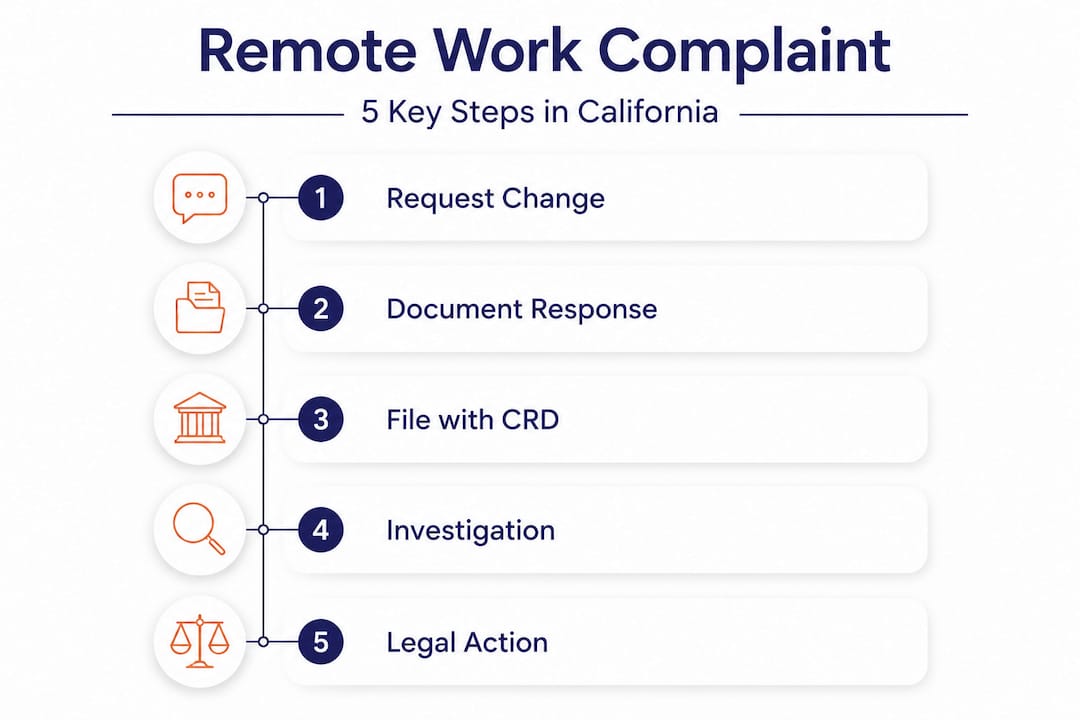
Here is the step-by-step process:
- Notify your employer. Before filing externally, many attorneys recommend giving your employer a written notice that you believe discrimination has occurred. This creates a record and sometimes triggers an internal investigation.
- File with the California Civil Rights Department (CRD). Employees must file a complaint with the CRD before they can sue their employer. This is a legal prerequisite for most FEHA discrimination claims in California.
- The CRD investigates. The CRD may investigate your complaint, attempt mediation, or issue a right-to-sue letter. Investigation timelines vary but can take several months to over a year.
- Receive a right-to-sue letter. Once you have this letter, you have one year to file a civil lawsuit in court. Do not let this deadline lapse.
- File a civil lawsuit if needed. With the letter in hand and an attorney on your side, you can pursue your case in the California Superior Court or federal court depending on your specific claims.
| Stage | Who handles it | Typical timeline |
|---|---|---|
| Internal complaint | Your employer | Days to weeks |
| CRD filing | You and the CRD | Within 3 years of the act |
| CRD investigation | CRD investigators | Several months to 1+ year |
| Right-to-sue letter | CRD issues to you | Varies by case |
| Civil lawsuit deadline | You and your attorney | 1 year from letter |
Missing any step in this process can permanently bar your claim. That is why it matters enormously to consult an attorney early, not after you have already made procedural mistakes.
Filing a complaint also triggers important retaliation protections. Once you file with the CRD, your employer cannot legally punish you for doing so. The same protections apply to sexual harassment claims process and other types of discrimination complaints.
Disability accommodations and limits of remote work rights
Understanding the eligibility limits helps you see how courts and agencies respond to remote work requests for disabilities.
When remote work genuinely qualifies as a reasonable accommodation for a covered disability, California law is clear: employers must either provide it or demonstrate that doing so creates undue hardship to the business. This is not a gray area in theory, though it often becomes contested in practice.
| Situation | Does remote work qualify? | Legal basis |
|---|---|---|
| Physical disability limiting commute | Likely yes, if job allows it | FEHA reasonable accommodation |
| Mental health condition worsened by office | Possibly yes, with documentation | FEHA interactive process |
| Fear of contracting illness (no diagnosis) | Generally no | Court precedent |
| Caregiving for a family member | Generally no | Not a protected class alone |
| Pregnancy with doctor’s recommendation | Possibly yes | FEHA, PDLL protections |
| Preference or work-life balance | No | Not legally protected |
The 2026 CRD settlement against the University of California San Francisco illustrates exactly how seriously the state takes accommodation failures. The CRD settled for $300,000 against UCSF after finding the university failed to accommodate remote work for an employee with a disability. The settlement required policy changes, training, and a formal audit of employment disability policies. That outcome sends a strong message to employers throughout Los Angeles and the broader state.
Statistic callout: While there is no West Hollywood-specific dataset on remote work discrimination cases, the UCSF settlement demonstrates that CRD enforcement in California is active, financially significant, and capable of driving systemic change at major institutions.
Requesting an accommodation the right way matters enormously. Here is what makes a strong request:
- Obtain written documentation from your treating physician clearly stating your diagnosis and the functional limitations it creates.
- Submit your request in writing, referencing California’s reasonable accommodation requirements under FEHA.
- Propose specific accommodations, such as full-time remote work, a hybrid schedule, or ergonomic modifications.
- Follow up in writing after any verbal conversations with HR or management.
Pro Tip: If your employer refuses your accommodation request without engaging in the interactive process, that refusal alone can be the basis of a legal claim. Do not just accept the denial. Document it and consult an attorney.
Understanding disability accommodations in detail and reviewing the 2026 disability discrimination guide can help you understand what employers are and are not allowed to do when responding to your request.
Risks of retaliation and additional workplace protections
Now that you’ve seen the legal foundation of accommodation, it’s crucial to address what can happen when you assert your rights in West Hollywood workplaces.
Retaliation is one of the most common and damaging responses employees face after filing a discrimination complaint or requesting accommodation. Retaliation does not always look obvious. It can be subtle, gradual, and designed to make you feel like the problem rather than the victim.
Common forms of retaliation include:
- Sudden termination or layoff shortly after a complaint
- Demotion or removal from high-visibility projects
- Reduction in hours or shift changes that affect your income
- Exclusion from meetings, communications, or workplace decisions
- Increased scrutiny or manufactured performance issues
- A shift in your manager’s tone or treatment toward you
- Hostile comments from coworkers that management tolerates
“Retaliation doesn’t require your employer to fire you. Any adverse action taken because you exercised a legal right can be unlawful. The law protects the act of asserting your rights, not just the rights themselves.”
West Hollywood employees may face heightened vulnerability due to the city’s significant LGBTQ+ population. Employers who respond to accommodation requests or discrimination complaints with comments or actions targeting an employee’s gender identity or sexual orientation layer discrimination claims on top of retaliation claims. Pregnancy is another area where retaliation risk rises sharply. Employees who disclose a pregnancy while simultaneously requesting remote accommodation sometimes face sudden negative performance reviews or restructuring.
While California-wide CRD enforcement provides the benchmarks we have for remote discrimination outcomes, those outcomes demonstrate that employees who act decisively and with proper documentation can achieve significant results. The key is not waiting until the situation becomes a full crisis.
If you believe your workplace has become hostile after a complaint, reviewing hostile work environment guidance is an important next step. Similarly, if you are pregnant and fear retaliation, the pregnancy discrimination retaliation resources specific to West Hollywood can clarify your options.
What most employees misunderstand about remote work discrimination
With the nuts and bolts covered, it is time for a frank, experience-based look at why most discrimination cases falter and what actually makes a difference.
Here is the uncomfortable truth: the majority of remote work discrimination claims fail not because the law is inadequate, but because employees misread what the law actually covers. They come in believing that any inconvenience or unfair treatment constitutes discrimination. It does not. The law protects specific people in specific circumstances, and it requires proof, not just a feeling of being wronged.
The most damaging myth is that employment law functions like a general fairness code. It does not. California law is strong, but it is also precise. If you cannot connect your employer’s decision to a protected characteristic with concrete evidence, your case will struggle. Courts and the CRD are not in the business of correcting every bad workplace decision. They intervene when a decision is tied to who you are, not just what you want.
Another pattern that weakens claims significantly: employees who wait too long before consulting an attorney. By the time they seek help, they have already responded emotionally to their employer, made statements that undermine their position, or missed critical documentation windows. The strongest cases we see are built by employees who recognized the problem early and started building a paper trail immediately.
The LGBTQ+ workplace rights landscape in West Hollywood is nuanced precisely because this community faces intersecting pressures. A single employer decision can simultaneously involve disability accommodation, gender identity, and retaliation. Addressing those intersecting claims requires a clear legal theory, not just a general sense of unfairness.
The employees who succeed are the ones who document every interaction, understand the specific legal theory supporting their claim, and work with an attorney who knows how to navigate the CRD process strategically. This is not a field where you can afford to improvise.
Next steps: Legal help for remote work discrimination and retaliation
Armed with better understanding, your next step is connecting with local professionals who focus on your rights and risks.
If you are facing a denied remote work accommodation, a suspicious return-to-office mandate, or retaliation after raising concerns, Shirazi Law Office is ready to help. Based in Los Angeles and serving West Hollywood, Beverly Hills, Westwood, Century City, and surrounding neighborhoods, the firm focuses exclusively on employment law. That means every case receives the full weight of Brian Y. Shirazi’s knowledge and personal attention, not a junior associate or an overloaded caseload. You can review the 2025 discrimination laws guide to understand your broader rights, explore what a dedicated Los Angeles employment lawyer can do for your specific situation, or find out how wrongful termination claims work if your employer crossed a legal line. Your situation deserves a real conversation.
Frequently asked questions
Does my employer have to allow remote work for any reason?
No, employers are only legally required to allow remote work if it serves as a reasonable accommodation for a qualified disability. There is no automatic right to remote work based on preference, fear of illness, or convenience.
What is the first step if I suspect remote work discrimination?
You must file a complaint with the California Civil Rights Department before you can sue your employer. This filing prerequisite applies to most FEHA discrimination claims in California and cannot be skipped.
Can caregiving or fear of illness force an employer to approve remote work?
No, caregiving responsibilities and general illness concerns do not guarantee remote work rights. Courts have ruled these reasons insufficient unless they are directly tied to a qualifying disability.
What are the risks if I file a remote work discrimination complaint?
Employer retaliation, such as termination, demotion, or a hostile work environment, is an unlawful but real risk after filing. Documenting your situation before and after filing is essential to protecting yourself.
Has anyone in California won a remote work discrimination case recently?
Yes. In 2026, the CRD reached a $300,000 settlement against UCSF for failing to accommodate remote work for an employee with a disability, requiring systemic policy changes and mandatory training.
Recommended
- Hostile Work Environment Claims in West Hollywood – Law Office of Brian Y. Shirazi, PC
- Sexual Harassment Claims In West Hollywood Nightlife: Your Rights – Law Office of Brian Y. Shirazi, PC
- LGBTQ+ Employment Discrimination in West Hollywood – Law Office of Brian Y. Shirazi, PC
- Sexual Harassment Risks for West Hollywood Workers





[…] Read the full article here. […]