
TL;DR:
- Most wrongful demotion claims fail in California because courts require a pattern of egregious conduct rather than a single unfair act. Executives should focus on documenting sustained, intentional actions that made continued employment objectively intolerable before considering legal action. Consulting an experienced employment lawyer promptly is crucial to navigate deadlines and build a strategic case.
Being demoted at work feels like the ground shifting beneath you, especially when you’ve spent years building your career. Many executives and senior managers in the Pico-Robertson area believe that any unfair demotion automatically gives them legal grounds for a lawsuit or constructive termination claim. The reality is more nuanced. California law sets a deliberately high bar, and understanding exactly where that bar sits can mean the difference between a strong legal claim and a costly mistake. This guide walks you through the key standards, common pitfalls, and concrete steps to take if you believe your employer has crossed the line.
Table of Contents
- What counts as wrongful demotion and constructive termination?
- When does workplace retaliation make a demotion unlawful?
- Comparing legal remedies: Demotion, constructive discharge, and retaliation claims
- Steps Pico-Robertson executives should take after a wrongful demotion or constructive termination
- Perspective: Why most wrongful demotion claims fail (and what executives should focus on instead)
- Talk to an experienced employment lawyer in Pico-Robertson and Los Angeles
- Frequently asked questions
Key Takeaways
| Point | Details |
|---|---|
| Demotion alone isn’t enough | California law requires ongoing, intolerable conditions beyond just a demotion to establish constructive termination. |
| Retaliation hinges on proof | A demotion after a protected complaint can qualify if there is documented evidence and clear timing. |
| Documentation is vital | Carefully tracking events, collecting records, and noting timelines can make or break your case. |
| Choose the right claim | Understand the differences in remedy, risk, and success between demotion, retaliation, and constructive termination claims. |
| Act promptly | Key legal deadlines are short—consulting with experienced counsel early protects your workplace rights. |
What counts as wrongful demotion and constructive termination?
Not every demotion is a wrongful demotion. A standard demotion happens when an employer reduces your title, pay, or responsibilities. That’s painful, and it may even be unjust. But under California law, unfair doesn’t automatically mean unlawful. A wrongful demotion occurs when the employer’s action violates a specific legal protection, such as a prohibition against discrimination, retaliation for protected activity, or a breach of your employment contract.

Constructive discharge goes one step further. This legal concept applies when you technically “resign,” but only because your employer made your working conditions so intolerable that staying was not a reasonable option. California courts apply a rigorous test here. Understanding wrongful termination standards under state law is essential before drawing conclusions about your own situation.
As one legal analysis explains, constructive discharge in California requires proof that the employer intentionally created or knowingly permitted working conditions that were objectively so intolerable that a reasonable person would have no reasonable alternative but to resign, and that the employee resigned because of those conditions.
Notice two important words: objectively and intentionally. The test isn’t what felt unbearable to you personally. A court looks at what a reasonable person in your position would experience. And the employer’s intent matters. An unfortunate management decision isn’t the same as deliberate or knowing conduct designed to push you out.
Here’s a quick breakdown of what may or may not qualify:
- May qualify: A pattern of humiliating public criticism, stripping all meaningful duties after you report misconduct, simultaneous reduction in pay and title combined with isolation and threats
- May not qualify: A single demotion following a poor performance review, being passed over for promotion, a salary cut during company-wide budget reductions, or being assigned to a less prestigious project
“A single act, however unfair it feels, rarely meets California’s threshold for constructive discharge. Courts look for sustained, egregious conduct that leaves a reasonable employee no real choice but to leave.”
Pro Tip: Start documenting everything the moment you sense something is wrong. Save emails, note the dates and witnesses to verbal comments, and record any changes to your duties or compensation in writing. Even if you later decide not to file a claim, thorough documentation gives you and your attorney a clearer picture of whether legal thresholds are met.
When does workplace retaliation make a demotion unlawful?
Retaliation is one of the most significant factors in determining whether a demotion crosses from unfair to unlawful. California law broadly protects employees who engage in certain activities from adverse employment actions, including demotion. If your employer demoted you because you did something legally protected, the demotion becomes a form of retaliation, which is independently unlawful regardless of whether it also meets the constructive discharge standard.
Protected activities in California include, but are not limited to:
- Filing or threatening to file a discrimination or harassment complaint internally or with a government agency
- Reporting wage theft, safety violations, or illegal conduct (whistleblowing)
- Requesting a medical or pregnancy-related leave of absence
- Participating in a workplace investigation as a witness
- Asserting rights under a labor agreement or employment contract
- Opposing practices you reasonably believe are unlawful, even if you turn out to be wrong
The sequence of events matters enormously. If your employer demotes you within days or weeks of a protected complaint, courts pay close attention to that timing. It doesn’t prove retaliation by itself, but it raises a strong inference that demands explanation from the employer.
Understanding retaliation issues in Pico-Robertson and how local case patterns develop is part of building a strategic claim. You can also review the broader framework for understanding retaliation under California law to see how your situation fits.
Research confirms that in California retaliation and demotion cases, causation and timing are central. Demotion or other adverse actions following protected complaints can qualify if retaliation is a substantial motivating factor, and courts often rely heavily on circumstantial evidence to establish that link.
“You don’t need a signed confession from your manager. Circumstantial evidence, including suspicious timing, shifting explanations for the demotion, and a history of positive performance reviews followed by sudden criticism, can be enough.”
Pro Tip: The moment you file any kind of complaint, internal or external, immediately save all communications related to your role, performance, and interactions with management. Use a personal device or personal email to store copies if allowed by company policy. Create a private calendar log noting every relevant date and conversation.
Comparing legal remedies: Demotion, constructive discharge, and retaliation claims
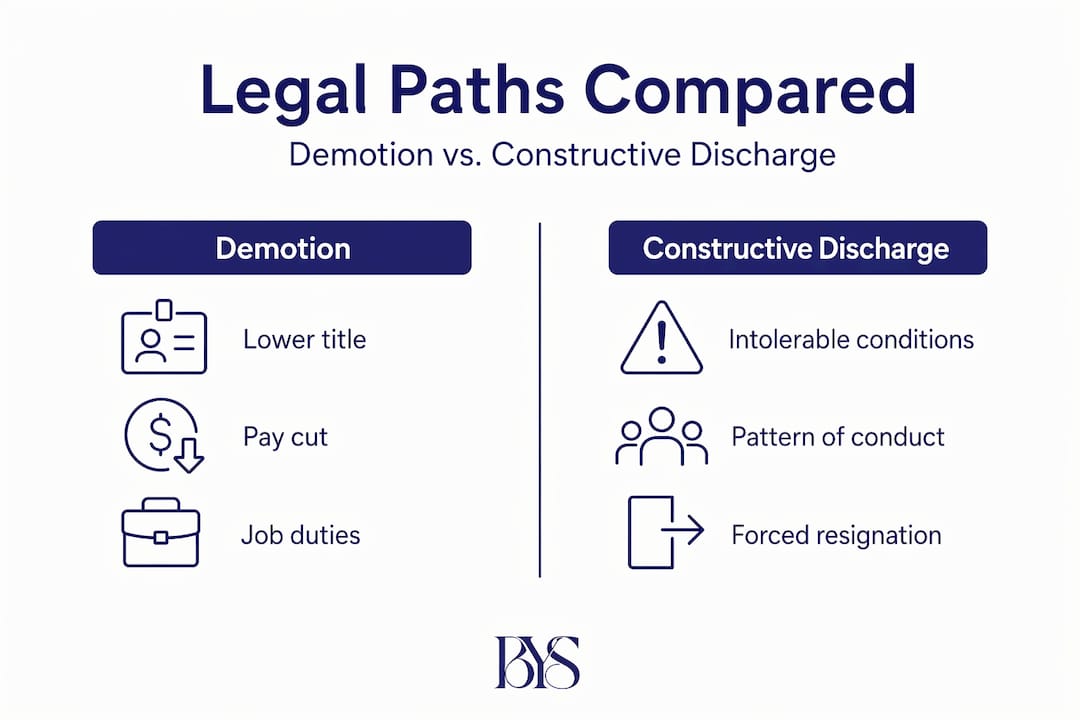
Once you understand what happened, the next step is knowing which legal path fits your situation. These three categories of claims are related but distinct in what they require you to prove and what you stand to recover.
| Claim type | What you must prove | Key evidence needed | Typical outcome for executives |
|---|---|---|---|
| Wrongful demotion | Demotion violated law or contract | Employment contract, discriminatory motive, protected activity | Reinstatement, lost wages, damages |
| Constructive discharge | Intolerable conditions forced resignation | Pattern of conduct, employer intent, objective standard met | Treated as wrongful termination damages |
| Retaliation | Demotion followed protected complaint | Timing, comparator treatment, shifting explanations | Compensatory damages, possible punitive damages |
As courts have consistently held, a demotion alone is often not enough to prove constructive discharge. Constructive discharge generally demands unusually aggravated or continuous circumstances, plus objective coercion rather than mere dissatisfaction, and an actual resignation caused by those intolerable conditions.
For executives and senior managers, the stakes are higher because compensation packages are complex. Stock options, deferred compensation, bonus structures, and equity grants can all be affected by whether a departure is characterized as voluntary or as constructive termination. Understanding the key risks for executives is critical before making any move. Similarly, reviewing available executive protections under California law gives you a clearer map of your options.
Common mistakes employees make when pursuing these claims include:
- Resigning too quickly before documenting sufficient evidence of intolerable conditions
- Waiting too long to consult an attorney, which can lead to missing critical filing deadlines
- Failing to use internal complaint processes before filing externally, which can weaken a retaliation claim
- Accepting a severance agreement without understanding what rights are being waived
- Assuming salary reduction alone proves constructive discharge without establishing the broader pattern required
Steps Pico-Robertson executives should take after a wrongful demotion or constructive termination
Knowing your legal options is one thing. Acting on them strategically is another. If you’re in Pico-Robertson or the greater Los Angeles area and believe you’ve been wrongfully demoted or pushed out, here’s a concrete action plan.
- Do not resign in the heat of the moment. Leaving immediately may feel like the only option, but it can significantly weaken a constructive discharge claim unless conditions are already clearly intolerable and documented. Consult an attorney before making that decision.
- Begin a private written record. Document every adverse action with dates, times, who was present, and what was said. Note any changes to your duties, title, pay, reporting structure, or office location.
- Preserve all relevant communications. Save emails, text messages, performance reviews, and any written evaluations to a personal, secure location. Do not delete anything, even if it reflects poorly on you.
- Identify any complaints you’ve previously made. Review your own history. Did you file an HR complaint? Report a safety issue? Oppose a discriminatory policy? These become critical to a retaliation claim.
- Review your employment contract and offer letter. Look for any provisions addressing demotion, termination for cause, severance, or dispute resolution. Understand what rights the contract gives you before any meeting with HR.
- Consult an employment attorney before meeting with HR or signing anything. Employers often present separation agreements quickly. An experienced attorney can tell you what you may be giving up.
As established in California case law, a pay cut or demotion does not by itself generally establish constructive discharge. Meeting with a lawyer helps you assess whether your specific facts cross the required threshold.
Here is a summary of critical deadlines to keep in mind:
| Action | Deadline | Notes |
|---|---|---|
| File DFEH (now CRD) charge for discrimination/harassment | 3 years from violation | Expanded under AB 9, effective January 2020 |
| File EEOC charge for federal discrimination claims | 300 days from violation | In California, the DFEH filing satisfies EEOC cross-filing |
| File wage and hour complaint with DLSE | 3 years for written contracts, 2 years for oral | Clock starts at each paycheck, not just first violation |
| Preserve electronic evidence | Immediately upon suspicion | Data can be lost quickly; act fast |
| Request personnel file | Within 30 days of formal request | California Labor Code Section 1198.5 |
For a fuller picture of your rights and the process involved, reviewing a general employment law overview can help you understand which laws apply to your specific circumstances.
Perspective: Why most wrongful demotion claims fail (and what executives should focus on instead)
Here’s something most guides won’t say plainly: the majority of wrongful demotion claims that proceed without legal counsel fail. Not because the employees weren’t genuinely treated badly, but because they misunderstood what the law actually requires.
California courts set the bar for constructive discharge high on purpose. The legal system doesn’t want employers to face liability every time a manager makes a poor decision or an employee dislikes a new reporting structure. That high standard protects both parties, and it’s worth respecting rather than fighting.
What executives tend to get wrong is focusing on the outcome rather than the pattern. A single demotion, even a humiliating one, almost never meets the threshold. What courts want to see is a series of acts, sustained over time, that cumulatively make a reasonable person’s continued employment genuinely impossible. One bad meeting doesn’t do it. A six-month campaign of exclusion, public humiliation, stripping of duties, pay cuts, and isolation might.
The second mistake is overvaluing job title and salary as evidence. Executives assume that because the financial impact of their demotion is significant, the legal threshold is automatically lower. It isn’t. A court applies the same objective standard whether you earn $80,000 or $800,000 a year. The question is always whether a reasonable person in your situation would have felt truly compelled to leave. That’s a factual question, answered with evidence, not with numbers on a pay stub.
What actually persuades courts is quality context. Documented patterns of conduct, clear timing between protected activity and adverse action, witnesses who can corroborate your account, and a consistent paper trail of your previously strong performance all carry far more weight than your seniority alone.
As confirmed by detailed legal analysis, constructive discharge demands unusually aggravated and continuous circumstances, not just a demotion the employee finds unfair or demoralizing. The word “continuous” is key. Think in terms of patterns, not moments.
If you’re a Pico-Robertson executive evaluating your options, the most powerful mindset shift is this: stop asking “was this unfair?” and start asking “can I prove a pattern of intolerable conduct caused by my employer’s intentional actions?” That reframe changes what evidence you gather, what conversations you have, and when you consult a lawyer. For context on how this plays out in cases involving misconduct reporting, see examples of wrongful termination misconduct claims in Los Angeles.
Talk to an experienced employment lawyer in Pico-Robertson and Los Angeles
If you’re navigating the uncertainty of a wrongful demotion or believe your employer is constructively pushing you out, getting informed legal guidance early changes everything. The decisions you make in the first days and weeks after a demotion can significantly affect your ability to pursue a claim later. Shirazi Law Office focuses exclusively on California employment law, providing executives and employees throughout Pico-Robertson and Los Angeles with the strategic, personalized representation they deserve. Whether you need to evaluate your LA wrongful termination solutions or want to speak with a trusted Los Angeles employment lawyer about your specific situation, Shirazi Law Office is ready to listen. Executives facing separation issues can also explore dedicated executive wrongful termination support tailored to the complexity of senior-level employment matters.
Frequently asked questions
Does every unfair demotion qualify as constructive termination in California?
No. California’s constructive discharge standard requires proof of intentionally created, objectively intolerable conditions that force a resignation. A demotion that feels unfair but doesn’t meet that threshold does not qualify.
What proof do I need if I think I was demoted in retaliation?
You need to show the demotion followed a protected complaint and that retaliation was a substantial motivating factor. Courts regularly accept circumstantial evidence, especially when timing between your complaint and the demotion is suspicious.
Can I file a lawsuit if I only received a bad performance review or a single demotion?
Typically not on constructive discharge grounds, since a demotion alone rarely meets California’s requirement for continuous, aggravated, and objectively intolerable circumstances. However, if the review or demotion followed protected activity, a retaliation claim may still be viable.
What deadlines apply for taking action after a wrongful demotion in California?
Deadlines vary based on the specific claim, but discrimination-related charges generally must be filed with the Civil Rights Department (formerly DFEH) within three years of the violation, while federal EEOC charges typically require action within 300 days. Consulting an attorney promptly helps ensure you don’t inadvertently waive your rights.
Recommended
- Seasoned Employment Lawyer in Pico-Robertson
- Wrongful Termination for Los Angeles Executives: Key Risks
- Your rights facing pregnancy discrimination in Pico-Robertson – Law Office of Brian Y. Shirazi, PC
- Wrongful Termination After Reporting Misconduct: Legal Impact on Downtown Los Angeles Executives – Law Office of Brian Y. Shirazi, PC