

TL;DR:
- California law protects employees from subtle and single severe incidents, not just overt harassment.
- A single incident like a racial slur can qualify as a hostile environment under FEHA.
- Document, report promptly, and seek legal advice to effectively address workplace hostility or retaliation.
Many law firm employees in Mid-Wilshire believe that only obvious, dramatic harassment qualifies as a hostile work environment. That assumption can cost you your case before it even begins. California’s Fair Employment and Housing Act (FEHA) casts a much wider net, protecting workers from subtle patterns of exclusion, microaggressions, and even a single severe incident. Whether you are a paralegal, associate attorney, or support staff, the law is on your side in ways most people never realize. This guide breaks down what legally qualifies, how California law compares to federal standards, what warning signs to watch for, and exactly what steps to take if you are experiencing hostility or retaliation at your Mid-Wilshire law firm.
Table of Contents
- What counts as a hostile work environment in Mid-Wilshire law firms?
- California FEHA vs. federal law: How the threshold works
- Common scenarios and subtle signs in Mid-Wilshire law firms
- What to do if you face a hostile work environment: Step-by-step guide
- A legal insider’s perspective on hostile work environments
- If you need legal help: Your expert resources in Mid-Wilshire
- Frequently asked questions
Key Takeaways
| Point | Details |
|---|---|
| FEHA protects employees | California law covers a broad range of discriminatory and hostile behaviors in law firms. |
| Documentation is critical | Keeping a detailed record boosts your credibility and legal options if you decide to act. |
| Single acts may count | Even one severe action, not just repeated patterns, can trigger legal protections under California law. |
| Prompt reporting matters | Following internal procedures and formal timelines improves your chances of a strong legal claim. |
What counts as a hostile work environment in Mid-Wilshire law firms?
Let’s clear up the most common misconception first. A hostile work environment is not just yelling, slurs, or physical threats. Under California law, hostile work environment claims are defined by both the severity and the persistence of unwelcome conduct tied to a protected characteristic.
Specifically, FEHA defines hostile environment as occurring when unwelcome conduct based on protected characteristics such as race, gender, age, or disability is severe or pervasive enough to alter employment conditions and create an abusive atmosphere. That is a broad standard, and it applies fully to law firms in Mid-Wilshire.
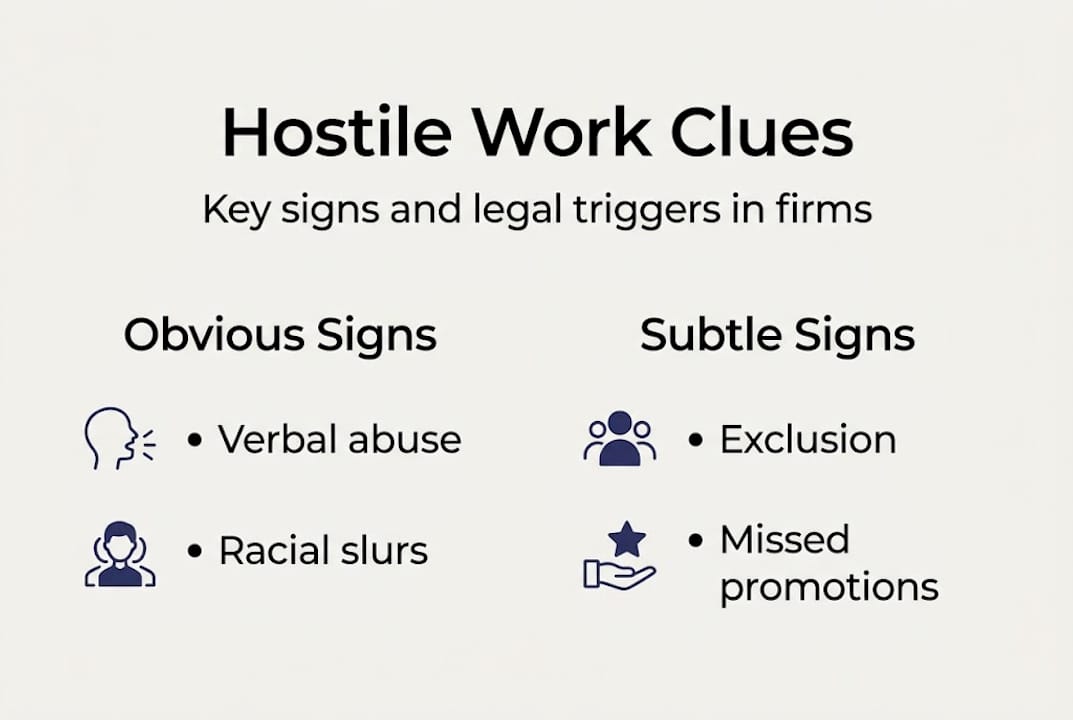
In professional legal settings, hostility often looks different than it does in other industries. A Mid-Wilshire employment lawyer will tell you that some of the most damaging conduct is the kind that goes unnoticed by bystanders. Think about being consistently excluded from client meetings, assigned less prestigious cases than peers with similar credentials, or receiving dismissive comments about your background during performance reviews.
Protected characteristics under FEHA include:
- Race and national origin
- Gender and gender identity
- Age (40 and older)
- Disability (physical or mental)
- Religion
- Sexual orientation
- Pregnancy and related conditions
- Marital status
Not every workplace conflict qualifies. Context, frequency, and the target of the conduct all matter. Here is a quick comparison to help you assess your situation:
| Type of conduct | Qualifies as hostile? | Why |
|---|---|---|
| Single use of a racial slur by a supervisor | Often yes | Severe enough on its own |
| Being passed over for promotion once | Unlikely alone | Needs pattern or clear discriminatory motive |
| Repeated exclusion from team meetings | Yes, if tied to protected trait | Persistent and alters working conditions |
| Rude comments unrelated to protected traits | No | Must be tied to a protected characteristic |
| Unwanted sexual comments from a partner | Yes | Severe and based on gender |
Law firm workplace practices vary widely, but the legal standard does not. If the conduct targets who you are rather than what you did, you likely have grounds worth exploring.
California FEHA vs. federal law: How the threshold works
Understanding what counts as hostile, let’s compare California’s law to federal standards for deeper clarity.
Federal law, specifically Title VII of the Civil Rights Act, requires that harassing conduct be severe or pervasive enough to create an objectively hostile environment. California’s FEHA sets a notably lower bar. That distinction matters enormously if you work in a Mid-Wilshire law firm and are weighing whether your experience is actionable.
A landmark example: a single severe incident such as the use of a racial slur can suffice under FEHA, as affirmed in Bailey v. San Francisco Dist. Attorney’s Office (2024). Federal courts have historically required more repeated conduct before reaching the same conclusion. California’s approach reflects a deliberate policy choice to protect employees earlier and more broadly.
Here is a practical breakdown of when a single act may be enough:
| Scenario | FEHA (California) | Title VII (Federal) |
|---|---|---|
| Single use of a racial slur | Can qualify | Usually insufficient alone |
| One instance of unwanted touching | Likely qualifies | Depends on severity |
| Isolated offensive joke | Unlikely | Unlikely |
| Threat tied to protected status | Likely qualifies | Depends on context |
Employers also carry a heavier burden under California law. Once a complaint is made, they are required to act promptly and thoroughly. Failure to investigate, even for conduct that occurred off-site, can expose the firm to direct liability. That is not a technicality. It is a meaningful protection for you.
“FEHA sets a lower threshold than federal Title VII; a single severe incident can suffice, as affirmed in Bailey v. San Francisco Dist. Attorney’s Office (2024).”
If you want to understand how California hostile work trends have evolved across industries, the pattern is consistent: courts increasingly favor employees when employers delay or dismiss complaints. Knowing hostile work law in LA gives you a real strategic advantage before you ever file a complaint.
Common scenarios and subtle signs in Mid-Wilshire law firms
With the legal test in mind, let’s see what hostile environments can look like in Mid-Wilshire law firms, including less obvious cases.

Law firms have a particular culture that can mask hostility behind professionalism. The conduct is real, but it is often framed as mentorship feedback, workload management, or firm culture. That framing is exactly what makes it harder to identify and fight.
Here are the most common patterns to watch for:
- Being excluded from informal networking events or lunches that directly affect career advancement
- Receiving disproportionately heavy or undesirable caseloads compared to similarly situated colleagues
- Having your ideas dismissed in meetings but credited to others later
- Experiencing sudden negative performance reviews after raising a concern
- Being subjected to comments about your accent, appearance, or family obligations
- Facing micromanagement that targets only you, not your peers
Documentation is crucial when building a case around patterns rather than isolated incidents. Mid-Wilshire professional settings, including law offices and medical practices, are especially prone to subtle exclusion and undermining based on protected status. A vague complaint about feeling unwelcome rarely moves a case forward. Specific dates, direct quotes, and named witnesses do.
Watch for gender discrimination signs that are easy to rationalize away, such as being steered away from rainmaking opportunities or excluded from high-profile client matters. Similarly, sexual harassment reporting is most effective when it starts with a documented record rather than a memory.
Pro Tip: Start a confidential log today, even if you are unsure whether your situation qualifies. Record the date, time, location, what was said or done, who was present, and how it affected your work. This log can be the difference between a strong case and a dismissed complaint.
What to do if you face a hostile work environment: Step-by-step guide
Recognizing a hostile work environment is only the first step. Here is exactly what you should do next.
Taking action can feel intimidating, especially when the people involved hold power over your career. But acting strategically and early gives you the best chance of protecting your rights and your livelihood.
Follow these steps:
- Document everything. Record each incident with dates, times, locations, what was said or done, who witnessed it, and how it affected your ability to work. Be specific, not general.
- Report in writing. Submit your complaint to HR or your supervisor in writing, even if you have already spoken verbally. An email creates a record. A conversation does not.
- Keep copies. Save all written communications, performance reviews, and any responses to your complaint. Store them somewhere your employer cannot access.
- File with the CRD or EEOC. If internal reporting fails, file with the CRD or EEOC within three years for administrative claims. Missing this deadline can bar your case entirely.
- Consult an employment attorney. An attorney can assess your documentation, advise on timing, and help you decide whether to pursue civil litigation.
- Monitor for retaliation. Watch for sudden changes in your schedule, assignments, reviews, or treatment after making a complaint. Document these changes immediately.
For complaint escalation to be effective, the record you build in the early stages is everything. Employers often argue that conduct was isolated or misunderstood. A detailed, contemporaneous log makes that argument much harder to sustain.
Pro Tip: Retaliation after a complaint is illegal under California law. If your workload suddenly increases, your hours shift, or your supervisor becomes cold after you report, document it the same way you documented the original conduct. Retaliation claims are often as powerful as the underlying harassment claim.
A legal insider’s perspective on hostile work environments
After covering the steps, here is what most legal insiders believe, and where employees often go wrong.
Even people who work in law firms doubt themselves. They think one incident is not enough, or that their experience sounds too subtle to matter. That self-doubt is the biggest obstacle we see. California law was designed specifically to address that gap, and yet employees consistently underestimate their own standing.
What actually loses cases is not a lack of substance. It is missing documentation. Employees often wait too long to start recording what is happening, assuming things will improve or that their memory will be sufficient. By the time they consult an attorney, key details are gone.
Employers also have obligations that many employees do not know about. As noted in one workplace harassment analysis, there is a sharp contrast between the employee-friendly rule that a single severe act can qualify and the employer’s obligation to respond promptly, even for conduct that occurs off-site. That tension creates real legal exposure for firms that dismiss early complaints.
Subtle undermining requires the same documentation discipline as overt harassment. Protecting your employee rights starts with treating every incident as potentially significant, even before you know whether you will take legal action.
If you need legal help: Your expert resources in Mid-Wilshire
If you are navigating a hostile work environment at a Mid-Wilshire law firm, you do not have to figure this out alone. Shirazi Law Office focuses exclusively on employment law for California workers, including those facing discrimination, harassment, and retaliation in professional settings. Whether you are building your documentation or ready to take formal action, having the right legal support can protect your career and your future. Start by reviewing our employee rights guide for a clear overview of your protections, then connect with an employment lawyer who understands the specific dynamics of Los Angeles law firm environments.
Frequently asked questions
What legal protections exist for employees facing a hostile work environment in California law firms?
California’s FEHA protects employees from harassment or discrimination based on protected traits like race, gender, age, and disability, and it offers broader protections than federal law in many situations.
Can one incident create a hostile work environment or does it require a pattern?
A single severe incident, such as the use of a racial slur, can be enough under California FEHA, as confirmed in Bailey v. San Francisco Dist. Attorney’s Office (2024).
What steps should an employee in a law firm take if they suspect a hostile environment?
Document every incident with specifics, report internally in writing, and if there is no resolution, escalate to the CRD or EEOC or pursue civil litigation with an attorney’s help.
Is retaliation for complaining about a hostile work environment illegal?
Yes. California law prohibits retaliation against employees who report hostile work environments or participate in related investigations, and retaliation itself can form the basis of a separate legal claim.
Recommended
- Mid-Wilshire sexual harassment claims guide for 2026 – Law Office of Brian Y. Shirazi, PC
- Hostile Work Environment in LA | LA Employment Lawyer
- Hostile Work Environment Claims in Mid-Wilshire Offices – Law Office of Brian Y. Shirazi, PC
- Seasoned Employment Lawyer in Mid-Wilshire
- Do Law Firms Drug Test? A Look at Hiring Practices in the Legal Indust