
TL;DR:
- Over 20% of pregnant retail workers in LA report discrimination and lack of accommodations.
- California law protects small businesses with five or more employees from pregnancy discrimination.
- Employees should document requests and seek legal advice if facing retaliation or denial of accommodations.
More than 1 in 5 women in LA boutique retail report discrimination or a lack of accommodations during pregnancy. If you work at a small shop along Larchmont Village and you’ve noticed unfair scheduling, denied breaks, or a suddenly cold attitude after announcing your pregnancy, you are not imagining it. Many boutique workers assume that small stores operate outside California’s legal protections. That assumption is wrong, and it can cost you. This guide breaks down your rights, the laws that protect you, how to request accommodations, and what to do if your employer pushes back.
Table of Contents
- Understanding pregnancy bias in boutique retail shops
- California laws and protections for pregnant boutique workers
- Securing reasonable accommodations in boutique retail
- How to respond to discrimination or retaliation
- The uncomfortable truth about pregnancy bias in boutiques
- Get help: Speak to a Los Angeles pregnancy bias lawyer
- Frequently asked questions
Key Takeaways
| Point | Details |
|---|---|
| FEHA covers small boutiques | Shops with five or more employees must provide pregnancy accommodations under California law. |
| Document every incident | Keeping detailed records greatly improves your chances in a complaint or mediation. |
| Retaliation is common | More than a quarter of LA boutique pregnancy complaints include retaliation after making requests. |
| Know your options | You can pursue mediation, seek internal help, or file with California Civil Rights for protection. |
Understanding pregnancy bias in boutique retail shops
Pregnancy bias in retail is not always obvious. It rarely looks like a manager saying, “We don’t want pregnant employees here.” More often, it shows up as suddenly reduced hours after you share your news, being taken off the schedule for busy weekends, or being told there’s no stool available when you need to sit. These are real patterns, and they happen in boutique settings across Los Angeles, including community-focused neighborhoods like Larchmont Village.
Boutique environments create unique conditions for this kind of bias to take root. There’s typically no HR department. The owner is often the manager, the buyer, and the disciplinarian all at once. When a small team runs a tight operation, any disruption, including a pregnancy, can feel threatening to the business. That fear, even when unspoken, often translates into unfair treatment.
More than 20% of pregnant workers in LA’s small retail businesses report discrimination. The complaints range from denied accommodations to outright retail pregnancy discrimination and hostile work environments. Retaliation in boutique shops is also common, particularly after an employee formally requests a schedule change or lighter duties.
One of the most persistent myths is that small boutiques are exempt from California’s anti-discrimination laws. That is not accurate. California’s Fair Employment and Housing Act, known as FEHA, applies to any employer with five or more employees. If your boutique has five people on payroll, you are protected.
“Small doesn’t mean exempt. California’s FEHA was specifically designed to cast a wide net, covering businesses that federal law often misses.” — CA employee rights guide
Here’s a snapshot of how these issues break down in LA boutique retail:
| Issue reported | Approximate rate among LA boutique workers |
|---|---|
| Accommodation denied (seating, breaks) | 22% |
| Schedule reduced after pregnancy disclosure | 18% |
| Retaliation after accommodation request | 27% |
| Hostile work environment complaints | 15% |
| Complaints resolved in employee’s favor | 61% |
Common forms of pregnancy bias in boutique retail include:
- Cutting hours or removing desirable shifts after pregnancy is disclosed
- Denying seating or rest breaks during long standing shifts
- Assigning heavier physical tasks than before pregnancy
- Excluding the employee from team communications or decisions
- Making comments about “reliability” or “commitment” tied to the pregnancy
California laws and protections for pregnant boutique workers
California offers some of the strongest pregnancy protections in the country. Understanding which laws apply to your situation gives you real leverage.
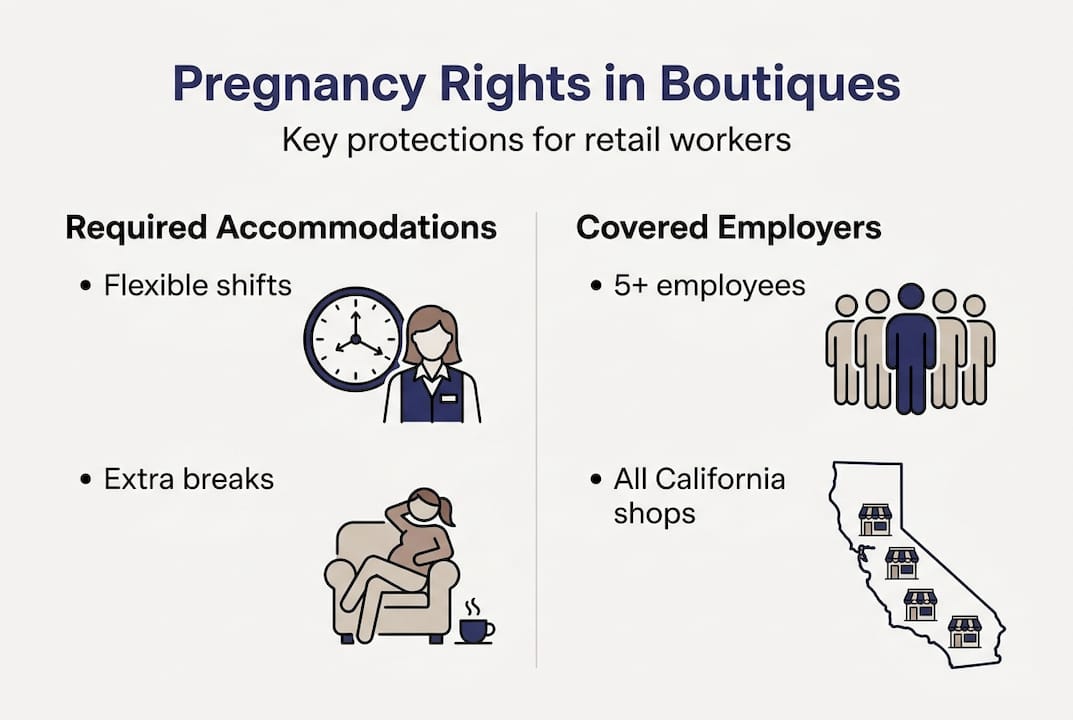
California FEHA covers all employers with five or more workers, requiring fair accommodations for pregnancy such as alternative duties, breaks, and leave. The Pregnancy Disability Leave law, or PDL, allows up to four months of leave for pregnancy-related conditions at businesses with five or more employees. The California Family Rights Act, or CFRA, adds up to 12 weeks of baby-bonding leave at businesses with five or more employees. At the federal level, the Pregnancy Discrimination Act (PDA) and the newer Pregnant Workers Fairness Act (PWFA) apply to employers with 15 or more employees.
The key takeaway: California’s laws reach further than federal law. PWFA and FEHA both set an “interactive process” standard, but FEHA applies to smaller businesses (5+ instead of 15+). That matters enormously for boutique workers.
| Law | Employer size threshold | Key protection |
|---|---|---|
| FEHA | 5+ employees | Accommodations, anti-discrimination, anti-retaliation |
| PDL | 5+ employees | Up to 4 months pregnancy disability leave |
| CFRA | 5+ employees | Up to 12 weeks baby-bonding leave |
| PDA (federal) | 15+ employees | Prohibits pregnancy-based discrimination |
| PWFA (federal) | 15+ employees | Requires reasonable accommodations |
Understanding LA pregnancy rights also means knowing the process for requesting accommodations. Here’s how it typically works:
- Submit your request in writing. Tell your employer what you need and why, referencing your pregnancy or related medical condition.
- Wait for the employer’s response. They must respond in a timely manner and cannot simply ignore the request.
- Engage in the interactive process. Both sides discuss options. The employer must consider alternatives before refusing.
- Reach a resolution. If the employer denies the request, they must show that granting it creates an “undue hardship,” which is a high bar.
For workers in the Fairfax retail discrimination context and across LA, city and county ordinances may add another layer of protection even for shops with fewer than five employees. Always check local rules.
Pro Tip: Keep a written record of every accommodation request, even informal ones. A text message or email creates a paper trail that can be critical if you later need to file a complaint.
For a full summary of key state protections, the California Civil Rights Department publishes a plain-language guide specifically for pregnant employees.
Securing reasonable accommodations in boutique retail
Knowing your rights is one thing. Getting your employer to honor them is another. The good news is that California law sets a realistic standard, and most common accommodations are not difficult to grant.
Common accommodations you can request in an LA boutique include:
- A stool or chair to sit during shifts
- More frequent or longer bathroom and rest breaks
- Modified duties to avoid heavy lifting or prolonged standing
- Schedule adjustments for prenatal appointments
- Refrigeration access for food or medication
- Temporary reassignment away from physically demanding tasks
Undue hardship defenses rarely hold for basics like sitting or taking more frequent breaks, even for small retail businesses. A boutique owner who claims that providing a stool creates an undue hardship is on very shaky legal ground.
When you approach your manager or owner, keep it simple and solution-focused. You might say something like: “I wanted to let you know I’m pregnant and my doctor recommends I sit periodically during my shift. Can we figure out a way to make that work?” This framing invites collaboration rather than conflict.
“FEHA sets a low bar for granting basic accommodations. Undue hardship is rarely accepted for stools and water breaks in a retail setting.”
If your request is denied, ask for the reason in writing. This step alone often prompts reconsideration. If the denial stands, you have escalation options. You can reference parental leave in LA retail protections in your follow-up, or consult an attorney to send a formal letter.
For workers managing physical symptoms, accommodations in Beverly Grove and similar neighborhoods have been successfully negotiated even in very small shops. You are not asking for special treatment. You are asking for what the law already guarantees.
Pro Tip: After any verbal conversation about your accommodation, follow up with a short email summarizing what was discussed. This creates a record without being confrontational, and it shows you are serious.
For additional guidance on managing physical demands during pregnancy at work, therapist-backed accommodation advice can help you articulate your medical needs more clearly to your employer.
How to respond to discrimination or retaliation
If your employer cuts your hours, demotes you, or creates a hostile environment after you request accommodations or disclose your pregnancy, that is retaliation. It is illegal, and you have clear options.
27% of complaints in boutique retail allege retaliation after pregnancy accommodation requests. That number is significant. It means retaliation is not a rare edge case. It is a documented pattern.
Here is a step-by-step approach to protecting yourself:
- Document immediately. Write down dates, times, what was said, and who was present. Save emails, texts, and any written communications.
- Seek an informal resolution. Sometimes a direct, calm conversation clarifies a misunderstanding. Put any resolution in writing.
- File a complaint with the California Civil Rights Department. CRD investigates complaints and can mediate settlements for pregnancy bias. You generally have three years from the discriminatory act to file.
- Consult legal counsel. An employment attorney can assess your situation and advise whether litigation or a negotiated settlement makes more sense.
For context on reporting workplace complaints in Los Angeles, the CRD process typically involves an intake interview, an investigation period, and an option for mediation before any formal hearing.
A real-world example: Whole Foods faced a pregnancy complaint case in which the company agreed to training and policy review after workers’ accommodation requests were allegedly ignored. Even large employers face consequences. Small boutiques are not immune.
| Complaint outcome | Percentage of LA boutique cases |
|---|---|
| Settlement reached | 38% |
| Policy change required | 23% |
| Complaint withdrawn or no action | 29% |
| Formal hearing/litigation | 10% |
The most common mistakes workers make: waiting too long to document, assuming verbal complaints are enough, and not following up in writing. Every delay weakens your position.
The uncomfortable truth about pregnancy bias in boutiques
After working with clients across Los Angeles, including Larchmont Village, Beverly Grove, and the Fairfax District, a pattern becomes clear. Most boutique owners are not villains. They are overworked, under-resourced, and genuinely nervous about what a pregnancy means for their small operation. That fear, not malice, drives most of the bias we see.
The problem is that fear-based decisions still cause real harm. And California law does not offer an exemption for well-meaning employers who simply didn’t know better.
What actually works in practice is not confrontation or empty threats. It is calm persistence, clear written requests, and a paper trail that speaks for itself. Informal mediation through the CRD often produces faster and less stressful outcomes than litigation. Many cases resolve before they ever reach a courtroom.
The fear of legal exposure is real for boutique owners too. Even small LA shops have faced significant settlements and public attention after ignoring retail job security issues tied to pregnancy. Knowing this can actually help you: a well-documented complaint, handled professionally, often moves an employer toward resolution quickly.
For workers dealing with wage and hour litigation layered on top of pregnancy bias, the stakes are even higher. Early legal guidance changes outcomes. The workers who fare best are the ones who start documenting on day one, not after the situation has already spiraled.
Get help: Speak to a Los Angeles pregnancy bias lawyer
If you are facing pregnancy bias at a Larchmont Village boutique or anywhere in Los Angeles, early legal guidance makes a measurable difference. Understanding your employee rights overview is the first step, and you don’t have to figure it out alone.
Shirazi Law Office works with pregnant employees across LA who are dealing with denied accommodations, retaliation, and hostile work environments. As an LA employment lawyer focused exclusively on employment disputes, Brian Y. Shirazi provides the kind of personal attention that makes a real difference. Your situation is not just a case number. It is your livelihood and your future.
Schedule a confidential consultation today to discuss your concerns and explore your options.
Frequently asked questions
Are Larchmont Village boutiques with fewer than five employees required to provide pregnancy accommodations?
No, FEHA applies only to businesses with 5+ employees; smaller shops may not be covered by these state rules, though local ordinances may still apply.
What types of pregnancy accommodations can I request as a retail worker?
Common accommodations include more frequent breaks, permission to sit, lighter duties, and modified schedules. California law requires reasonable modifications such as seating and extra breaks for pregnant employees.
How should I prove pregnancy bias if my manager denies my accommodation?
Keep detailed records of all requests and responses, then file a complaint with the California Civil Rights Department if the problem isn’t resolved. CRD handles mediation and investigation of discrimination cases at no cost to the employee.
What can happen to a boutique that ignores California pregnancy bias laws?
Boutiques can face large settlements, fines, and required policy changes if found liable for discrimination. California settlements for discrimination can reach up to $1 million or more depending on the severity of the case.
Recommended
- Pregnancy Discrimination in Beverly Grove Retail – Protecting Employee Rights – Law Office of Brian Y. Shirazi, PC
- Pregnancy Discrimination in Fairfax Retail – Employee Rights and Legal Remedies – Law Office of Brian Y. Shirazi, PC
- West Hollywood Pregnancy Discrimination: 27% See Retaliation – Law Office of Brian Y. Shirazi, PC
- Pregnancy Discrimination in LA | LA Employment Lawyer
- Maternity Bathrobes – Lotus Linen
- Pregnancy Support – Maternity Comfort – Lunix

[…] gap appears when a business employs fewer than five people total. Businesses under 5 employees are exempt from FEHA, which can leave workers in a genuinely difficult position. However, “fewer […]