
Most writers, producers, and showrunners believe studios like Warner Bros. can enforce non-compete clauses, but California voids almost all such contracts. Understanding this legal landscape is crucial for career mobility and negotiating power. This guide will demystify current laws, practical alternatives, and how creative professionals can protect their rights in an industry where contract myths often overshadow legal reality.
Table of Contents
- How California law treats non-compete agreements
- Key exceptions and what actually applies in Hollywood
- Recent legal changes and their impact on studio practices
- Practical alternatives studios try and their limits
- How Hollywood disputes play out: cases and real-world insights
- If a studio pushes a non-compete: rights, remedies, and next steps
- Get expert help with Hollywood contract disputes
- Frequently asked questions
Key Takeaways
| Point | Details |
|---|---|
| California bans most non-competes | Employment-related non-compete agreements are generally void for Hollywood creatives under state law. |
| Exceptions are extremely rare | Only business sale or partnership exit scenarios permit non-competes, not typical Hollywood contracts. |
| Studios face penalties for enforcement | Attempting to enforce or threaten a void non-compete can expose studios to serious legal consequences. |
| Fixed-term deals differ from non-competes | Exclusivity during contract terms is allowed, but post-employment restrictions are not enforceable. |
| Legal guidance is essential | Hollywood talent should always consult a knowledgeable employment attorney before signing or disputing contract terms. |
How California law treats non-compete agreements
Now that the common misconception is clarified, let’s dig into the exact legal framework that governs non-compete clauses in Hollywood employment.
California Business and Professions Code §16600 renders most non-compete provisions in employment contracts void and unenforceable. This statute protects your right to work wherever you choose after leaving a studio or production company. The law favors employee mobility and competition over studio-centered exclusivity, recognizing that creative talent drives innovation and industry growth.
Amendments in 2023 and 2024 closed loopholes on out-of-state contracts and choice-of-law provisions. Studios can no longer circumvent California protections by having you sign agreements in New York or inserting clauses that invoke another state’s laws. If you work in California, California law protects you, period.
Pro Tip: Even if you signed your contract out of state, California law still protects you once you’re working here.
Many studios perpetuate the myth that non-competes can be “reformed” or modified by courts to make them reasonable. California law says otherwise. The statute doesn’t allow judges to rewrite or narrow these clauses. They’re simply void. This bright-line rule gives you certainty and leverage when negotiating new deals or challenging existing provisions.
Key protections under §16600 include:
- Complete voidance of post-employment restrictions on where you can work
- No geographic limitations that courts will enforce
- No time-based restrictions on future employment
- Protection regardless of contract signing location
The California Business and Professions Code Section 16600 framework ensures that your career trajectory remains in your control. Studios cannot legally prevent you from taking your talents to a competitor, launching your own production company, or pursuing any other professional opportunity after your contract ends.
For professionals working in entertainment hubs like Century City, understanding non-compete agreements in Century City provides additional context for local industry practices. Similarly, broader protections apply throughout the region, as detailed in resources on non-compete agreements in LA.
Key exceptions and what actually applies in Hollywood
With the basic legal principle established, it’s critical to know where the real boundaries lie and when a non-compete could legally come into play.
Only three exceptions exist: sale of business goodwill, partnership dissolution, and LLC dissociation. These narrow carve-outs apply when someone sells their ownership stake in a business and agrees not to compete with the buyer. They have nothing to do with employment relationships.
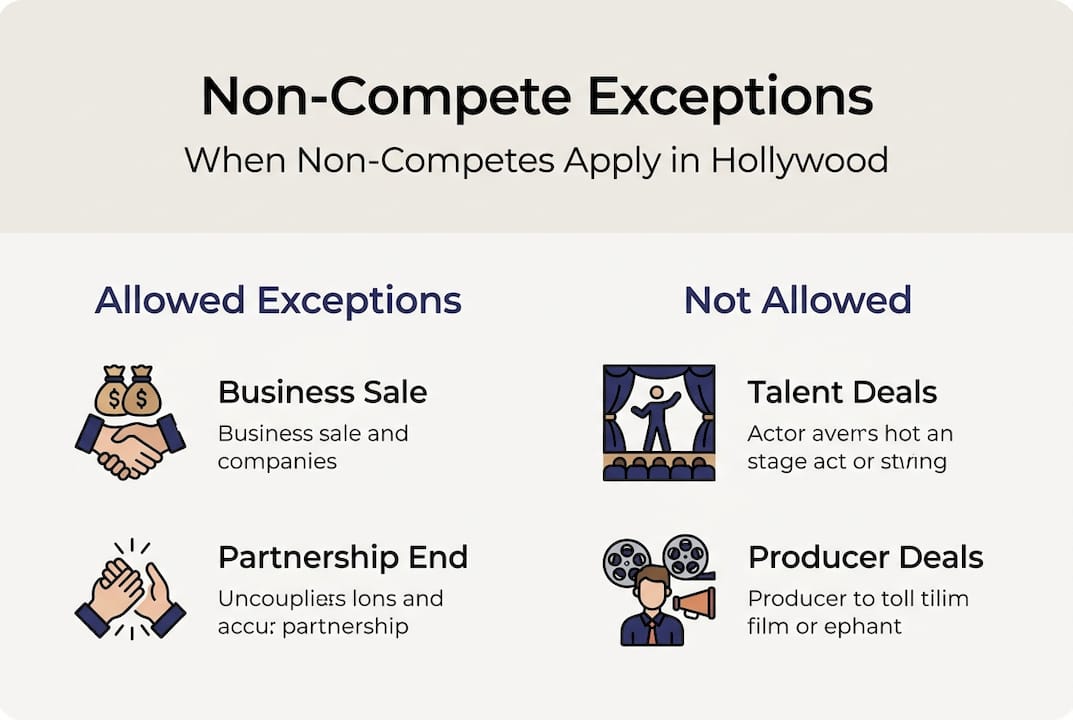
No carve-out exists for Hollywood talent, writing, or producing contracts. You’re an employee or independent contractor, not a business owner selling goodwill. Studios sometimes try to characterize deals as falling under these exceptions, but courts consistently reject such arguments when applied to creative professionals.
Pro Tip: Requests for a “non-compete” during deal negotiation should raise immediate red flags for creatives.
| Exception Type | Applies to Hollywood Contracts? | Why It Doesn’t Apply |
|---|---|---|
| Sale of business goodwill | No | Writers/producers are employees, not selling businesses |
| Partnership dissolution | No | Employment relationships aren’t partnerships |
| LLC dissociation | No | Talent contracts don’t involve ownership dissolution |
| General employment | Never enforceable | §16600 voids all employment non-competes |
The distinction matters because studios occasionally attempt to structure deals as “partnerships” or claim you’re selling intellectual property rights that trigger an exception. These tactics fail under scrutiny. Your employment relationship remains protected regardless of how creatively a studio labels the arrangement.
When you encounter non-compete language in a contract, recognize it as either a negotiating tactic or a misunderstanding of California law. Either way, you’re not bound by it. Resources on non-compete disputes in Culver City illustrate how these protections apply across different entertainment industry locations.
Recent legal changes and their impact on studio practices
Understanding California law is just the beginning. The state’s most recent amendments have further protected creative talent and transformed how studios draft their agreements.
Amendments AB 1076 and SB 699 make non-competes void everywhere, regardless of contract state or governing law. These 2023 and 2024 changes eliminated the last remaining loopholes studios used to enforce restrictive covenants. Now, if you work in California, no out-of-state provision can bind you.
Studios must now notify employees of invalid provisions. If your contract contains a non-compete clause, your employer has a legal obligation to inform you that it’s unenforceable. Failure to provide this notice exposes studios to penalties and liability.
| Year | Legal Change | Impact on Hollywood Contracts |
|---|---|---|
| 2023 | AB 1076 enacted | Voided non-competes regardless of signing location |
| 2024 | SB 699 enacted | Required employer notification of void provisions |
| 2024 | Enhanced penalties | Added damages and attorney fees for enforcement attempts |
| 2026 | Current enforcement | Studios shift to NDAs and fixed-term exclusivity |
Studio practices have shifted toward NDAs and exclusivity during fixed-term deals. Rather than trying to restrict where you work after a contract ends, studios now focus on protecting confidential information and ensuring exclusivity during active production periods. This shift aligns with California law and creates clearer boundaries for both parties.
Steps to take when challenging a studio’s non-compete clause:
- Document everything related to the non-compete provision and any enforcement threats
- Request written confirmation that the studio acknowledges the clause is void
- Consult with an employment attorney experienced in entertainment law
- Notify the studio in writing that you understand your rights under §16600
- Preserve all communications regarding the disputed provision
These legal developments have practical implications for your career planning. You can now negotiate with competing studios without fear of legal retaliation. You can leave a project for better opportunities without worrying about post-employment restrictions. The law firmly supports your professional mobility.
For professionals in the tech sector facing similar issues, understanding non-compete disputes in California tech provides useful parallels. Executive-level talent can also benefit from resources on executive mobility and non-compete agreements.
Practical alternatives studios try and their limits
As studios adapt, they turn to other legal tools. Here’s what actually holds up and what doesn’t.
NDAs (non-disclosure agreements) are enforceable, but only for confidential information, not for restricting employment. Studios can legitimately protect trade secrets, unreleased scripts, financial information, and strategic plans. However, an NDA cannot prevent you from working for a competitor or starting your own production company. The restriction applies only to what you can disclose, not where you can work.
Non-solicitation clauses are narrowly allowed, mostly regarding theft of clients or staff. A studio can prevent you from actively recruiting its employees or poaching its client relationships immediately after departure. These provisions must be reasonable in scope and duration. Courts scrutinize them carefully to ensure they don’t function as disguised non-competes.
Trade secret clauses prohibit taking or misusing proprietary information, but don’t limit career moves. You cannot walk away with confidential scripts, financial models, or strategic documents. You can, however, use general skills, knowledge, and industry relationships you developed during your employment. The line between protectable trade secrets and general professional expertise is crucial.
Pro Tip: Studios may overreach with these provisions. Always have a Hollywood-savvy lawyer review them before signing.
Alternatives like NDAs serve legitimate business interests without trampling your career rights. The key is understanding where protection of confidential information ends and unlawful employment restriction begins. Many disputes arise from studios conflating these distinct concepts.
Common overreach tactics include:
- Overly broad confidentiality definitions that encompass general industry knowledge
- Non-solicitation clauses that effectively prevent you from working in your field
- Trade secret provisions that claim ownership of your general creative skills
- Combination clauses that function as non-competes despite different labels
When reviewing these alternative provisions, ask yourself: Does this clause restrict where I can work, or only what information I can share? If it limits your employment options rather than protecting specific confidential information, it likely violates California law.
Professionals facing aggressive contract terms can learn from battles on non-compete agreements and executive contract disputes in Hollywood that illustrate successful challenges to overreaching provisions.
How Hollywood disputes play out: cases and real-world insights
With studios shifting tactics, let’s see what actual disputes look like and what lessons those cases hold for Hollywood professionals.
Fixed-term contracts are enforceable during the term, not after. If you sign a three-year overall deal with a studio, they can hold you to that exclusivity period. What they cannot do is prevent you from working elsewhere once that term expires. This distinction is fundamental to understanding Hollywood employment law.

Famous cases like Fox v. Netflix actually concern exclusivity during the term, not traditional non-competes. When Fox sued Netflix for poaching talent, the dispute centered on whether Netflix tortiously interfered with active contracts, not whether Fox could restrict where talent worked after contracts ended. The case reinforced that studios can enforce exclusivity during a contract period but cannot extend that control beyond the term.
Studios may try to claim breach if you leave mid-term for a rival. These claims focus on contract enforcement and potential damages for early departure, not on preventing your future employment. The legal theory is breach of contract, not non-compete enforcement. The remedies and defenses differ significantly.
“Most Hollywood non-compete disputes vanish once §16600 is explained. Studios know they cannot win these cases, so they rely on intimidation and confusion instead.”
Disputes focus on poaching and tortious interference, not post-employment bans. When studios sue competitors, they typically allege that the competing studio actively induced a breach of an existing contract. These cases require proof that the competitor knew about the contract and intentionally caused the breach. They don’t involve restricting where you can work after your contract ends.
Key lessons from actual disputes:
- During-term exclusivity is enforceable and studios will litigate to protect it
- Post-term restrictions are void and studios rarely pursue them in court
- Tortious interference claims target competing studios, not individual talent
- Settlement pressure often comes from litigation costs, not legal merit
Understanding these patterns helps you assess risk when considering career moves. If you’re under an active contract, leaving early may expose you to breach claims and damages. If your contract has ended or you’re negotiating a new deal, non-compete provisions are simply unenforceable noise.
For broader context on handling these situations, resources on Hollywood contract dispute strategies and Hollywood workplace defamation provide additional guidance on protecting your professional reputation during disputes.
If a studio pushes a non-compete: rights, remedies, and next steps
After learning from recent disputes, what should you do if a studio still tries to push an illegal clause?
Studios risk damages, injunctions, and penalties if they attempt to enforce non-competes. California law doesn’t just void these provisions. It punishes employers who try to enforce them. You may be entitled to attorney fees, actual damages, and in some cases, civil penalties. The law creates strong disincentives for studios to pursue invalid restrictions.
Pro Tip: Even threatening to enforce a void non-compete can entitle you to legal remedies.
How to respond if faced with a non-compete demand:
- Do not panic or assume the provision is enforceable simply because it’s in writing
- Document the demand including dates, communications, and any threats made
- Respond in writing stating your understanding that non-competes are void under California law
- Consult with an employment attorney immediately to assess your specific situation
- Consider your leverage in negotiations, knowing the law strongly favors your position
- Preserve evidence of any retaliation or adverse treatment related to the dispute
Seek immediate legal counsel and document all communications. If a studio threatens legal action or suggests you cannot work for a competitor, those communications become evidence of unlawful conduct. Keep emails, text messages, and notes from phone conversations. This documentation protects you and strengthens any potential claim for damages.
Your rights include the ability to work wherever you choose after your contract ends. You can negotiate with competitors, accept offers from rival studios, and pursue any professional opportunity without restriction. Studios cannot blacklist you, interfere with new employment, or retaliate against you for asserting these rights.
Available remedies when studios overstep:
- Declaratory relief confirming the non-compete is void
- Injunctive relief preventing enforcement attempts
- Damages for lost opportunities or economic harm
- Attorney fees and litigation costs
- Civil penalties under California’s unfair competition law
The legal framework strongly supports your position. Studios know this, which is why most non-compete disputes resolve quickly once you assert your rights with competent legal counsel. The key is not being intimidated by provisions that look official but lack legal force.
For location-specific guidance, understanding enforcement of non-competes in Century City provides practical insights into how these disputes unfold in major entertainment industry hubs.
Get expert help with Hollywood contract disputes
Once you know your rights and the landscape, the next step is to ensure you’re prepared and protected for every contract conversation.
Industry-savvy legal advice makes a difference in high-stakes Hollywood negotiations. Entertainment contracts involve unique provisions, industry customs, and power dynamics that require specialized knowledge. An attorney who understands both employment law and entertainment industry practices can spot problematic clauses, negotiate better terms, and protect your long-term career interests.
Skilled attorneys can help you review, negotiate, or challenge unfair contract provisions. Whether you’re signing a new overall deal, facing a non-compete demand, or dealing with a studio’s enforcement threat, experienced legal counsel levels the playing field. Studios have entire legal departments. You deserve equally strong representation.
Prompt legal counsel prevents future disputes and protects your career. Addressing contract issues before they escalate saves time, money, and professional relationships. Early intervention often resolves problems through negotiation rather than litigation, preserving your reputation while securing your rights.
Navigating Hollywood contract dispute strategies requires understanding both legal principles and industry realities. Working with a Los Angeles employment lawyer who focuses on entertainment industry clients ensures you receive advice tailored to your specific situation. Shirazi Law Office provides dedicated representation for creative professionals facing contract disputes, helping you protect your rights and advance your career without unlawful restrictions.
Frequently asked questions
Can a studio outside California enforce a non-compete against me if I work in California?
No, California law invalidates non-competes for employees working in the state, regardless of where the contract was signed or what governing law it specifies.
What if I agreed to a non-compete as part of a development deal or overall deal?
Such provisions are void post-employment. Only exclusivity during the active contract term is enforceable, not restrictions after the deal ends.
What penalties could a studio face for trying to enforce a void non-compete?
Studios may face injunctions, damages, attorney fees, and civil penalties if they attempt to enforce void non-competes under California law.
Are NDAs and confidentiality agreements a threat to mobility?
NDAs protect confidential information only and cannot prevent you from working elsewhere. They restrict what you disclose, not where you work.
What should I do if a studio refuses to remove a non-compete clause?
Consult with an employment lawyer immediately. You have legal grounds to void the provision in California, and studios face penalties for enforcement attempts.