

Spotting the signs of workplace retaliation is more challenging than many healthcare workers in Mid-Wilshire, California, expect. After reporting safety concerns, you might notice subtle changes—a sudden shift in your schedule, exclusion from professional meetings, or unexpected job criticism. These behaviors do more than discourage speaking up; they undermine your rights and jeopardize patient safety. Understanding protections against retaliation for reporting safety violations empowers you to respond with confidence and secure the workplace respect you deserve.
Table of Contents
- Workplace Retaliation After Safety Reports Defined
- Types and Signs of Retaliation in Healthcare
- California Laws Protecting Whistleblowers
- Employee Rights and Employer Duties
- Steps to Take If You Experience Retaliation
Key Takeaways
| Point | Details |
|---|---|
| Understanding Retaliation | Retaliation can occur in both obvious and subtle ways after reporting safety violations, and can include termination, demotion, or negative performance reviews. |
| Legal Protections | California law offers strong protections against retaliation for healthcare workers, ensuring you can report unsafe conditions without fear of punishment. |
| Documentation Importance | Keeping detailed records of safety reports and subsequent treatment is crucial in supporting any retaliation claims. |
| Employer Obligations | Employers are legally required to provide a safe work environment and must not retaliate against employees for reporting safety concerns. |
Workplace Retaliation After Safety Reports Defined
Workplace retaliation in healthcare occurs when an employer takes adverse action against you for reporting safety violations. This might sound straightforward, but the reality is more complex than you’d expect. Your employer may retaliate in obvious or subtle ways, both of which violate California law.
What counts as retaliation? Retaliation occurs when an employer takes adverse action against an employee for engaging in protected activity such as reporting safety concerns. In healthcare settings, this protection applies directly to you when you report unsafe patient care conditions, inadequate staffing, or equipment failures.
Retaliation includes actions designed to discourage reasonable employees from raising concerns:
- Termination or threats of termination
- Demotion or reassignment to undesirable shifts
- Reduction in hours, pay, or benefits
- Exclusion from meetings or decision-making
- Negative performance reviews unrelated to actual performance
- Harassment, hostile treatment, or social isolation
- Suspension without cause or investigation
The key phrase here is “discourage a reasonable employee.” Your employer doesn’t need to fire you for retaliation to occur. A pattern of smaller actions—being scheduled for worse shifts after reporting a safety issue, being excluded from training opportunities, or receiving unexpected negative feedback—all constitute illegal retaliation.
The healthcare context matters significantly. When you report unsafe staffing levels, inadequate training, infection control failures, or medication errors, you’re engaging in protected activity. Your employer cannot punish you for this. Yet many healthcare facilities in Mid-Wilshire and surrounding areas respond to safety reports with subtle (or not-so-subtle) consequences for the reporting employee.
You have the right to report unsafe conditions without fear of retaliation. This protection exists specifically because healthcare workers often face pressure to stay quiet about patient safety issues.
Understanding the legal framework helps clarify your rights. The right to report unsafe working conditions without fear of retaliation is protected under federal law. California employment law provides even stronger protections for employees who report violations.
Retaliation negatively impacts more than just the individual reporting—it affects team morale, patient safety, and the entire organization’s culture. When healthcare workers fear consequences for speaking up, dangerous conditions persist. This is precisely why the law prohibits retaliation and why understanding this definition matters for your career and legal rights.

Pro tip: Document the timeline of your safety report and any changes to your work conditions immediately afterward—dates, what you reported, who you reported it to, and any shift changes or negative interactions that follow. This documentation becomes invaluable evidence if you need to pursue a retaliation claim.
Types and Signs of Retaliation in Healthcare
Retaliation in healthcare settings takes many forms—some obvious, others deliberately subtle to avoid detection. Understanding what retaliation looks like helps you recognize it when it happens and document it properly for legal protection.
Obvious retaliation actions are easier to spot but still occur regularly. These include termination without legitimate cause, immediate demotion following your safety report, or sudden suspension. Physicians and healthcare workers report facing severe professional consequences for speaking up about safety or ethical concerns. When an employer acts quickly and dramatically after you report something, that timing matters legally.
Subtle retaliation is more common and harder to prove, but equally damaging. Watch for these warning signs:
- Assignment to undesirable shifts immediately after reporting
- Exclusion from meetings, committees, or professional development
- Sudden increase in performance scrutiny or unfair write-ups
- Reduction in hours, responsibilities, or desirable assignments
- Micromanagement that didn’t exist before your report
- Harassment from supervisors or coworkers
- Removal from projects you normally handle
- Negative performance reviews unrelated to actual work quality
Many healthcare workers describe a shift in workplace atmosphere. Colleagues become distant, supervisors become critical of work previously acceptable, or you’re isolated from team activities. Recognizing these signs early helps employees respond appropriately and build a stronger legal case.
Here’s how obvious and subtle retaliation differ in healthcare:
| Aspect | Obvious Retaliation | Subtle Retaliation |
|---|---|---|
| Visibility to Others | Easily noticed by coworkers | Often hidden, not discussed openly |
| Legal Proof | Easier to connect to reporting | Requires pattern and timeline evidence |
| Employer Motivation | Rapid, direct consequence | Gradual, designed to discourage future reports |
| Impact on Employee | Immediate job insecurity | Ongoing stress, undermined career growth |
Retaliation often follows a pattern rather than a single incident. One negative shift might coincide with your safety report, but a series of changes shows intentional retaliation.
Timing is critical evidence. If negative consequences follow your safety report within days or weeks, that temporal connection strengthens your retaliation claim. California courts recognize that sudden changes in treatment after protected activity suggest retaliation, even without direct statements about why the change happened.
Impact on patient care matters too. When retaliation silences healthcare workers who spot safety problems, patients suffer. This is why California law protects you so strongly—your ability to report without fear directly protects others.
Pro tip: Keep a detailed log with dates, times, what happened, and who was present whenever you notice negative treatment. Note what you reported and when. This contemporaneous documentation becomes your strongest evidence if you need to pursue a retaliation claim with an employment attorney.
California Laws Protecting Whistleblowers
California offers some of the strongest whistleblower protections in the nation. If you work in healthcare and report safety violations, multiple state laws shield you from retaliation—making your legal position significantly stronger than employees in other states.
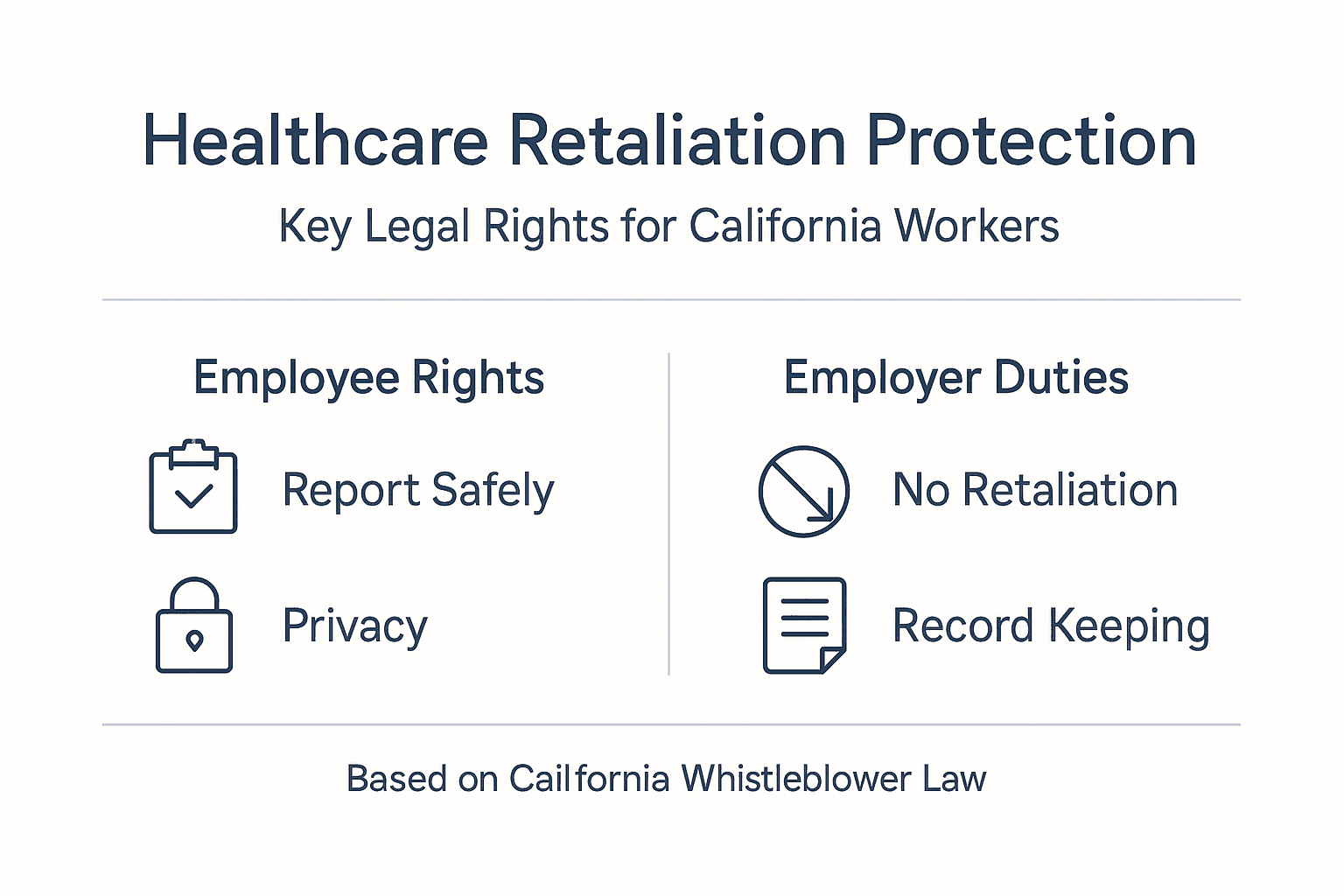
The foundation of your protection is California’s Whistleblower Protection Act. This law encourages employees to report violations of laws or unsafe work conditions without fear of retaliation. The act explicitly prohibits employers from taking adverse actions like termination, demotion, or discrimination against you for whistleblowing or refusing to engage in illegal practices.
The law applies broadly across public and private sectors. Healthcare facilities—whether large hospital systems or smaller clinics in Mid-Wilshire—cannot legally retaliate against you for reporting patient safety issues, infection control failures, staffing violations, or other regulatory problems.
What protections does the law provide? You’re shielded from:
- Termination or threats of termination
- Demotion, suspension, or reassignment as punishment
- Reduction in pay, hours, or benefits
- Negative performance evaluations related to your report
- Harassment, hostile treatment, or discrimination
- Any adverse action intended to discourage reporting
Reporting channels matter legally. You can report to your employer directly, government agencies like Cal/OSHA or the California Department of Public Health, or even externally. The law protects you regardless of which pathway you choose. Some healthcare workers worry about “going outside the chain of command.” Don’t. California law protects external reporting just as strongly.
California law presumes retaliation occurred if negative employment action follows your protected activity within a reasonable timeframe. Your employer then bears the burden of proving the action had nothing to do with your report.
Additional privacy protections strengthen your position. California’s advanced whistleblower protections include anti-retaliation provisions and financial incentives designed to shield insiders from retaliation while promoting transparency and enforcement of regulations. This multi-layered approach means you have protection from several different state laws, not just one.
The burden shifts to your employer. Once you demonstrate that you engaged in protected activity and suffered negative consequences afterward, California law presumes retaliation. Your employer must prove the action was completely unrelated to your report. This is powerful protection—it reverses the normal burden of proof.
Pro tip: When reporting safety concerns, use clear language stating you’re reporting a violation of law or unsafe conditions. Use words like “safety hazard,” “regulatory violation,” or “patient safety risk.” This explicit language activates legal protections and creates a written record of your protected activity.
Employee Rights and Employer Duties
The relationship between your rights and your employer’s duties is fundamental to understanding workplace retaliation. California law creates clear obligations on both sides—knowing what you’re entitled to and what your employer must provide strengthens your legal position significantly.
Your core rights start with safety. Employees have the right to report workplace issues including safety concerns without fear of retaliation. This isn’t a suggestion or a courtesy—it’s a legal right backed by state and federal law. You can report unsafe conditions, inadequate staffing, infection control failures, or equipment problems without your employer punishing you.
Employer duties are equally clear and mandatory. Healthcare employers must:
- Provide a safe work environment free from recognized hazards
- Comply with all applicable labor laws and safety regulations
- Train employees on safety procedures and hazard recognition
- Maintain equipment and facilities in safe working condition
- Refrain from retaliating against employees who report safety issues
- Investigate safety reports promptly and thoroughly
- Protect employees who refuse to work in dangerous conditions
These aren’t optional guidelines. They’re legal obligations. When your Mid-Wilshire healthcare employer violates these duties, you have grounds for legal action.
Protection extends to refusal to work in dangerous conditions. Workers must be protected from retaliation for reporting hazards or refusing to work in dangerous conditions. You have the legal right to step back from patient care if you believe the situation poses an immediate risk—to you or to patients. Your employer cannot punish you for this.
Your employer’s duty to provide safety and protect you from retaliation is absolute. There’s no exception for “business needs” or “staffing challenges” or “budget constraints.”
Documentation becomes your evidence. When you report safety issues, your employer’s duty includes maintaining records of that report. You have the right to access documentation of your complaint and any investigation that followed. This creates accountability and gives you evidence of your protected activity.
The burden is on the employer to prove non-retaliation. Once you establish you reported a safety concern and suffered negative consequences, California law presumes retaliation occurred. Your employer must then prove the adverse action had nothing to do with your report. This reversal of burden is powerful protection.
Pro tip: Submit safety reports in writing when possible—email, formal incident report, or written memo. Get confirmation that your report was received. Written reports create undeniable evidence of your protected activity and when it occurred, making retaliation claims much stronger.
This table summarizes your legal protections and employer duties under California law:
| Protection Type | Employee Right | Employer Duty |
|---|---|---|
| Whistleblower Protection | Free to report safety issues | Must not retaliate in any form |
| Safe Workplace | Work free from hazards | Provide training, maintain safety |
| Retaliation Claims | Burden shifted to employer | Must prove action unrelated to report |
| Access to Evidence | Obtain all investigation records | Keep and share documentation |
Steps to Take If You Experience Retaliation
When you notice retaliation happening, acting quickly and strategically makes the difference between a weak claim and a strong legal case. The steps you take now will either support or undermine your future legal action, so precision matters.
Step 1: Document everything immediately. If you experience retaliation at work, it is important to document all incidents with dates, descriptions, and witnesses. Don’t rely on memory—write down what happened on the day it occurred. Include the date, time, location, who was involved, what was said or done, and any witnesses present.
Your documentation should include:
- Dates and times of negative actions or comments
- Specific descriptions of what happened
- Names of people involved and any witnesses
- What you reported originally (attach copies if available)
- Changes to your schedule, assignments, or treatment
- Email exchanges, performance reviews, or written feedback
- Any statements from supervisors about your report
Step 2: Report internally through proper channels. Notify your HR department or follow your employer’s designated complaint procedure. Do this in writing—email is perfect because it creates a time-stamped record. State clearly that you’re reporting retaliation and describe what happened. Keep a copy for yourself.
Step 3: Know when internal remedies fail. If your employer doesn’t respond appropriately or retaliation continues, filing complaints with government agencies like Cal/OSHA, the California Labor Commissioner, or the DFEH becomes necessary. These agencies investigate retaliation and can order remedies.
Don’t wait for retaliation to escalate. The moment you notice a pattern of negative treatment following your safety report, begin documenting and reporting internally.
Step 4: Consult an employment attorney early. You don’t need to file a lawsuit immediately, but getting legal advice helps you understand your options and avoid mistakes. An experienced attorney can review your documentation, evaluate your case strength, and guide your next steps.
Attempting to handle this alone often results in lost claims or reduced damages. Healthcare retaliation cases are complex, and employers have legal resources on their side. You deserve the same advantage.
Step 5: Preserve evidence. Don’t delete emails, texts, or documents. Back up your documentation in multiple places—personal email, cloud storage, or physical copies. Your employer may try to delete records later.
Pro tip: Create a simple spreadsheet or document log starting today with columns for date, time, incident description, witnesses, and any written evidence (emails, texts, performance reviews). Update it whenever something happens. This organized, contemporaneous documentation becomes your case foundation and demonstrates your credibility to investigators or a jury.
Protect Your Rights Against Healthcare Retaliation in Mid-Wilshire
If you have reported safety violations or unsafe working conditions in your healthcare job and are now facing retaliation such as unfair shift changes, demotion, or hostile treatment you are not alone. This kind of workplace retaliation violates your legal protections under California law and can severely impact your career and well-being. Understanding your rights and timely action are crucial to stopping ongoing harm and safeguarding your future.
At Shirazi Law Office, we specialize in defending employees against workplace retaliation and related employment disputes in Los Angeles including Mid-Wilshire. Our experienced employment lawyers know the complexities of healthcare workplace retaliation claims and will help you document evidence, assert your legal rights, and pursue the strongest possible outcome. Learn more about your employment rights and how to respond when facing retaliation. Don’t wait until it is too late. Contact us today to protect your career and ensure your voice is heard in the fight against retaliation.
Frequently Asked Questions
What constitutes workplace retaliation in healthcare?
Retaliation in healthcare occurs when an employer takes adverse actions against an employee for reporting safety violations, such as termination, demotion, or negative performance reviews.
How can I recognize subtle forms of workplace retaliation?
Subtle forms of retaliation may include being assigned to undesirable shifts, increased scrutiny of performance, exclusion from meetings, or experiencing hostility from coworkers, all occurring after a safety report.
What legal protections do I have if I report safety concerns in my workplace?
Under California’s Whistleblower Protection Act, employees are protected from retaliation for reporting safety issues, which includes being free from termination, harassment, or other adverse actions related to their report.
What steps should I take if I experience retaliation for reporting safety violations?
You should document all incidents of retaliation, report the issue internally through proper channels, consult an employment attorney if necessary, and preserve all evidence related to your case.
Recommended
- Hostile Work Environment Claims in Mid-Wilshire Offices – Law Office of Brian Y. Shirazi, PC
- Retaliation After Medical Leave in Fairfax District – Law Office of Brian Y. Shirazi, PC
- Retaliation After Medical Leave: Protecting Your Career in Los Angeles
- Medical Leave and Disability Rights for Westwood Healthcare Workers – Law Office of Brian Y. Shirazi, PC





[…] healthcare retaliation risk factors specific to your field can help you identify warning signs before they escalate into something […]
Wohh exactly what I was searching for, thanks for posting.