

Working behind the scenes at Gucci or Louis Vuitton in Beverly Hills means more than helping clients make luxury purchases. Navigating unclear commission structures, unpaid overtime, and off-the-clock demands creates stress for employees who deserve fair compensation. Facing wage and hour disputes isn’t just a hassle—it impacts your livelihood and legal rights. This guide offers clear steps and expert insight to help luxury retail associates understand and assert their employee rights under California law when wage violations or unfair treatment arise.
Table of Contents
- Wage And Hour Disputes In Luxury Retail
- Common Violations In Stores Like Gucci And LV
- California Laws Protecting Retail Employees
- Employee Rights And Employer Obligations
- How To Address Unpaid Wages Or Retaliation
Key Takeaways
| Point | Details |
|---|---|
| Wage Violations Are Common | Luxury retail employees often experience off-the-clock work and misclassification issues that lead to unpaid wages. |
| Legal Protections Exist | California laws ensure minimum wage, overtime pay, and mandate itemized wage statements for all retail workers. |
| Documentation is Crucial | Employees should maintain thorough records of hours worked, commission agreements, and communications regarding pay. |
| Action Steps for Violations | When facing wage issues, employees should document evidence, seek clarification from HR, and consider filing a complaint with the California Labor Commissioner. |
Wage and Hour Disputes in Luxury Retail
Luxury retail in Beverly Hills creates a unique environment for wage disputes. The sales floor at Gucci or Louis Vuitton isn’t just about ringing up purchases—it’s about cultivating relationships, providing consultations, and maintaining a curated experience. These demands often blur the line between compensated work and off-the-clock activity, creating serious wage and hour complications for employees.
Commission-based pay structures are the norm in luxury retail, but they introduce complexity. Many employees receive a base wage plus commission, yet the agreement about how commissions are calculated, when they’re paid, and whether they count toward minimum wage requirements isn’t always clear. When your paycheck depends on sales targets and commission percentages, misunderstandings become expensive.
Common wage and hour issues in luxury retail include:
- Off-the-clock work like contacting clients before or after shifts, styling appointments scheduled outside regular hours, or responding to client requests during personal time
- Overtime misclassification where employees are labeled as independent contractors or exempt when they should be hourly employees eligible for overtime pay
- Meal and rest break violations when shifts exceed legal thresholds without proper break periods
- Commission disputes involving uncalculated or withheld commissions, clawbacks for returns, or commission reductions without proper notice
- Minimum wage failures when commissions don’t bring total pay to California’s minimum wage requirement
Complex wage structures in retail require careful coordination between payroll systems and state law compliance. California wage and hour law is particularly strict—it mandates that employers pay for all hours worked, provide itemized wage statements, and calculate overtime at time-and-a-half for hours exceeding 8 per day or 40 per week.
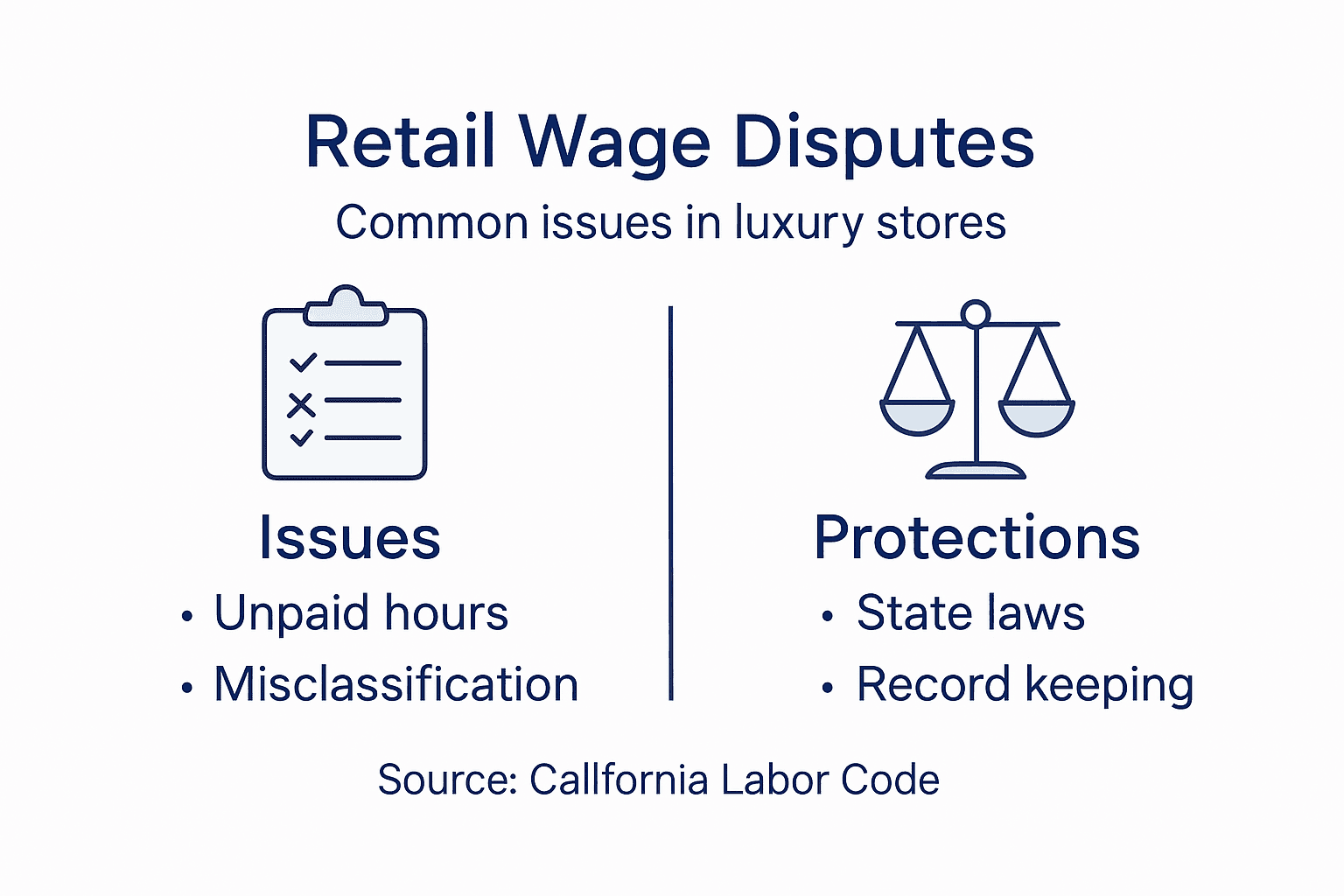
Luxury brand associates often work irregular schedules with peak hours during holidays and special events. This unpredictability can lead to untracked off-the-clock time. You might spend 30 minutes before your shift setting up displays, or an hour after closing handling client follow-ups—but if it’s not on the clock, it’s not being paid.
Here’s how luxury retail wage disputes differ from violations in mainstream retail settings:
| Aspect | Luxury Retail Stores | Mainstream Retail Stores |
|---|---|---|
| Pay Structure | Base wage plus commission | Hourly wage, occasional bonuses |
| Off-the-clock Work | Frequent client outreach and styling | Rare, mainly inventory prep |
| Documentation | Written commission agreements required | Simple payroll records suffice |
| Shift Scheduling | Irregular, event-driven hours | Steady, regular scheduling |
| Minimum Wage Issues | Complex due to commission variability | Typically clear due to fixed rate |
| Wage Disputes | High-value, frequent disputes | Lower-value, less frequent disputes |
If you’re not being compensated for work you performed, that’s a wage violation—regardless of the luxury retail environment or the prestige of the brand.
Commission agreements must be in writing under California law. Without documentation, disputes arise about what was promised versus what was actually paid. Some employers retroactively adjust commissions due to returns or chargebacks, cutting your earnings weeks or months after the sale.
Multiple pay periods can also create confusion. If you earned commission in one pay period but it was paid in the next, or if you received an advance that was deducted from future commissions, you need clarity on whether these practices comply with California wage law.
Pro tip: Keep detailed personal records of all hours worked, client contacts made outside scheduled shifts, and commission-earning sales, including dates and amounts. If your paychecks don’t match your records, you have documentation to support a wage dispute claim.
Common Violations in Stores Like Gucci and LV
Luxury brands maintain pristine brand images on the sales floor, but behind the scenes, wage violations are common. High-end retailers operate on thin profit margins despite their premium pricing, creating pressure to cut labor costs. This pressure often translates into practices that violate California wage and hour law.

Gucci and Louis Vuitton stores in Beverly Hills frequently encounter similar violation patterns. These aren’t accidental oversights—they’re systemic problems built into how luxury retail operates.
Off-the-clock client services represent the most widespread violation. Associates contact clients before scheduled shifts to discuss new collections, confirm appointments, or handle returns. You’re not clocked in, but you’re working. Some stores expect this as part of the job, without compensation.
Violations commonly seen in luxury retail include:
- Pre-shift and post-shift unpaid work like opening displays, preparing styling notes, or handling customer inquiries
- Commission calculations that don’t meet minimum wage when hourly rate plus commission falls below California’s minimum wage threshold
- Misclassification of employees as independent contractors to avoid overtime and benefit obligations
- Retroactive commission adjustments where sales credited weeks earlier are reversed due to returns, cutting your final paycheck
- Inadequate meal and rest breaks during busy sales periods or special events
- Withheld commissions under vague policies about “performance standards” or “clawback clauses”
Styling and consultation time is another gray area. You might spend 45 minutes with a client reviewing options, trying on items, and providing personalized recommendations. If that time isn’t fully compensated or if it’s treated as non-billable, that’s a violation.
Luxury retailers also use commission structures to minimize wage obligations, banking on employees not understanding their rights. A commission-heavy structure can legally replace base wages only if total earnings meet or exceed minimum wage for all hours worked.
Special events create additional violations. Holiday sales, private shopping events, or inventory counts might require extended hours without overtime pay. Employees are sometimes told these are “special circumstances” exempt from overtime rules—they’re not.
Luxury retailers bet on employee silence. They assume you won’t question violations because you value the prestige of working for an elite brand.
Inventory mismanagement also leads to wage disputes. If merchandise is missing, some stores deduct the cost from employee paychecks. California law strictly prohibits this practice, but it happens regularly in high-theft environments like luxury retail.
Many associates don’t track their actual hours because the schedule seems flexible or because they’re focused on making sales. That’s exactly what employers count on—without documentation, violations are harder to prove.
Pro tip: Photograph or screenshot your work schedule, timeclock records, and any messages requesting work outside scheduled hours. Save commission statements, paystubs, and any written policies about commission calculations or deductions. Digital documentation is essential if you need to challenge violations.
California Laws Protecting Retail Employees
California employment law is among the strongest in the nation, and it exists specifically to protect workers like you. These laws don’t have exceptions for luxury brands or high-end retail—they apply equally to every employer, regardless of prestige or profitability.
Understanding your rights under California law is your first line of defense against wage violations. The state has enacted comprehensive protections that go far beyond federal minimums, and enforcement agencies actively pursue violations in retail environments.
Minimum wage protections are non-negotiable. California’s minimum wage increases annually, and in 2024, it reached historic highs. For retail employees in Beverly Hills, this means your base wage—before commissions or tips—must meet or exceed the state minimum. If your total compensation falls short, that’s a violation, period.
Your core protections include:
Here is a quick overview of the core California protections for retail employees:
| Protection Type | Legal Requirement | Impact for Employees |
|---|---|---|
| Minimum Wage | State-set, updated annually | Ensures fair base compensation |
| Overtime Pay | 1.5x rate for excess hours | Protects against overwork |
| Itemized Wage Statements | Must include all details | Enables transparency |
| Written Commission Agreement | Mandatory for commission pay | Clarifies payment terms |
| Anti-Retaliation Safeguards | Cannot punish for complaints | Secures rights to speak up |
| No Wage Deductions | Forbidden for merchandise loss | Shields take-home pay |
- Paid minimum wage for all hours worked, including off-the-clock time
- Overtime pay at 1.5 times your regular rate for hours beyond 8 per day or 40 per week
- Meal and rest breaks with uninterrupted, uncompensated time away from work
- Itemized wage statements showing all deductions, hours worked, and rates paid
- Protection from retaliation if you report violations or ask about wages
- No wage deductions for merchandise loss, shortages, or damage
California labor laws enforce fair wages and protect workers from retaliation when raising concerns about pay or conditions. You can ask your manager about compensation without fear of being fired, demoted, or punished.
The Division of Labor Standards Enforcement (DLSE) is the agency responsible for investigating wage violations. They handle complaints about unpaid wages, misclassified employees, commission disputes, and break violations. If you file a complaint, the DLSE will investigate at no cost to you.
Commission employees have specific protections that many luxury retailers ignore. Your commission agreement must be in writing. Employers cannot unilaterally change commission structures without notice, and they cannot use retroactive clawbacks or deductions to reduce your final payout without clear written authorization.
California law assumes employers will violate wage rules—that’s why penalties are stiff and enforcement is aggressive.
Misclassification is particularly common in retail. Some stores label associates as “independent contractors” or “exempt managers” to avoid overtime obligations. California has strict tests for these classifications, and if you don’t meet them, you’re entitled to overtime pay and employee benefits regardless of your job title.
You also have protection against wage theft through California’s strict liability standards. Employers are responsible for wage violations even if they claim it was a mistake or a rogue manager’s decision. The company as a whole is liable.
One powerful protection is the statute of limitations. In most cases, you can recover unpaid wages going back three years. If an employer intentionally withheld wages, you can go back four years. This means violations from years ago aren’t necessarily beyond reach.
Pro tip: Request a copy of your written commission agreement in writing (via email), and ask HR for a wage statement breakdown showing how your pay was calculated for the last three pay periods. If they refuse or cannot provide these documents, that’s itself evidence of a violation.
Employee Rights and Employer Obligations
Employer obligations exist because employee rights matter. California law doesn’t ask employers to “consider” following rules—it demands compliance. Understanding what your employer must do legally is just as important as knowing your own rights.
Your employer has specific, non-negotiable duties to you as a retail employee. These aren’t suggestions or best practices—they’re legal requirements enforced by state agencies and civil courts.
Payment obligations are fundamental. Your employer must pay you for all hours worked, including time before the store opens, after it closes, or during unpaid breaks when you’re handling work tasks. They must pay on time according to California’s pay schedules. They cannot withhold wages as discipline, and they cannot require you to repay shortages or damages through wage deductions.
Your employer must also:
- Provide accurate wage statements showing hours worked, rate of pay, deductions, and gross earnings for each pay period
- Honor commission agreements as written and calculate commissions accurately and timely
- Maintain timekeeping records documenting all hours you worked
- Ensure proper break periods with uninterrupted time away from work duties
- Classify employees correctly based on actual job duties, not arbitrary titles
- Post labor law notices informing you of your rights and how to file complaints
Employers must provide workplace rights protections including non-retaliation safeguards when you ask about wages or report violations. You cannot be fired, demoted, or punished for exercising your legal rights.
Your employer is responsible for preventing wage theft, even if a manager acts alone. The company as a whole is liable for violations. This is strict liability—intent doesn’t matter. If wages are unpaid, the employer pays damages regardless of excuses.
Commission structures create specific employer obligations. If your pay relies on commission, the employer must provide a written agreement explaining how commissions are calculated, when they’re paid, and what happens if a sale is reversed. They cannot retroactively change these terms without your consent.
Employers often gamble that employees won’t know the law or won’t pursue violations. Your knowledge of these obligations makes them accountable.
Misclassification exposes employers to serious liability. If you’re labeled “exempt” or “independent contractor” but your actual duties don’t match those classifications, your employer violates wage and hour law. The label matters far less than what you actually do.
Retention of records is also required. Your employer must keep payroll records, timesheets, and communication about wages for at least three years. If records are missing or “lost,” courts often presume the employer violated your rights.
Pro tip: Request a written copy of your job description, commission agreement, and the official wage and hour posting notice required by California law. If your employer cannot or will not provide these documents, that’s documentary evidence of non-compliance worth noting.
How to Address Unpaid Wages or Retaliation
Discovering unpaid wages or facing retaliation feels personal, but it’s a legal issue with clear remedies. You have options, and you’re not alone—many luxury retail employees in Beverly Hills have successfully pursued claims. The key is acting strategically and documenting everything.
Don’t ignore the problem hoping it resolves itself. Wage violations and retaliation typically escalate when employees stay silent. Taking action protects you and forces accountability.
Start with documentation immediately. Compile all evidence of unpaid work, missed commissions, or retaliatory treatment. This includes timesheets, emails, text messages from managers, screenshots of schedules, commission statements, paystubs, and witness names. Create a timeline showing when violations occurred and how you were affected.
Your action steps should include:
- Request written clarification from HR about wage calculations, commission structures, or policy changes via email
- Send a formal wage inquiry in writing, asking for detailed explanations of any discrepancies
- Document all adverse actions like schedule changes, reduced hours, negative performance reviews, or exclusion from shifts after reporting issues
- Report to the California Labor Commissioner by filing a wage claim or retaliation complaint
- Consult with an employment attorney before escalating further
When you suspect retaliation, file retaliation complaints with the California Labor Commissioner within one year of the adverse action. Retaliation includes firing, demotion, schedule reduction, negative performance reviews, or any punishment for exercising your rights.
The Labor Commissioner’s office investigates wage claims at no cost to you. You don’t need a lawyer to file, though representation strengthens your case. The investigation process is straightforward—you submit a complaint, the agency investigates, and they attempt to recover unpaid wages.
Don’t resign out of frustration or fear. Quitting can complicate claims, though constructive dismissal may still apply if conditions become intolerable due to violations. Staying employed (or documenting the hostile environment if you leave) strengthens your position.
Filing a complaint isn’t retaliation—it’s exercising your legal right. If your employer punishes you afterward, that’s a separate violation worth pursuing.
Preserve all communication with your employer. Don’t delete emails, texts, or messages even if they’re upsetting. These are evidence. Forward important messages to your personal email immediately as backup.
If you experience intimidation or threats after reporting violations, document those too. Coercion related to wage claims is itself illegal and grounds for additional damages.
Pro tip: Before filing any complaint, consult with an employment attorney who works on contingency or initial consultation—you won’t pay unless you recover money. They can evaluate your claim’s strength and advise whether to pursue administrative remedies first or move directly to litigation.
Protect Your Rights in Beverly Hills Luxury Retail Wage Disputes
Working in Beverly Hills luxury retail means navigating complex wage and hour challenges including commission disputes, off-the-clock work, and overtime misclassification. If you are not being paid for every minute of your labor or facing unlawful deductions and retaliation, you deserve strong legal support that understands the unique pressures of high-end brands.
At Shirazi Law Office, we specialize in helping employees like you assert your rights against unlawful wage practices. Whether you face unpaid commissions, misclassification, or withheld overtime, we protect your interests with strategic legal representation tailored for the Beverly Hills community. Visit our Beverly Hills page to learn more about your local rights. Do not let wage violations go unchallenged. Take action now by contacting Shirazi Law Office through our main website https://www.shirazilawoffice.com/ and secure the compensation and workplace respect you deserve.
Frequently Asked Questions
What are common wage and hour disputes in luxury retail?
Common disputes include off-the-clock work, overtime misclassification, meal and rest break violations, commission disputes, and failures to meet minimum wage requirements.
How can I track off-the-clock work in luxury retail?
Keep detailed personal records of all hours worked, including time spent contacting clients or handling tasks outside scheduled shifts. This documentation is crucial in case of a wage dispute.
What protections do I have under California law regarding my wages?
California law mandates minimum wage protections, overtime pay, itemized wage statements, written commission agreements, and safeguards against retaliation for reporting violations.
What should I do if I suspect wage theft or retaliation in luxury retail?
Start by documenting all evidence of unpaid wages or retaliatory actions. You can request clarifications from HR, file a complaint with the California Labor Commissioner, and consult with an employment attorney for guidance.