

Standing up for your health should not cost you your career. Yet many employees in the Fairfax District of Los Angeles find themselves penalized after requesting medical leave, especially in creative industries like entertainment and retail. Retaliation after medical leave can appear as sudden demotions, reduced hours, exclusion from projects, or even a hostile work environment. Understanding your rights and recognizing subtle signs can help protect your well-being and professional future.
Table of Contents
- What Constitutes Retaliation After Medical Leave
- Common Forms of Employer Retaliation
- Legal Protections for Fairfax District Employees
- How to Prove Unlawful Retaliation
- Employee Rights and Remedies Available
Key Takeaways
| Point | Details |
|---|---|
| Retaliation Prohibition | Employers are legally barred from retaliating against employees for taking medically protected leave, as outlined by the Family and Medical Leave Act (FMLA). |
| Understanding Retaliation | Retaliation can manifest through various subtle and overt actions, including termination, demotion, and workplace hostility. |
| Documentation Importance | Employees should meticulously document all workplace interactions and communications after medical leave to support potential claims of retaliation. |
| Legal Remedies Available | Affected employees have options such as financial compensation, reinstatement, and administrative remedies to address workplace retaliation. |
What Constitutes Retaliation After Medical Leave
Retaliation after medical leave represents a serious violation of employee rights in the Fairfax District and throughout Los Angeles. When an employee takes legally protected medical leave, employers are prohibited from taking adverse actions that penalize the worker for exercising their fundamental workplace protections.
Under federal law, retaliation occurs when an employer responds to an employee’s medical leave with actions designed to punish or discourage the use of legally protected time off. Workplace retaliation can manifest through various discriminatory behaviors that negatively impact an employee’s professional standing and career trajectory.
Specific examples of retaliation after medical leave include:
- Unexplained termination shortly after returning from medical absence
- Sudden demotion or reduction in job responsibilities
- Significant reduction in work hours or compensation
- Systematic exclusion from professional opportunities
- Creating a hostile work environment to force resignation
The legal threshold for proving retaliation requires demonstrating a direct connection between the medical leave and the subsequent adverse employment action. Employers cannot legally punish employees for utilizing protections under the Family and Medical Leave Act (FMLA).
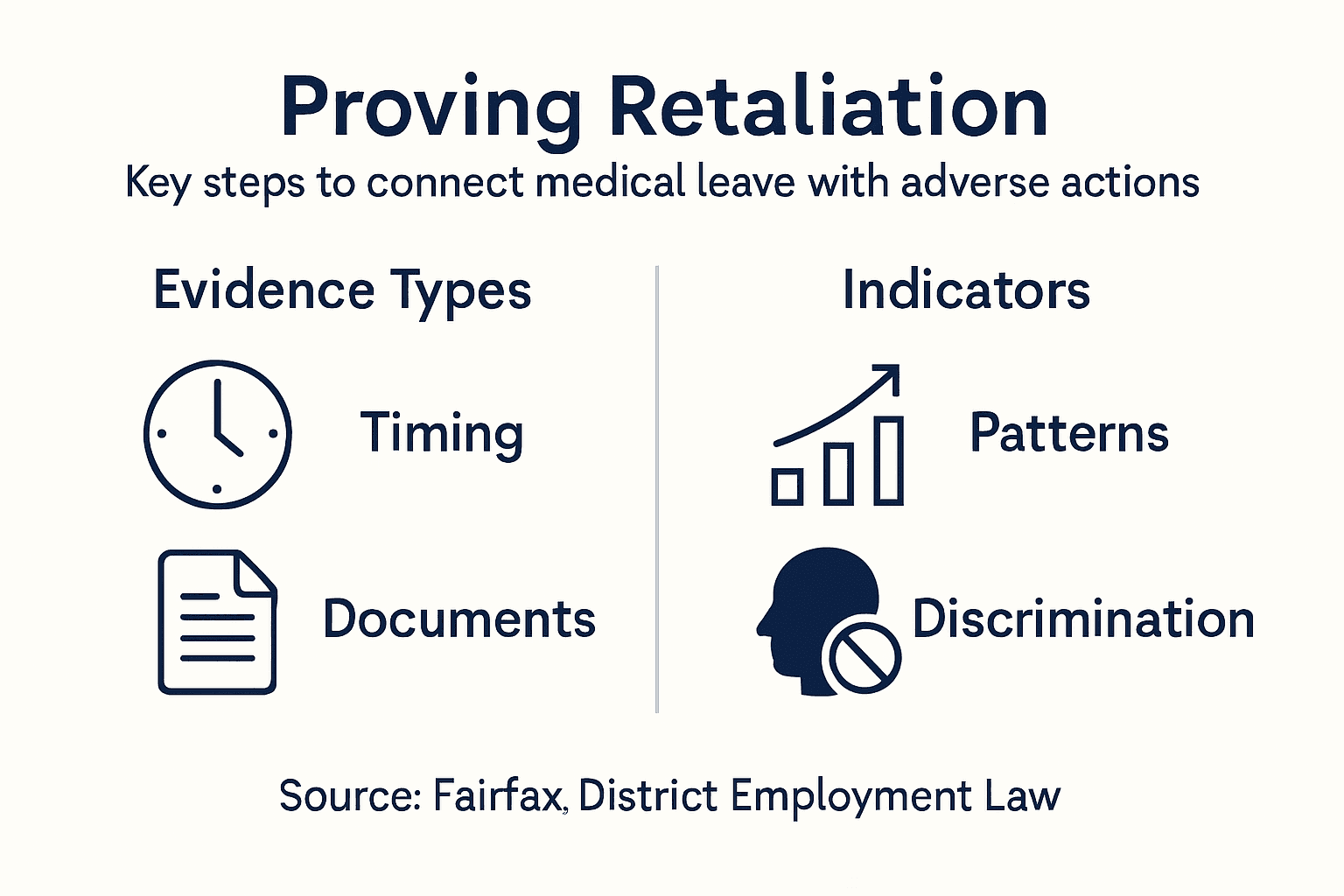
Crucial indicators of potential retaliation involve timing, documented evidence, and a clear pattern of discriminatory behavior. Employees should carefully document all interactions, performance reviews, and communications surrounding their medical leave and return to work.
Here’s a quick comparison of retaliation types and possible supporting evidence:
| Retaliation Type | Typical Employer Behavior | Potential Evidence |
|---|---|---|
| Termination | Fired soon after return | Dated termination letter, email trail |
| Demotion | Job duties downgraded | Updated job description, HR memos |
| Pay/Hours Reduction | Fewer hours, less pay | Payroll records, work schedules |
| Missed Opportunities | Excluded from projects | Meeting invites, correspondence |
| Hostile Work Environment | Targeted negative treatment | Colleague statements, formal complaints |
Retaliation is not just about dramatic actions like firing – it can be subtle workplace behaviors designed to marginalize an employee who has taken medical leave.
Pro tip: Keep a detailed, dated record of all workplace interactions and communications after returning from medical leave, as this documentation can be critical evidence if retaliation occurs.
Common Forms of Employer Retaliation
Employers in the Fairfax District may attempt to disguise retaliation through subtle and complex workplace actions that undermine an employee’s professional standing after medical leave. Employer retaliation tactics often involve strategic maneuvers designed to marginalize workers who have exercised their legally protected medical leave rights.
The most prevalent forms of workplace retaliation can be categorized into several distinct strategies:
-
Punitive performance management
- Sudden, unwarranted negative performance reviews
- Implementing unrealistic work expectations
- Creating impossible performance metrics
-
Compensation and opportunity manipulation
- Reducing work hours without justification
- Cutting pay or eliminating potential bonuses
- Blocking promotion opportunities
-
Psychological workplace harassment
- Intentional social isolation from team members
- Creating a hostile work environment
- Systematic exclusion from important meetings or projects
Employers may strategically use these tactics to create an environment that pressures employees into voluntarily resigning, thereby avoiding direct termination and potential legal consequences. The goal is often to make the workplace so uncomfortable that the employee feels compelled to leave.
Retaliation isn’t always obvious – it can be a calculated, gradual process of professional undermining designed to break an employee’s spirit and career trajectory.
Documentation becomes crucial in these scenarios. Employees must meticulously record every interaction, performance review, communication, and potential instance of discriminatory behavior to build a comprehensive evidence trail.
Pro tip: Maintain a contemporaneous, dated log of all workplace interactions and potential retaliatory actions, including screenshots, emails, and witness contact information to support potential future legal claims.
Legal Protections for Fairfax District Employees
Employees in the Fairfax District have robust legal safeguards designed to protect them from workplace retaliation after taking medical leave. Local human rights protections ensure that workers can exercise their legal rights without fear of professional repercussions.
The legal framework protecting employees encompasses multiple levels of defense:
-
Federal Level Protections
- Family and Medical Leave Act (FMLA)
- Americans with Disabilities Act (ADA)
- Civil Rights Act workplace discrimination provisions
-
County-Level Protections
- Fairfax County Human Rights ordinances
- Local anti-discrimination regulations
- Independent complaint investigation processes
-
Key Legal Safeguards
- Protection against termination
- Defense against salary reduction
- Prevention of career advancement blockades
- Prohibition of hostile work environment creation
Employers who violate these protections can face significant legal consequences, including financial penalties, mandated reinstatement, and potential civil litigation. The burden of proof typically rests on demonstrating that adverse actions were directly linked to an employee’s medical leave.
Legal protections are not just theoretical concepts – they are concrete shields designed to preserve an employee’s professional dignity and right to necessary medical care.
Documentation becomes critical in substantiating potential retaliation claims. Employees should maintain comprehensive records of all workplace interactions, medical documentation, and any communications related to their leave.
Pro tip: Consult an employment attorney immediately if you suspect workplace retaliation, as timely legal intervention can preserve crucial evidence and protect your professional rights.
How to Prove Unlawful Retaliation
Proving workplace retaliation requires a strategic and methodical approach that systematically documents and connects adverse employment actions to an employee’s protected medical leave. Establishing FMLA retaliation claims demands careful collection of compelling evidence demonstrating a clear causal relationship between medical leave and professional consequences.
The most critical elements for constructing a robust retaliation case include:
-
Temporal Evidence
- Precise timeline of medical leave
- Date of adverse employment action
- Demonstrating close proximity between leave and retaliation
-
Documentary Evidence
- Performance reviews before and after medical leave
- Email communications
- Written warnings or disciplinary notices
- Medical documentation
-
Comparative Evidence
- Treatment of other employees who took medical leave
- Historical workplace behavior patterns
- Inconsistent employer explanations
Crucial indicators of potential retaliation involve examining whether the employer’s actions deviate from standard workplace practices, demonstrate a pattern of discriminatory behavior, or appear designed to punish the employee for exercising legally protected rights.
Retaliation cases are rarely straightforward – they require meticulous documentation and a strategic approach to connecting circumstantial evidence.
Employees must build a comprehensive narrative that demonstrates how their medical leave directly triggered subsequent adverse employment actions. This involves gathering not just individual incidents, but a holistic view of workplace interactions and professional treatment.

Pro tip: Maintain a detailed, contemporaneous log of all workplace interactions, including dates, participants, and specific details, which can serve as critical evidence in potential legal proceedings.
Employee Rights and Remedies Available
Employees in the Fairfax District who experience workplace retaliation after medical leave have multiple legal avenues to protect their professional rights and seek comprehensive compensation. Retaliation remedies provide employees with robust mechanisms to challenge and address discriminatory workplace actions.
The spectrum of available legal remedies encompasses several critical components:
-
Financial Compensation
- Back pay restoration
- Front pay for future lost earnings
- Liquidated damages
- Compensation for emotional distress
-
Professional Reinstatement
- Restoration to original position
- Equivalent job placement
- Removal of negative employment records
- Preservation of professional reputation
-
Administrative Remedies
- Filing complaints with Department of Labor
- Initiating workplace investigations
- Pursuing administrative hearings
- Compelling employer corrective actions
Employees must understand that these remedies are not automatic and require strategic documentation, precise legal arguments, and often expert legal representation to successfully navigate complex employment discrimination claims.
This summary shows legal remedies and their impact for affected employees:
| Remedy Type | What It Provides | How It Benefits Employees |
|---|---|---|
| Back Pay | Restores lost earnings | Offsets income lost to retaliation |
| Reinstatement | Position or job restoration | Reclaims career progression |
| Emotional Damages | Compensation for distress | Acknowledges non-financial harm |
| Employer Penalties | Fines and corrective action | Discourages future violations |
| Clean Record | Clears adverse documentation | Protects professional reputation |
Legal remedies are not just about financial compensation – they represent a fundamental mechanism for restoring professional dignity and challenging systemic workplace injustices.
The burden of proof remains with the employee, necessitating comprehensive evidence collection that demonstrates a direct link between medical leave and subsequent retaliatory actions. This requires meticulous documentation and potentially expert witness testimony.
Pro tip: Consult an employment attorney immediately after experiencing potential retaliation to preserve critical evidence and understand the full range of legal remedies available in your specific case.
Protect Your Rights Against Retaliation After Medical Leave
Facing retaliation after medical leave can feel overwhelming and unfair. If you have experienced termination, demotion, reduction in hours, or exclusion from important workplace opportunities after taking legally protected medical leave, you are not alone. The challenge is proving this retaliation and defending your professional dignity under powerful laws like the Family and Medical Leave Act. The Shirazi Law Office specializes in helping Fairfax District employees combat workplace retaliation and disability discrimination to regain control of their careers and secure the justice they deserve.
Do not let subtle or overt retaliation damage your livelihood or emotional well-being. Connect with experts who understand California employment protections and can build a strong case based on detailed documentation and legal strategy. Learn more about your rights and how we advocate for employees at Workplace Retaliation – Law Office of Brian Y. Shirazi, PC. If you need focused help in your community, explore our dedicated services for the Fairfax District – Law Office of Brian Y. Shirazi, PC. Take immediate action to protect your future by reaching out today at Shirazi Law Office. Your career and well-being should never be compromised for using your rightful medical leave.
Frequently Asked Questions
What constitutes retaliation after medical leave?
Retaliation occurs when an employer takes adverse action against an employee for exercising their rights to medical leave, such as termination, demotion, or creating a hostile work environment.
How can I prove that I faced retaliation after taking medical leave?
To prove retaliation, you must document evidence showing a direct link between your medical leave and the adverse employment action, such as timing, performance reviews, and comparative treatment of other employees.
What are my rights if I experience retaliation after medical leave?
Employees have legal protections under laws like the Family and Medical Leave Act (FMLA) and can seek remedies such as financial compensation, job reinstatement, and administrative actions against their employer.
What should I do if I suspect retaliation after medical leave?
If you suspect retaliation, document all incidents thoroughly and consult an employment attorney to explore your legal options and ensure your rights are protected.
Recommended
- Retaliation After Medical Leave: Protecting Your Career in Los Angeles
- Medical Leave and Disability Rights for Westwood Healthcare Workers – Law Office of Brian Y. Shirazi, PC
- Medical Leave and Disability Rights for LA Healthcare
- Pregnancy Discrimination in Fairfax Retail – Employee Rights and Legal Remedies – Law Office of Brian Y. Shirazi, PC
- Top Monrovia Workplace Retaliation Lawyers
- Retaliation in the Workplace: Your Rights and Legal Options in California – Los Angeles Employment Lawyers | California United Law Group, P.C.





[…] Retaliation After Medical Leave in Fairfax District – Law Office of Brian Y. Shirazi, PC […]
[…] Retaliation After Medical Leave in Fairfax District – Law Office of Brian Y. Shirazi, PC […]