

Losing a high-profile role in Beverly Hills can put your reputation and livelihood at risk overnight. Wrongful termination goes beyond unfair dismissal, triggering legal consequences when your departure violates anti-discrimination laws, whistleblower protections, or breaches critical contract terms. For executives, understanding employment law safeguards is essential to defending your professional standing and pursuing compensation when facing unlawful termination.
Table of Contents
- Defining Wrongful Termination For Executives
- Types Of Executive-Level Wrongful Termination
- California Legal Protections For Executives
- Executive Contracts And Termination Clauses
- Key Risks And Reputational Consequences
- What To Do After Wrongful Termination
Key Takeaways
| Point | Details |
|---|---|
| Understanding Wrongful Termination | Executives are protected from unlawful dismissal under specific legal standards that differ from general employee protections. |
| Types of Wrongful Termination | Discriminatory actions and retaliatory terminations are common scenarios faced by executives. |
| California Legal Protections | California law offers robust protections, including anti-discrimination statutes and whistleblower protections for executives. |
| Post-Termination Action Steps | Executives should preserve documentation and seek legal consultation immediately following wrongful termination. |
Defining wrongful termination for executives
Wrongful termination represents a critical legal concept that protects executives from unlawful dismissal in the complex landscape of employment law. Unlike standard employee protections, executive termination cases involve nuanced legal standards that require sophisticated understanding of workplace rights.
According to employment law guidelines, wrongful termination occurs when an employer fires an executive for reasons that violate public policy, anti-discrimination statutes, or contractual agreements. Wrongful termination involves illegal dismissal that transgresses established legal protections designed to safeguard professional dignity and career trajectory.
Executives can face wrongful termination through several distinct scenarios:
- Discrimination based on age, gender, race, or protected characteristics
- Retaliation for reporting unethical or illegal corporate practices
- Violation of explicit employment contract terms
- Termination that contradicts established company policies
- Dismissal resulting from whistleblowing activities
The legal landscape for executive termination is particularly complex in Beverly Hills, where high-stakes professional environments demand meticulous adherence to employment regulations. Proving wrongful termination requires substantive evidence such as documented communications, witness testimonies, and comprehensive records demonstrating unlawful motivations behind the dismissal.
Potential damages for executives successfully proving wrongful termination might include:
- Lost wages and compensation
- Unpaid benefits
- Emotional distress compensation
- Attorney fees
- Potential punitive damages
Pro tip: Maintain comprehensive documentation of all workplace interactions, performance reviews, and communication with employers to strengthen potential wrongful termination claims.
Types of executive-level wrongful termination
Executive-level wrongful termination encompasses a complex range of scenarios that extend far beyond standard employment disputes. In Beverly Hills’ high-stakes professional environment, wrongful termination involves multiple legal nuances that can significantly impact an executive’s career trajectory and professional reputation.
The most common types of executive-level wrongful termination include:
- Discriminatory termination based on protected characteristics
- Retaliation for whistleblowing or reporting unethical practices
- Violation of explicit employment contract terms
- Termination contradicting established company policies
- Dismissal resulting from an executive’s refusal to engage in illegal activities
Discriminatory termination represents a particularly critical subset of wrongful dismissal. This occurs when an executive is fired due to characteristics such as age, gender, race, national origin, disability status, or other legally protected classifications. Employment protections in Beverly Hills are robust, ensuring that executives cannot be dismissed based on these inherently discriminatory motivations.
Retaliation-based terminations are another significant category of executive dismissals. These scenarios emerge when an executive is fired for:
- Reporting corporate misconduct
- Refusing to participate in illegal activities
- Challenging unethical workplace practices
- Filing internal complaints about harassment
- Cooperating with regulatory investigations
Pro tip: Maintain a contemporaneous, detailed record of all workplace interactions, communications, and potential instances of discrimination or misconduct to strengthen your potential legal claim.
California legal protections for executives
California provides robust legal safeguards specifically designed to protect executives from unjust workplace treatment. Legal protections for workers extend beyond standard employment rules, creating a comprehensive framework that shields executives from discriminatory or retaliatory actions in high-stakes professional environments.
The primary legal protections for executives in California include:
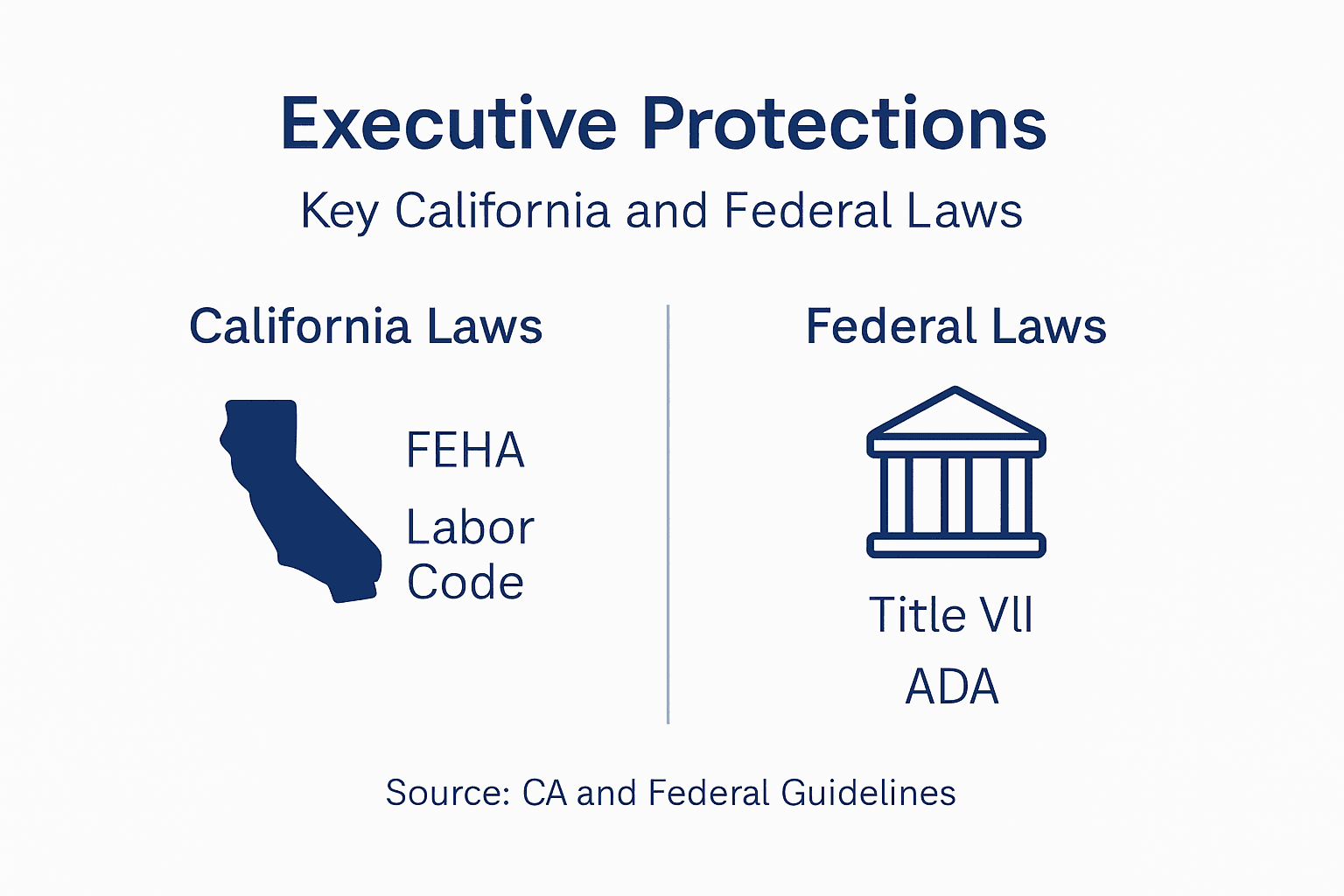
- Statutory protections under the California Fair Employment and Housing Act (FEHA)
- Whistleblower protection laws
- Contract breach prevention mechanisms
- Anti-discrimination statutes
- Retaliation defense regulations
The California Fair Employment and Housing Act (FEHA) represents the cornerstone of executive employment protection. This comprehensive legislation prohibits discrimination based on protected characteristics and provides executives with powerful legal recourse when facing unfair workplace treatment. Employment rights in Beverly Hills and across California are particularly strong, offering multifaceted protections that go well beyond federal standards.
Executives have specific legal protections through multiple channels:
- Protection against age discrimination
- Defense against gender-based workplace actions
- Safeguards for racial and ethnic minorities
- Disability accommodation requirements
- Sexual orientation and gender identity protections
Pro tip: Consult with an employment law specialist immediately if you suspect your termination might violate California’s comprehensive legal protections.
Here’s how executive legal protections compare between California and federal law:
| Protection Area | California (FEHA, etc.) | Federal Law (Title VII, ADA, etc.) |
|---|---|---|
| Anti-Discrimination Scope | Covers more protected classes | Covers fewer classifications |
| Whistleblower Rights | Broader and more protective | More limited scope |
| Retaliation Safeguards | Extensive remedies available | Basic protection, narrower remedies |
| Contract Enforcement | Strong state-level mechanisms | Varies by jurisdiction |
| Damages/Penalties | Allows punitive damages, fees | Punitive damages, but stricter limits |
Executive contracts and termination clauses
Executive employment contracts represent complex legal documents that define the intricate relationship between high-level professionals and their organizations. Contract termination regulations provide critical protections for executives navigating potential workplace disputes in Beverly Hills and across California.
Key elements of executive contracts typically include:
- Comprehensive compensation structures
- Detailed performance expectations
- Severance provisions
- Confidentiality requirements
- Non-compete clauses
- Termination conditions
Termination clauses in executive contracts are particularly nuanced, outlining specific circumstances under which an employer can legally end the professional relationship. Contractual safeguards protect executives from arbitrary dismissal, ensuring that termination can only occur under well-defined conditions such as documented performance issues, significant misconduct, or fundamental business restructuring.
Executive contracts often specify multiple termination scenarios:
- Termination with cause
- Termination without cause
- Constructive termination
- Mutual agreement termination
- Performance-based termination
Pro tip: Always have an experienced employment law attorney carefully review your executive contract before signing, paying special attention to termination and severance provisions.

Below is a reference table outlining typical executive contract clauses and their business significance:
| Contract Clause | Business Purpose | Risk if Omitted |
|---|---|---|
| Severance Provision | Ensures financial security after exit | Unclear post-termination terms |
| Non-Compete Clause | Protects proprietary interests | Potential competitive exposure |
| Termination Clause | Defines lawful ending of contract | Ambiguity over dismissal rights |
| Confidentiality | Safeguards sensitive company data | Risk of information leakage |
Key risks and reputational consequences
Executive wrongful termination disputes carry profound implications that extend far beyond immediate legal outcomes. Corporate governance risks can devastate professional reputations, potentially undermining years of carefully constructed professional credibility in Beverly Hills’ competitive executive landscape.
The primary reputational risks for executives facing wrongful termination include:
- Permanent damage to professional network connections
- Potential blacklisting within industry circles
- Negative references from previous employers
- Challenges securing future high-level positions
- Public perception of professional instability
Reputation management becomes critically important during wrongful termination scenarios. The professional consequences can cascade rapidly, potentially limiting future career opportunities and creating long-term challenges in maintaining executive-level employment. Each public interaction, legal filing, and professional communication becomes a strategic element in preserving one’s professional standing.
Specific reputational risks can manifest through multiple channels:
- Professional networking platform perceptions
- Industry-specific reputation databases
- Executive search firm communications
- Peer and colleague perspectives
- Online professional reputation management
Pro tip: Develop a strategic communication plan with legal counsel to manage professional narrative and minimize potential reputation damage during wrongful termination proceedings.
What to do after wrongful termination
Executives facing wrongful termination must act strategically and methodically to protect their professional interests and legal rights. Immediate documentation and legal consultation are critical steps in navigating the complex landscape of employment disputes in Beverly Hills’ competitive professional environment.
Immediate action steps following wrongful termination include:
- Preserve all employment-related documents
- Request a comprehensive copy of personnel files
- Document the circumstances of termination in writing
- Avoid signing any severance agreements hastily
- Collect potential witness contact information
Evidence collection becomes paramount in establishing a compelling wrongful termination case. Executives must meticulously gather and organize all relevant documentation, including performance reviews, email communications, employment contracts, and any records that might substantiate potential discrimination or illegal dismissal.
Formal administrative procedures require specific actions:
- File a complaint with the Equal Employment Opportunity Commission (EEOC)
- Document the precise timeline of events
- Obtain copies of all termination-related correspondence
- Consult with an employment law specialist
- Prepare a comprehensive narrative of the termination circumstances
Pro tip: Create a dedicated digital and physical file containing all employment-related documents, ensuring secure and organized preservation of potential evidence.
Protect Your Rights Against Wrongful Termination in Beverly Hills
Facing wrongful termination as an executive in Beverly Hills can be overwhelming and threaten your professional future. The challenges include discrimination, retaliation, and complex contract disputes that require specialized legal knowledge to navigate. If you are experiencing unfair treatment or unlawful dismissal, understanding your employment rights and protecting your reputation is critical.
The Wrongful Termination and Senior Management Representation teams at Shirazi Law Office are committed to providing strategic legal support tailored for executives and senior leaders. Do not wait until your career is irreversibly damaged. Visit Beverly Hills today and contact us at Shirazi Law Office for guidance on preserving your rights and recovering what you deserve.
Frequently Asked Questions
What constitutes wrongful termination for executives?
Wrongful termination occurs when an executive is fired for reasons that violate public policy, anti-discrimination laws, or the terms of their employment contract.
What are common scenarios for wrongful termination of executives?
Common scenarios include discriminatory firing based on protected characteristics, retaliation for whistleblowing, violation of employment contract terms, and terminations contradicting company policies.
What legal protections do executives have against wrongful termination?
Executives are protected by California’s Fair Employment and Housing Act (FEHA), whistleblower laws, anti-discrimination statutes, and regulations against retaliation, ensuring their rights in the workplace.
What actions should an executive take after being wrongfully terminated?
Executives should document all employment-related communications, preserve records, consult with an employment law specialist, and consider filing a complaint with the EEOC to protect their legal rights.
Recommended
- Wrongful Termination Claims in Beverly Hills Luxury Jobs
- Wrongful Termination for Los Angeles Executives: Key Risks
- Wrongful Termination Risks in Beverly Hills Retail
- Wrongful Termination in LA | Employee Rights & Remedies
- Wrongful Termination in California: What You Need to Know – Los Angeles Employment Lawyers | California United Law Group, P.C.
- Wrongful Demotion California: You Need To Know This





Your authenticity shines through every single post you create for us here
You 🙏 consistently create content that builds better community and brings people together through shared experiences
[…] Read the article here. […]