

A single misstep in worker classification can lead to legal challenges that threaten both financial stability and business reputation for Downtown Los Angeles executives. Local companies face intense scrutiny under the strict California ABC Test, making it vital to understand the real differences between employees and independent contractors. This article offers guidance on critical legal protections, employer obligations, and the best strategies for resolving disputes efficiently and compliantly.
Table of Contents
- Defining Independent Contractor vs Employee Status
- California Laws and Downtown LA Classification Tests
- Worker Rights and Employer Obligations
- Risks, Liabilities, and Misclassification Consequences
- Dispute Resolution Options and Legal Strategies
Key Takeaways
| Point | Details |
|---|---|
| Understanding Worker Classification | Properly distinguishing between independent contractors and employees is crucial for compliance, impacting wages, taxes, and legal protections. |
| Adhering to California Laws | The ABC Test mandates that businesses prove independent contractor status to avoid penalties and legal repercussions. |
| Consequences of Misclassification | Misclassifying workers can result in hefty fines, back taxes, and legal exposure, making it vital to maintain accurate records. |
| Dispute Resolution Strategies | Businesses should explore mediation and negotiation to resolve classification disputes while preserving relationships and minimizing costs. |
Defining Independent Contractor vs Employee Status
Understanding the legal distinction between independent contractors and employees is critical for businesses and workers in Downtown Los Angeles. The U.S. Department of Labor’s economic reality test provides a comprehensive framework for determining worker classification, which has significant implications for wage, tax, and legal protections.
The classification hinges on several key factors that demonstrate the true nature of the working relationship. Workers are typically evaluated based on multiple economic and behavioral criteria:
- Degree of Control: How much direction does the employer provide over work performance?
- Financial Investment: Does the worker invest in their own tools and equipment?
- Opportunity for Profit/Loss: Can the worker negotiate rates and manage business expenses?
- Permanence of Relationship: Is the work engagement ongoing or project-based?
- Skill Level: Does the work require specialized skills or training?
The IRS utilizes common law rules to further refine these distinctions, focusing on three primary categories of evaluation: behavioral control, financial control, and the overall relationship between worker and business. Behavioral control examines the extent to which the business directs and supervises work processes, while financial control evaluates the worker’s economic independence.
In practical terms, an independent contractor typically operates more autonomously, provides services to multiple clients, sets their own schedules, and bears greater financial risk. Employees, conversely, are economically dependent on a single employer, receive consistent wages, and are subject to more direct supervision and performance management.
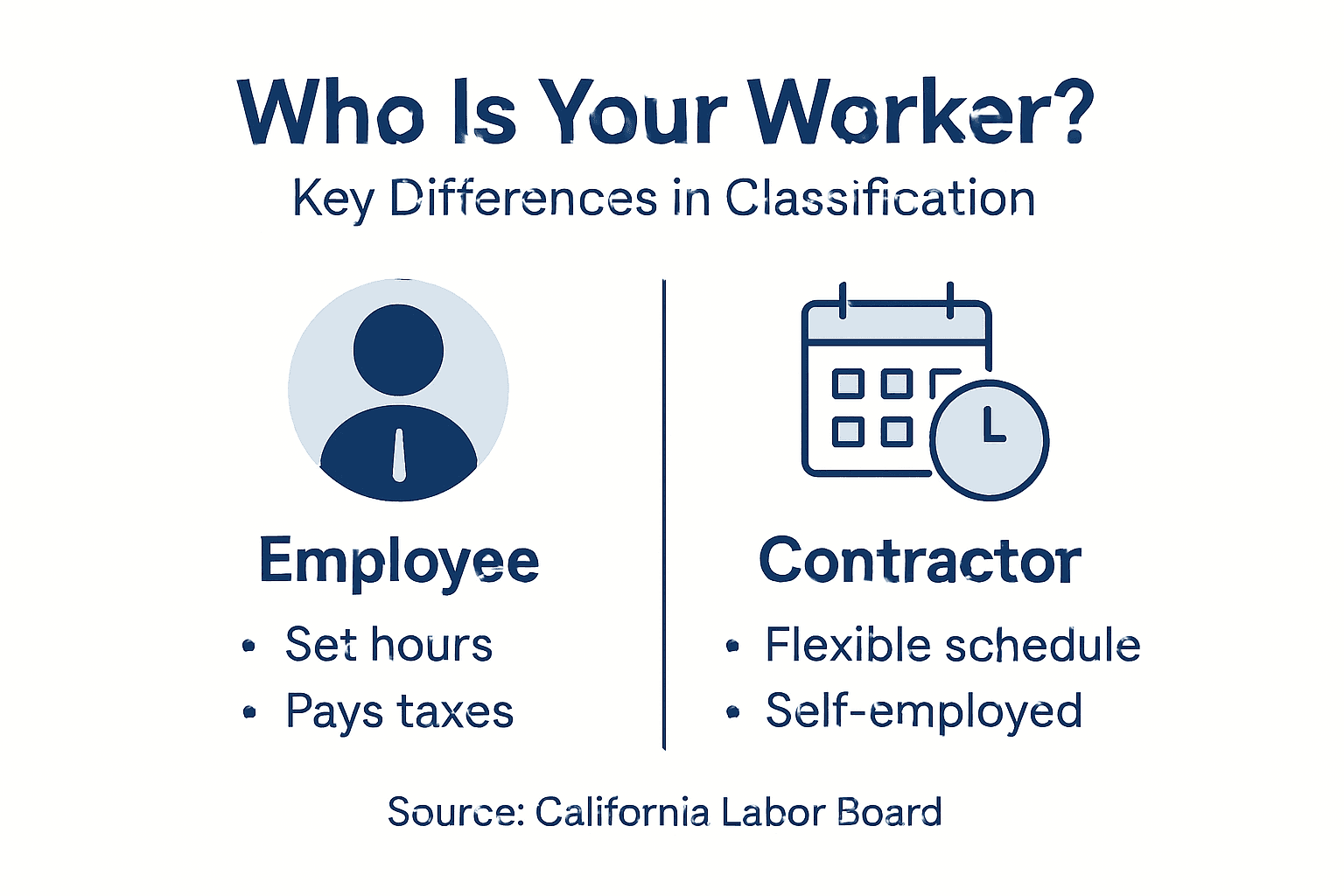
Here is a concise comparison of key differences between employees and independent contractors for Downtown Los Angeles businesses:
| Criterion | Employee | Independent Contractor |
|---|---|---|
| Work Control | Direct employer supervision | Autonomy over how work is done |
| Pay Structure | Regular wages or salary | Per project or invoice basis |
| Benefits Eligibility | Eligible for company benefits | Not eligible for benefits |
| Tax Responsibility | Employer withholds and pays taxes | Individual handles own taxes |
| Job Relationship | Long-term, ongoing | Short-term, project-based |
Pro tip: Consult with an employment law professional to accurately assess your specific worker classification and understand the potential legal and financial implications.
California Laws and Downtown LA Classification Tests
Downtown Los Angeles employers must navigate complex worker classification regulations, with the California Labor and Workforce Development Agency’s ABC Test serving as the primary framework for determining independent contractor status. This stringent test represents a significant shift in how businesses must evaluate worker relationships, replacing previous more ambiguous standards with a rigorous three-part evaluation.
The ABC Test establishes three critical conditions that must be simultaneously satisfied for a worker to be classified as an independent contractor:
- Freedom from Control: The worker must be free from the hiring entity’s direction and control
- Outside Business Operations: The work performed must be outside the usual course of the hiring entity’s business
- Independent Trade: The worker must be engaged in an independently established trade, occupation, or business
For Downtown LA businesses, this means carefully examining each working relationship through a multifaceted lens. Companies must demonstrate that contractors are truly independent professionals rather than de facto employees. The test creates significant challenges for industries like technology, creative services, and professional consulting, where traditional employment boundaries have historically been more fluid.
The implications of misclassification are substantial, with potential penalties including back taxes, wage violations, and legal consequences. Businesses must proactively audit their worker classifications, documenting clear evidence of independent contractor status and maintaining meticulous records that substantiate each working relationship’s unique characteristics.

Pro tip: Conduct a comprehensive internal audit of your worker classifications with the guidance of an employment law professional to ensure full compliance with California’s rigorous ABC Test standards.
Worker Rights and Employer Obligations
Employers in Downtown Los Angeles must carefully navigate the complex landscape of worker rights and legal obligations, understanding the critical distinctions between employee and independent contractor classifications. The stakes are high, with potential legal and financial consequences for misclassification that can significantly impact both workers and businesses.
California law establishes clear protections for workers, which vary dramatically based on classification status:
- Employee Rights: Minimum wage, overtime pay, workers’ compensation
- Employer Tax Responsibilities: Payroll tax withholding, social security contributions
- Benefit Entitlements: Health insurance, unemployment coverage, mandated rest breaks
- Legal Protections: Anti-discrimination and anti-retaliation safeguards
The nuanced distinctions in worker classification create substantial legal implications. California labor regulations mandate that employers provide comprehensive protections for traditional employees, including consistent wage standards, mandatory breaks, and comprehensive benefits. Independent contractors, by contrast, assume greater responsibility for their own tax obligations and lack many of these protective mechanisms.
Misclassification can result in severe penalties, including back wage payments, tax liabilities, and potential legal action. Employers must meticulously document worker relationships, ensuring that classification decisions are based on substantive work characteristics rather than administrative convenience. Downtown LA businesses must remain particularly vigilant, as California’s labor laws are among the most stringent in the United States.
Pro tip: Conduct regular internal audits of worker classifications and consult with an employment law specialist to ensure ongoing compliance with California’s complex labor regulations.
Risks, Liabilities, and Misclassification Consequences
Employers in Downtown Los Angeles face substantial legal and financial risks when incorrectly classifying workers, with California labor laws imposing severe penalties for willful misclassification that can devastate business operations and reputation.
The potential consequences of misclassification include multiple layers of financial and legal exposure:
- Monetary Penalties: Fines up to $25,000 per violation
- Retroactive Obligations: Unpaid wages, benefits, and payroll taxes
- Legal Exposure: Potential civil lawsuits and administrative actions
- Tax Liabilities: Cumulative back taxes with substantial interest charges
Downtown LA businesses must recognize that misclassification is not merely an administrative error but a significant legal vulnerability. Employers can be held responsible for retroactive compensation, including overtime, minimum wage violations, and missed benefit contributions. The financial impact extends beyond immediate penalties, potentially triggering comprehensive audits that can uncover additional compliance failures.
Critical legal risks emerge from systematic misclassification, which can trigger class action lawsuits, government investigations, and permanent reputational damage. Companies found deliberately misclassifying workers may face enhanced penalties, including potential criminal charges for intentional wage theft and systematic labor law violations.
Pro tip: Engage an employment law specialist to conduct a comprehensive worker classification audit before potential government investigations or employee complaints arise.
Dispute Resolution Options and Legal Strategies
Downtown Los Angeles businesses facing independent contractor classification disputes have multiple strategic pathways for resolution, with mediation offering a confidential alternative to traditional litigation that preserves professional relationships and minimizes financial exposure.
The primary dispute resolution strategies include:
- Negotiated Settlement: Direct discussions between parties to resolve classification issues
- Mediation: Confidential third-party facilitated negotiation
- Arbitration: Binding legal process with faster resolution than court litigation
- Administrative Hearing: Regulatory agency review of classification disputes
- Litigation: Formal court proceedings for complex unresolved conflicts
Legal strategies demand proactive approaches that anticipate potential classification challenges. California business compliance requires comprehensive agreements that clearly define worker relationships, documenting the specific conditions that demonstrate independent contractor status under the stringent ABC Test.
Each resolution strategy carries unique risks and benefits. Businesses must carefully evaluate their specific circumstances, considering factors like potential financial exposure, relationship preservation, and long-term legal implications. Skilled employment law counsel can provide tailored guidance, helping organizations navigate the complex landscape of worker classification disputes with minimal disruption.
For quick reference, here is a summary of common dispute resolution options and their typical business impact:
| Resolution Method | Speed of Outcome | Cost Impact | Relationship Preservation |
|---|---|---|---|
| Negotiated Settlement | Fast if parties agree | Minimal legal expenses | Often preserves goodwill |
| Mediation | Moderate | Shared third-party costs | Encourages cooperation |
| Arbitration | Faster than litigation | Moderately high | Less collaborative |
| Court Litigation | Slowest | Highest legal costs | Often damages relations |
Pro tip: Document every aspect of worker relationships meticulously and consult legal professionals before finalizing any classification or dispute resolution strategy.
Protect Your Worker Classification Rights in Downtown Los Angeles
Independent contractor versus employee disputes create serious challenges for both workers and employers in Downtown Los Angeles. Misclassification risks costly penalties, lost wages, and damaged professional reputations. If you face wage and hour inconsistencies, unclear job status, or wrongful termination concerns related to your classification, you need expert guidance that understands California’s strict ABC Test and labor laws.
At Shirazi Law Office we specialize in defending employees and executives against misclassification and workplace disputes. Our firm focuses on securing fair treatment and protecting your legal rights through strategic advocacy focused on employment law compliance. Learn more about how we help clients in strategies specific to Downtown Los Angeles and resolving complex wage and hour disputes and wrongful termination.
Do not wait until costly legal action or lost wages accumulate. Contact Shirazi Law Office today to schedule an evaluation of your worker classification status and receive guidance tailored to your unique situation.
Frequently Asked Questions
What is the main difference between an independent contractor and an employee?
The primary difference lies in control and independence. Independent contractors have more autonomy over how they perform their work, while employees are subject to employer control and supervision.
What are the legal implications of misclassifying workers?
Misclassifying workers can lead to severe penalties such as fines, unpaid wages, and tax liabilities, as well as potential legal action against the business.
How can businesses properly classify their workers?
Businesses can properly classify their workers by conducting thorough evaluations based on criteria such as control over work, financial investment, permanence of the relationship, and adherence to the ABC Test outlined in California’s labor regulations.
What are some dispute resolution options available for classification disputes?
Businesses can resolve classification disputes through methods like negotiated settlements, mediation, arbitration, or formal litigation, each with its unique risks and benefits.