

Facing professional retaliation after reporting misconduct disrupts more than just your daily routine—it threatens your reputation and future opportunities in Century City. California law provides broad protection against not only obvious actions like termination, but also subtle forms of professional isolation and harassment. This guide clarifies what qualifies as executive retaliation, highlights critical legal safeguards, and shares actionable steps to defend both your legal rights and your career trajectory.
Table of Contents
- What Constitutes Executive Retaliation In California
- Whistleblower Protections For Century City Executives
- Types Of Retaliatory Actions In The Workplace
- How California Law Governs Retaliation Claims
- Proving A Retaliation Case And Common Challenges
- Key Remedies And Steps For Protecting Your Rights
Key Takeaways
| Point | Details |
|---|---|
| Understanding Retaliation | California law recognizes both direct and subtle forms of retaliation against employees engaging in protected activities. |
| Documentation is Crucial | Maintain detailed records of workplace interactions to support potential retaliation claims. |
| Whistleblower Protections | California offers strong legal safeguards for whistleblowers against retaliation, requiring strategic reporting. |
| Legal Remedies Available | Executives facing retaliation can seek various remedies, including financial compensation and job reinstatement. |
What Constitutes Executive Retaliation in California
In California, executive retaliation represents a complex legal landscape with significant protections for employees who report workplace misconduct. Retaliation under California law encompasses a broad range of adverse actions designed to punish or discourage an individual from engaging in legally protected activities.
Under state regulations, executive retaliation involves several critical elements that employees must understand to establish a valid claim:
-
Direct adverse employment actions, including:
- Termination
- Demotion
- Salary reduction
- Denial of promotion
- Involuntary transfer
-
Subtle retaliatory behaviors, such as:
- Professional isolation
- Excluding from critical meetings
- Unwarranted negative performance evaluations
- Harassment or creating hostile work environments
To successfully prove retaliation, executives must demonstrate three fundamental components: engaging in a protected activity, experiencing an adverse employment action, and establishing a causal connection between these events. The temporal proximity of the protected activity and subsequent adverse action often serves as compelling circumstantial evidence.
Retaliation need not be overt dismissal but can include subtle professional marginalization designed to undermine an executive’s career trajectory.
California courts recognize that retaliation can manifest through both explicit and implicit workplace behaviors. Legal standards for retaliation provide robust protections, ensuring that employees who report misconduct, file complaints, or participate in workplace investigations are shielded from punitive actions.
The following table summarizes the main differences between direct and subtle executive retaliation in the workplace:
| Aspect | Direct Retaliation | Subtle Retaliation |
|---|---|---|
| Visibility | Easily recognized by others | Often only noticeable to the target |
| Common Examples | Demotion, firing | Professional isolation, exclusion |
| Documentation | Frequent official records exist | May require careful tracking |
| Legal Complexity | Simpler to prove legally | Often harder to demonstrate in court |
Pro tip: Document every interaction and communication potentially related to your protected activity to build a strong evidentiary foundation for a potential retaliation claim.
Whistleblower Protections for Century City Executives
Century City executives facing potential workplace misconduct have robust legal protections under California law. Whistleblower protections ensure that employees who report improper activities or significant workplace threats can do so without fear of professional retaliation.
The legal framework for whistleblower protection in California encompasses several critical safeguards:
-
Confidential Reporting Mechanisms:
- Anonymous complaint channels
- Formal institutional reporting procedures
- Protection against disclosure of identity
-
Legal Protections Against Retaliation:
- Prohibition of discriminatory actions
- Job security guarantees
- Legal recourse for retaliatory behaviors
- Financial and professional damage recovery
Executives must understand that whistleblower protections extend beyond simple termination prevention. Whistleblower policies comprehensively shield employees from subtle forms of professional marginalization, including career impediments, negative performance evaluations, and strategic workplace isolation.
Whistleblower protections are not just legal safeguards, but critical mechanisms that maintain institutional integrity and employee accountability.
Successful whistleblower claims require precise documentation and strategic legal approach. Executives should meticulously record all interactions, communications, and potential retaliatory actions, creating a robust evidentiary foundation for potential legal proceedings.
Pro tip: Consult an employment law specialist immediately after identifying potential workplace misconduct to understand your specific protections and develop a strategic reporting approach.
Types of Retaliatory Actions in the Workplace
Workplace retaliation represents a complex spectrum of professional consequences that can devastate an executive’s career trajectory. Retaliatory actions encompass a wide range of behaviors designed to punish employees who engage in legally protected activities, extending far beyond simple termination.
California law recognizes multiple categories of retaliatory conduct:
-
Direct Professional Retaliation:
- Termination of employment
- Demotion to lower-level positions
- Significant salary reduction
- Denial of previously promised promotions
- Involuntary transfer to less desirable roles
-
Subtle Workplace Marginalization:
- Strategic exclusion from critical meetings
- Unwarranted negative performance evaluations
- Increased hostile scrutiny of work performance
- Deliberate professional isolation
- Undermining career advancement opportunities
Retaliatory behaviors are not always immediately apparent. California workplace protections recognize that retaliation can manifest through nuanced professional obstacles designed to discourage future whistleblowing or complaint filing.
Retaliation is less about a single dramatic action and more about systematic professional undermining designed to silence potential whistleblowers.
Executives must understand that retaliatory actions can be both overt and subtle, ranging from explicit job termination to more insidious forms of professional suppression that gradually erode career prospects and workplace standing.
Pro tip: Maintain a comprehensive, dated documentation of all workplace interactions and potential retaliatory behaviors to establish a robust evidentiary foundation for potential legal proceedings.
How California Law Governs Retaliation Claims
California’s comprehensive legal framework provides robust protections for employees facing workplace retaliation. Complaint processes through the Civil Rights Department (CRD) and Fair Employment and Housing Act (FEHA) establish clear mechanisms for executives to challenge retaliatory workplace actions.
The legal standard for proving retaliation requires demonstrating three critical elements:
-
Substantive Legal Requirements:
- Evidence of engaging in a protected activity
- Proof of an adverse employment action
- Establishing a direct causal connection
-
Key Legal Protections:
- Prohibition of discriminatory responses
- Confidential complaint processing
- Comprehensive investigation procedures
- Potential financial and professional remedies
- Strict filing deadline enforcement
California institutions maintain stringent investigation protocols to ensure fairness and comprehensive evaluation of retaliation claims. These procedures prioritize maintaining workplace integrity while protecting both complainants and organizational interests.
Retaliation claims in California are not merely about punishment, but about systematically preventing and addressing workplace misconduct.
Executives must understand that the legal system provides multiple avenues for addressing retaliation, ranging from administrative complaints to potential litigation. The burden of proof requires meticulous documentation and strategic legal approach.

Pro tip: Consult an employment law specialist immediately after experiencing potential retaliation to preserve critical evidence and understand your specific legal rights.
Proving a Retaliation Case and Common Challenges
Establishing a successful retaliation claim requires executives to navigate a complex legal landscape with strategic precision. Retaliation evidence standards demand comprehensive documentation and nuanced legal understanding to demonstrate the connection between protected activities and adverse employment actions.
The legal framework requires proving three fundamental elements:
-
Critical Evidentiary Requirements:
- Documented protected activity
- Clear evidence of adverse employment action
- Demonstrable causal relationship
-
Common Investigative Challenges:
- Establishing employer’s true motivations
- Overcoming claimed legitimate reasons
- Proving pretextual employment decisions
- Managing potential witness intimidation
- Documenting temporal proximity of actions
Successful claims often hinge on sophisticated fact-finding techniques that meticulously analyze workplace interactions, communication patterns, and chronological sequences of events.
Retaliation claims are complex legal puzzles where circumstantial evidence can be as powerful as direct testimony.
Executives must recognize that proving retaliation requires more than emotional narrative – it demands rigorous, systematic documentation of workplace interactions and potential discriminatory patterns.
Pro tip: Maintain a contemporaneous, detailed record of all workplace communications and potential retaliatory incidents to build a compelling evidentiary foundation for your legal claim.
Key Remedies and Steps for Protecting Your Rights
Executives facing workplace retaliation have multiple strategic avenues for protecting their professional interests and legal rights. Legal remedies available through California’s Civil Rights Department provide comprehensive mechanisms for addressing and potentially resolving workplace misconduct.
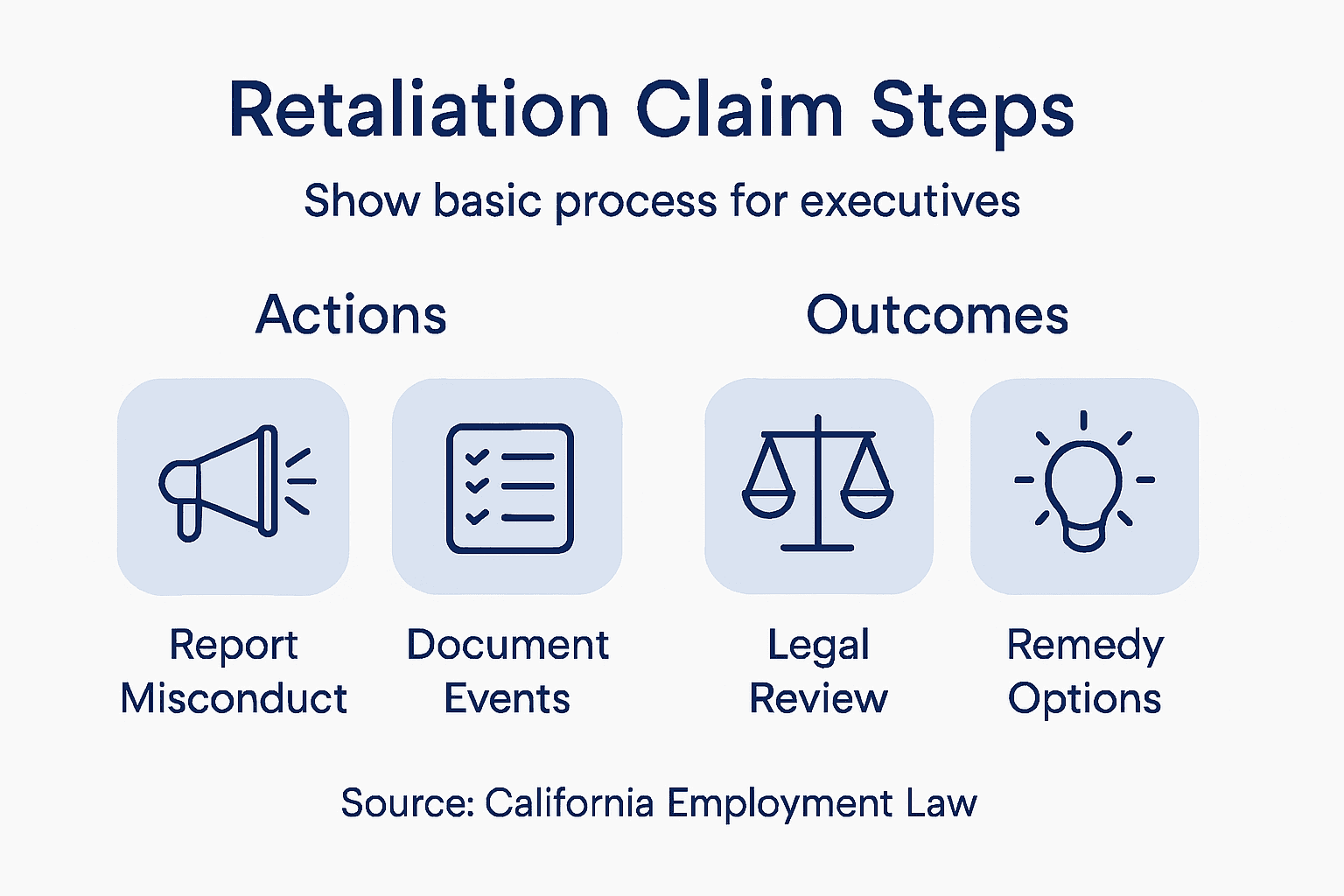
Critical steps for executives confronting retaliation include:
-
Immediate Documentation Actions:
- Create detailed written records of incidents
- Preserve email communications
- Note dates, times, and witnesses
- Collect performance evaluations
- Maintain a chronological incident log
-
Strategic Legal Remedies:
- Seek financial compensation
- Request job reinstatement
- Pursue compensatory damages
- Challenge discriminatory policies
- Obtain potential punitive damages
Successful claims through retaliation complaint processes can result in substantial workplace protections and financial recovery for affected executives.
Legal remedies are not just about financial compensation, but about restoring professional dignity and organizational accountability.
Navigation of retaliation claims requires strategic, methodical approaches that balance legal precision with professional discretion. Executives must approach these challenges with calculated, well-documented strategies.
Here is a quick reference for California executive retaliation claim processes and likely remedies:
| Phase | Action Required | Potential Outcome |
|---|---|---|
| Initial Filing | Submit complaint to CRD or DFEH | Official investigation begins |
| Investigation | Provide detailed documentation | Workplace interviews and document review |
| Resolution | Legal or negotiated settlement | Reinstatement, financial awards, policy changes |
Pro tip: Consult an employment law specialist before taking any significant actions to develop a comprehensive, strategic approach tailored to your specific workplace situation.
Protect Your Career After Reporting Workplace Misconduct
Executives in Century City who face retaliation for whistleblowing confront serious challenges such as termination, demotion, and subtle professional isolation. The emotional toll of these unfair actions can be overwhelming and impact your career trajectory. Understanding your rights against these adverse employment actions is the first step toward regaining control.
At Shirazi Law Office, we specialize in Workplace Retaliation and Senior Management Representation to provide personalized legal support tailored to your situation. Our experienced team helps you document incidents, navigate complex retaliation claims, and protect your professional reputation. Do not let retaliation silence your voice or stall your career. Visit Shirazi Law Office today to get the strategic guidance needed to assert your rights and secure your future.
Frequently Asked Questions
What constitutes executive retaliation in California?
Executive retaliation in California includes both direct adverse actions, such as termination or demotion, and subtle forms of retaliation, like professional isolation or unwarranted negative performance evaluations.
How can I prove a retaliation claim after whistleblowing?
To prove a retaliation claim, you must demonstrate that you engaged in a protected activity, experienced an adverse employment action, and established a causal connection between the two events, often supported by documentation.
What legal protections do whistleblowers have in California?
Whistleblowers in California are protected from retaliation for reporting misconduct. These protections include confidential reporting mechanisms, legal recourse against discriminatory actions, and job security guarantees.
What steps should I take if I believe I am a victim of workplace retaliation?
If you believe you are facing retaliation, it’s vital to document all related incidents meticulously, seek advice from an employment law specialist, and consider filing a complaint with the appropriate authorities like the Civil Rights Department.
Recommended
- Wrongful Termination After Whistleblowing in Downtown LA
- Executive Retaliation Claims in Los Angeles: Protecting Career and Reputation
- Workplace Retaliation in LA | Los Angeles Employment Lawyer
- Retaliation on Hollywood Sets – Legal Protections for Whistleblowers
- Employment Claims for Individuals | Ali Legal





[…] Executive Retaliation Claims After Whistleblowing in Century City – Law Office of Brian Y. Shi… […]
[…] California law protects executives from retaliation including termination, demotion, exclusion, and harassment. Proving requires showing protected activity, adverse action, and causal link. Many senior professionals mistakenly assume their executive status or at-will employment contracts eliminate these protections. The reality is more nuanced and favorable to employees who understand their rights. […]