

Working on set all week only to realize your pay, benefits, and job security are in question can leave creative professionals in Hollywood feeling frustrated and exposed. Misclassification turns job titles like graphic designer or actor into a legal puzzle, costing artists fundamental protections like minimum wage and overtime that true employees receive. Learn how California’s rules and the ABC test impact your rights, and what steps you can take to address your employment status with confidence.
Table of Contents
- Defining Worker Misclassification In Hollywood
- Types Of Creative Roles And Work Arrangements
- California’s Legal Tests For Classification
- Consequences For Misclassified Creative Workers
- Remedies, Penalties, And How To Take Action
Key Takeaways
| Point | Details |
|---|---|
| Worker Misclassification | Misclassification affects many creative professionals in Hollywood, denying them legal rights and benefits typically reserved for employees. |
| California’s ABC Test | The ABC test shifts the burden of proof to employers, making it harder to classify workers as independent contractors. |
| Consequences for Workers | Misclassified individuals face significant economic risks, including loss of healthcare, unemployment insurance, and overtime pay. |
| Legal Remedies | Creative professionals can challenge their misclassification through various avenues, including filing complaints and seeking reclassification. |
Defining Worker Misclassification in Hollywood
Worker misclassification is a critical issue in Hollywood’s complex entertainment landscape, where creative professionals frequently find themselves navigating ambiguous employment classifications. Worker misclassification occurs when employers incorrectly label employees as independent contractors, deliberately avoiding legal obligations and financial responsibilities.
In the entertainment industry, misclassification often impacts actors, graphic designers, technical crew members, and other creative professionals who may be treated as contractors despite functioning essentially as employees. The key distinction lies in how much control an employer exercises over the worker’s performance. When a production company dictates specific work hours, mandates how tasks are completed, provides essential equipment, and sets detailed performance standards, the worker should legally be classified as an employee.
The consequences of misclassification are significant and can include:
- Loss of critical employment benefits like health insurance
- Ineligibility for unemployment compensation
- Denial of minimum wage and overtime protections
- Elimination of workers’ compensation coverage
- Reduced social security contributions
Independent contractors are genuinely self-employed professionals who:
- Control their own work schedule
- Use their own equipment
- Work for multiple clients simultaneously
- Set their own rates and working conditions
- Have minimal supervision from hiring entities
employers in Hollywood frequently misuse contractor classifications to reduce expenses, denying workers fundamental legal protections that employees would normally receive. This practice shifts financial burdens onto workers while allowing companies to avoid payroll taxes, benefits, and compliance with labor regulations.
Pro tip: If you suspect misclassification in your Hollywood workplace, document all interactions, work assignments, and communication that demonstrate an employer-employee relationship.
Types of Creative Roles and Work Arrangements
The entertainment industry in Hollywood features a complex array of creative work arrangements that challenge traditional employment classifications. These diverse roles span multiple professional categories, each with unique legal and economic implications for workers and employers alike.
Creative professionals in Hollywood typically fall into three primary work classifications:
- Full-time Employees: Receive regular salaries, benefits, consistent work schedules, and direct employer management
- Freelancers: Work project-by-project, maintain independent status, control their schedules, but lack long-term employment guarantees
- Independent Contractors: Operate as essentially self-employed professionals, providing specialized services with minimal employer oversight
California’s AB5 legislation has significantly impacted these work arrangements by introducing the ABC test, which rigorously evaluates the nature of professional relationships. California worker classification rules now require employers to prove that independent contractors genuinely operate as independent businesses.
Here’s how full-time employees, freelancers, and independent contractors differ in Hollywood’s creative industry:
| Classification Type | Employer Control | Benefits & Protections | Income Stability |
|---|---|---|---|
| Full-time Employee | High, direct supervision | Health insurance, overtime pay | Consistent salary |
| Freelancer | Low, project-based input | Limited or no benefits | Fluctuates by project |
| Independent Contractor | Minimal, self-management | No legal employment benefits | Varies by client work |
The gig economy’s evolution has further complicated traditional work structures, creating hybrid roles that blend employee and contractor characteristics. For instance, a graphic designer might simultaneously work on long-term studio projects while maintaining independent client relationships, making precise classification increasingly challenging.
The lines between employment categories have become increasingly blurred in modern creative industries.
Key factors determining worker classification include:
- Degree of control over work performance
- Investment in independent business infrastructure
- Opportunity for profit or loss
- Specialized skill requirements
- Permanence of the working relationship
Pro tip: Always document the specific terms of your professional engagement and maintain clear records of your work arrangements to protect your legal rights.
California’s Legal Tests for Classification
The ABC test represents California’s most critical legal framework for determining worker classification, fundamentally reshaping employment relationships in the creative industries. This rigorous standard places the burden of proof squarely on employers to demonstrate that workers are genuinely independent contractors.
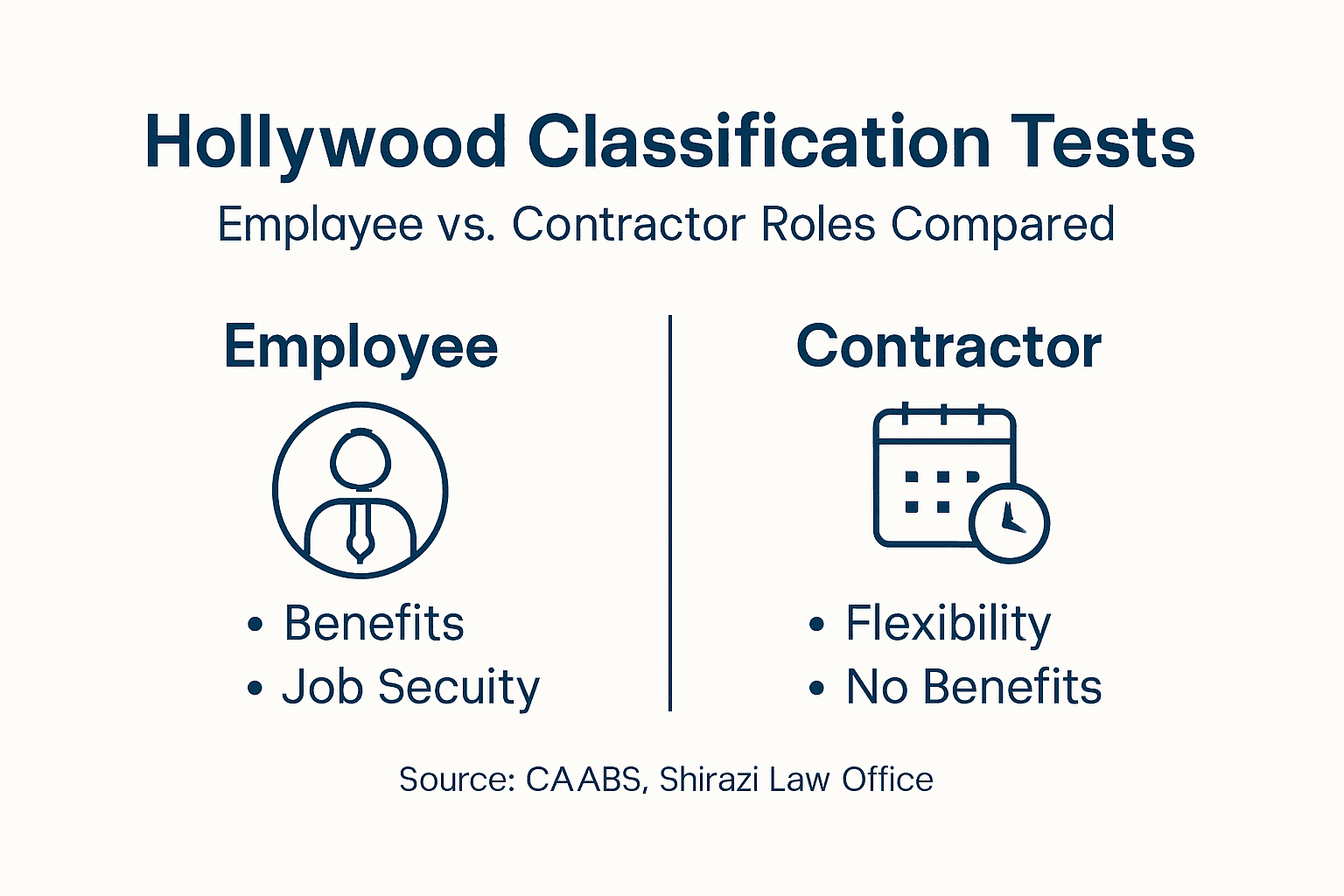
Under the ABC test, an worker is considered an employee unless the hiring entity can prove three specific conditions:
- Condition A: The worker is free from the control and direction of the hiring entity
- Condition B: The worker performs work outside the usual course of the hiring entity’s business
- Condition C: The worker is independently established in their trade or profession
California worker classification rules establish significant penalties for misclassification, with potential fines ranging from $5,000 to $25,000 per violation. These substantial financial consequences underscore the state’s commitment to protecting worker rights and preventing systemic employment abuse.
The ABC test effectively shifts the legal presumption toward employee status, making it challenging for employers to classify workers as independent contractors.
For creative professionals in Hollywood, this means:
- Graphic designers working primarily for one studio might be classified as employees
- Actors with consistent contracts could be considered full-time workers
- Freelance writers with long-term relationships may lose independent contractor status
The test’s complexity reflects the nuanced nature of modern work arrangements, particularly in industries like entertainment where professional relationships can be multifaceted and dynamic.
Pro tip: Maintain detailed documentation of your work arrangements, including contracts, communication, and the degree of control exercised by hiring entities, to protect your potential employee classification rights.
Consequences for Misclassified Creative Workers
Worker misclassification carries profound financial and professional consequences for creative professionals in Hollywood, fundamentally undermining economic security across multiple dimensions of their careers. These impacts extend far beyond simple paperwork, directly affecting a worker’s financial stability and professional opportunities.
Misclassified creative workers experience significant economic challenges, including:
- Loss of minimum wage protections
- Elimination of overtime compensation
- Absence of unemployment insurance
- No worker’s compensation coverage
- Reduced social security contributions
- Lack of employer-sponsored health benefits
- Exclusion from workplace anti-discrimination laws
Legal consequences of misclassification create substantial risks for both workers and employers in Hollywood’s competitive creative landscape. Creative professionals suddenly become responsible for:
- Paying full payroll taxes
- Covering personal healthcare expenses
- Managing retirement savings independently
- Absorbing professional liability costs
- Navigating complex tax reporting requirements
Misclassification transforms employment from a structured relationship to a precarious financial arrangement.
The cumulative effect transforms creative work from a stable career path into an unpredictable financial journey, where workers bear disproportionate economic risks. Graphic designers, actors, writers, and other creative professionals find themselves vulnerable to exploitation and financial instability.

Pro tip: Regularly document your work arrangements, maintain detailed communication records, and consult an employment lawyer to understand your potential classification status.
Remedies, Penalties, and How to Take Action
Creative professionals facing misclassification have multiple avenues to challenge their employment status, with robust legal protections designed to protect worker rights in California’s entertainment industry.
The primary mechanisms for addressing misclassification include:
- Filing a complaint with the California Labor Commissioner
- Initiating legal action through employment law attorneys
- Requesting an official workplace classification review
- Pursuing back wages and unpaid benefits
- Seeking reclassification as a full-time employee
California worker classification rules establish significant penalties for employers who misclassify workers, including:
- Fines ranging from $5,000 to $25,000 per violation
- Mandatory payment of back wages
- Coverage of unpaid payroll taxes
- Potential civil penalties
- Requirement to reclassify workers
Worker advocacy and legal action are critical tools in combating systemic employment misclassification.
Successful action requires meticulous documentation, including contracts, communication records, work assignments, and evidence demonstrating the true nature of the working relationship. Creative professionals must be prepared to demonstrate how their work arrangement resembles traditional employment despite being labeled as an independent contractor.
The table below summarizes possible legal actions and outcomes for misclassified Hollywood workers:
| Action Step | Main Benefit | Key Challenge |
|---|---|---|
| File Labor Complaint | Possible back pay recovery | Requires thorough documentation |
| Employment Law Lawsuit | Potential damages awarded | May involve lengthy process |
| Official Classification Review | Clarifies worker status | Employer resistance likely |
Pro tip: Collect and preserve all professional communications, work agreements, and evidence of employer control to strengthen your potential misclassification claim.
Protect Your Rights Against Misclassification in Hollywood
Worker misclassification poses serious challenges for creative professionals in Hollywood, threatening your financial security and legal protections. If you have experienced unfair labeling as an independent contractor despite working under employer control, it is crucial to understand your rights and take immediate action. Misclassification can cost you minimum wage, overtime, health benefits, and even unemployment insurance.
At the Hollywood – Law Office of Brian Y. Shirazi, PC, we specialize in advocating for creative workers facing wage and classification disputes. Our firm offers strategic legal support tailored to California employment laws to help you challenge wrongful labeling and recover lost wages. Don’t let misclassification derail your career. Visit the Wage and Hour Disputes page to learn more about your rights and connect with experts who will protect your interests.
Take control of your career and financial future now. Contact us at Shirazi Law Office to schedule a confidential consultation and explore your options for reclaiming your rightful employee status.
Frequently Asked Questions
What is worker misclassification in Hollywood?
Worker misclassification in Hollywood occurs when employers incorrectly classify employees as independent contractors, bypassing legal obligations and financial responsibilities.
How does California’s AB5 legislation impact worker classification?
California’s AB5 legislation uses the ABC test to evaluate professional relationships, requiring employers to prove that independent contractors operate as independent businesses, otherwise they may be considered employees.
What are the consequences of being misclassified in the creative industry?
Misclassified workers may lose access to minimum wage protections, unemployment insurance, health benefits, and could be responsible for paying full payroll taxes and managing personal expenses independently.
How can creative professionals challenge misclassification?
Creative professionals can challenge misclassification by filing complaints with the California Labor Commissioner, initiating legal action, requesting official reviews, and seeking reclassification as full-time employees.