

Every employee in Westwood deserves a fair chance to succeed, regardless of disability. For those working near UCLA or anywhere in Los Angeles, understanding your legal rights to workplace accommodations is vital for getting equal treatment and opportunity. California law provides stronger protections than federal rules, requiring employers to offer reasonable accommodations—like flexible schedules or assistive technology—so you can do your job and enjoy the same benefits as coworkers. This guide helps you recognize your rights and the practical steps to take when seeking support.
Table of Contents
- Defining Disability Accommodation At Work
- Key Laws Protecting UCLA-Area Employees
- Types Of Reasonable Workplace Accommodations
- The Interactive Process For Requesting Help
- Employer Obligations And Common Mistakes
- Legal Remedies For Unlawful Denials
Key Takeaways
| Point | Details |
|---|---|
| Reasonable Accommodations | Employers are required to provide reasonable accommodations for employees with disabilities, allowing them to perform essential job functions without facing undue hardship. |
| Interactive Process | Employees must engage in an interactive process with employers to discuss accommodation requests, ensuring mutual understanding and suitable solutions. |
| Legal Protections | The Americans with Disabilities Act and California’s Fair Employment and Housing Act provide significant protections for employees, including the right to file complaints if accommodations are unlawfully denied. |
| Documentation Importance | Keeping thorough documentation of accommodation requests and employer responses is crucial for legal protection and potential claims. |
Defining Disability Accommodation at Work
A reasonable accommodation is any change or adjustment to a job, work environment, or how work is performed that allows you to do your job effectively if you have a disability. This isn’t about lowering standards or giving special treatment. It’s about removing barriers that prevent you from performing the essential functions of your role. Under Title I of the Americans with Disabilities Act (ADA), employers in the United States are required to provide reasonable accommodations that don’t cause undue hardship to the business. In Los Angeles and throughout California, both state and federal law protect your right to request these adjustments.
Accommodations come in many forms and vary depending on your specific disability and job requirements. Common examples include flexible work schedules that allow you to attend medical appointments, remote work arrangements, modifications to physical spaces like installing ramps or accessible parking, assistive technologies such as screen readers or voice recognition software, job restructuring to focus on essential functions, modified break schedules, or adjusted communication methods. The key is that reasonable accommodations must allow you to perform the core responsibilities of your position while enjoying equal employment opportunities. Many accommodations cost little to implement and actually benefit all employees, not just those with disabilities. For instance, flexible schedules help working parents and caregivers of all abilities, while improved lighting and ergonomic furniture benefit everyone in the workspace.
What makes an accommodation “reasonable” depends on whether it creates undue hardship for your employer. Undue hardship considers factors like the cost of the accommodation relative to company size and resources, the nature of your employer’s business, and the overall impact on operations. A small business in Westwood might reasonably claim hardship from a $50,000 accommodation that a large corporation could easily absorb. Your employer isn’t required to provide the exact accommodation you request if a different, equally effective option exists that causes less hardship. However, they must engage in an interactive process with you, discussing your needs and potential solutions before denying your request.
Pro tip: Document your accommodation request in writing and keep copies of all communications with your employer, including dates, names of people you spoke with, and their responses, as this creates a clear record if your request is delayed or denied.
Key Laws Protecting UCLA-Area Employees
If you work near UCLA in Westwood or anywhere in Los Angeles, you’re protected by multiple layers of disability rights laws that work together to safeguard your job and your dignity. The most comprehensive protection comes from California’s Fair Employment and Housing Act, or FEHA, which actually provides broader protections than the federal Americans with Disabilities Act. While the ADA is the baseline for disability rights across the country, California’s FEHA uses a wider definition of disability and imposes stricter requirements on employers. This means California employees like you get more expansive coverage, which is significant because it means more conditions qualify for protection and more situations trigger your right to request accommodations.
The federal Americans with Disabilities Act and Section 504 of the Rehabilitation Act form the foundation of your rights at the national level. These laws require employers with 15 or more employees to provide reasonable accommodations unless doing so creates undue hardship. At UCLA specifically, the university maintains an ADA/504 Compliance Office that coordinates efforts to ensure the campus meets accessibility standards and investigates discrimination complaints. This office handles accommodation requests for students and staff, demonstrating that even large institutions in the Westwood area have dedicated resources for processing your needs. The key point is that employers must engage in a timely interactive process with you when you request an accommodation, meaning they cannot simply deny your request without discussing alternatives.
California law also provides additional protections beyond the ADA. FEHA prohibits discrimination based on disability in hiring, promotion, compensation, training, and all other employment terms and conditions. This matters because it means you’re protected not just in getting accommodations for your current job, but also in being hired, promoted, and compensated fairly. If your employer fails to provide reasonable accommodations or retaliates against you for requesting them, you have the right to file a complaint with the Civil Rights Department or pursue legal action. In the Westwood area, local attorneys specializing in employment law understand these overlapping protections and can help you navigate them if your rights are violated.
Here’s a quick comparison of key disability laws protecting employees in California:
| Law/Act | Who It Protects | Employer Coverage | Notable Protections |
|---|---|---|---|
| ADA (Americans with Disabilities Act) | Employees with qualifying disabilities | Employers with 15+ employees | Requires reasonable accommodation, prohibits discrimination |
| FEHA (CA Fair Employment and Housing Act) | Broader range of disabilities; more inclusive | Most CA employers, even smaller businesses | Stricter requirements, broader disability definition |
| Section 504 (Rehabilitation Act) | Employees of federally funded institutions | Any entity receiving federal funds | Accessibility and nondiscrimination for federal work |
Pro tip: Become familiar with UCLA’s specific accommodation process if you work there, as universities often have dedicated disability services offices that streamline requests and create documented records that protect you.
Types of Reasonable Workplace Accommodations
Reasonable accommodations take many different forms because disabilities themselves are diverse. What works for one person may not work for another, so your employer is expected to consider your specific situation and disability type. The law recognizes several broad categories of accommodations that can help you perform your job effectively. Physical modifications to the workplace include installing ramps for wheelchair access, providing accessible parking, adjusting desk heights, improving lighting, or modifying restroom facilities. Assistive technology covers screen readers for visually impaired employees, voice recognition software, text-to-speech programs, hearing loop systems, and specialized equipment tailored to your needs. Schedule and work arrangement changes allow flexible hours to accommodate medical appointments, remote work options, job sharing, reduced hours, or modified break times. These are among the most common accommodations because they often cost little to implement while significantly improving your ability to work.

Communication and service accommodations include providing interpreters for deaf or hard-of-hearing employees, real-time captioning, written materials in alternative formats, or allowing service animals in the workplace. Job restructuring involves modifying specific duties, reassigning non-essential tasks, or redistributing workload to focus on core functions you can perform. For example, if your disability prevents you from traveling frequently, your employer might restructure your role to eliminate that requirement while keeping the essential aspects of the job intact. Workplace accommodations must be tailored to your individual needs and job responsibilities. What’s important to understand is that accommodations are not one-size-fits-all. Your employer should work with you to identify what actually removes the barriers you face rather than offering something generic.
Many accommodations cost very little or nothing at all. A flexible schedule might cost your employer nothing. Allowing you to work from home occasionally may reduce office overhead. Accessible software often costs less than accommodating a workplace injury. This is why California law and the ADA both emphasize that cost alone is rarely sufficient justification for denying an accommodation. Your employer must evaluate whether the accommodation would genuinely create undue hardship considering the company’s size, resources, and nature of business. A small dental practice in Westwood might reasonably claim hardship from a six-figure technology investment that a large corporation could absorb easily. However, the burden of proof falls on your employer to demonstrate hardship, not on you to prove the accommodation is cheap.
Pro tip: When requesting an accommodation, be as specific as possible about your limitation and suggest concrete solutions rather than vague requests, as this makes it easier for your employer to engage in the interactive process and increases the likelihood of approval.
The Interactive Process for Requesting Help
When you need a workplace accommodation, your employer is legally required to engage in what’s called the interactive process. This isn’t a formal hearing or adversarial proceeding. Instead, it’s a collaborative conversation between you and your employer designed to understand your disability’s impact on your work and figure out solutions together. The interactive process is based on good faith dialogue where both sides share information openly. Your role is to explain how your disability affects your ability to perform job duties, while your employer’s role is to listen, ask clarifying questions, and propose reasonable solutions. This conversation should happen relatively quickly. Your employer cannot delay indefinitely or pretend the request doesn’t exist. In California, employers are expected to respond promptly and work toward resolution within a reasonable timeframe.
The process typically unfolds in several steps. First, you make a request for accommodation, ideally in writing so there’s a clear record. Your employer should then meet with you to discuss your needs and ask questions about your disability and how it impacts your work. You don’t need to disclose your diagnosis if you don’t want to, but you do need to explain the functional limitations you experience. Your employer may ask for medical documentation to verify the disability and understand its scope. Next, your employer should propose possible solutions. This is where your input matters. If their suggestion won’t actually solve your problem, say so. The process should continue until you reach a workable accommodation or until your employer can demonstrate undue hardship. Important thing to remember: interim accommodations might be offered while the process continues, which shows good faith effort.
What makes this process fail is when employers skip steps or rush to denial. A common problem occurs when an employer says no to your specific request without discussing alternatives. Another red flag is when they refuse to engage in conversation or demand you prove your disability before even discussing what you need. In Westwood and throughout Los Angeles, employment lawyers have seen employers mishandle this process repeatedly. The process should be flexible and ongoing. If an accommodation isn’t working well after implementation, you can ask to adjust it. Employers cannot retaliate against you for requesting an accommodation or participating in the interactive process, which means they cannot threaten, demote, cut hours, or take any negative action because you asked for help.
Pro tip: Document every step of the interactive process by sending follow-up emails summarizing what was discussed, what accommodations were proposed, and any deadlines, so you have written evidence of your employer’s compliance or failures.
Below is a summary of typical steps and documentation involved in the workplace accommodation interactive process:
| Stage | Key Action | Important Documentation |
|---|---|---|
| Request | Submit accommodation request | Written request (email, letter) |
| Discussion | Meet to discuss limitations and needs | Meeting notes, follow-up summaries |
| Evaluation | Employer reviews documentation | Medical/supporting documents, HR records |
| Solution | Propose and agree on accommodation | Agreed plan, confirmation in writing |
| Follow-up | Review and adjust as needed | Emails documenting outcomes, adjustments |
Employer Obligations and Common Mistakes
Your employer has clear legal obligations when it comes to disability accommodations, and these requirements apply regardless of company size or industry. Under the ADA, employers with 15 or more employees must provide reasonable accommodations to qualified employees with disabilities and cannot discriminate against them in any aspect of employment. But obligations go deeper than just saying yes to requests. Employers must engage in the interactive process in good faith, maintain confidentiality about your disability and medical information, and avoid retaliation of any kind. Your employer cannot disclose your accommodation needs to coworkers without your permission, cannot share medical details with people who don’t need to know, and cannot punish you for requesting help. This is where many employers go wrong, especially smaller businesses in Westwood that lack HR departments or formal procedures.
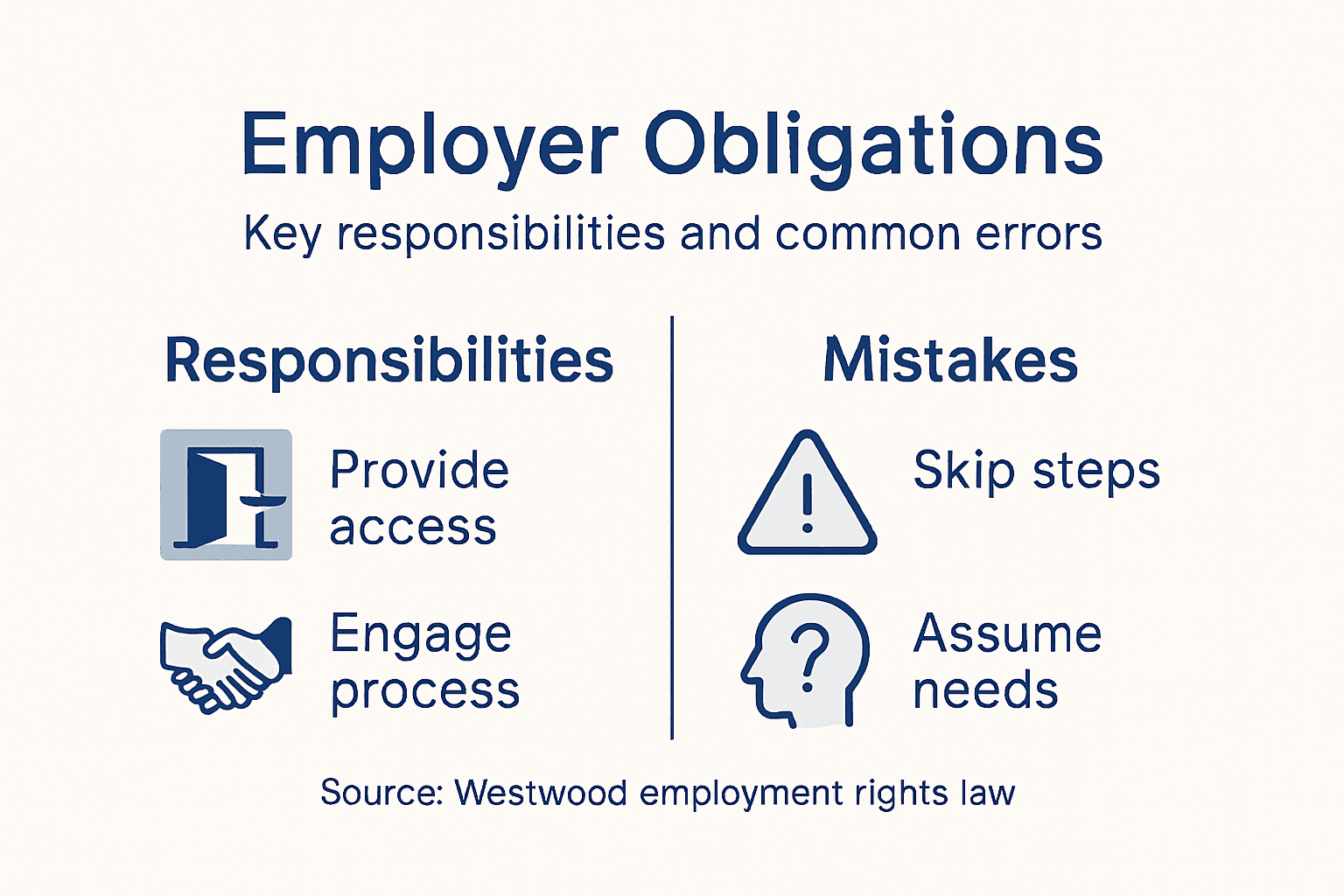
Common employer mistakes cluster around avoidance and assumptions. The first major mistake is failing to engage in the interactive process at all. Some employers simply say no without discussing alternatives or understanding your actual functional limitations. Others make assumptions about what your disability means without asking you directly. For example, an employer might assume that someone with anxiety cannot work in a busy environment and deny a flexible schedule request without exploring whether that specific accommodation would help. Another frequent error is providing an accommodation that sounds good in theory but doesn’t actually remove the barrier you face. If you request remote work and your employer agrees but then schedules mandatory in-person meetings that defeat the purpose, that’s not a valid accommodation. Employers also commonly fail to keep information confidential, discussing your disability status in team meetings or mentioning it to unnecessary staff members. Retaliation is perhaps the most serious mistake. When an employee requests an accommodation and suddenly faces discipline, reduced hours, negative evaluations, or termination, that’s illegal retaliation. In Los Angeles employment cases, retaliation claims often follow quickly after accommodation requests when timing suggests causation.
A critical obligation many employers overlook is the responsibility to provide effective accommodations. Just because an employer offers something does not mean the accommodation counts if it fails to solve the problem. Additionally, employers must update and adjust accommodations as circumstances change. If an accommodation worked initially but becomes ineffective, your employer should be willing to discuss modifications. Employers are also required to maintain training and ensure supervisors understand ADA requirements. A supervisor who tells you “we don’t do accommodations here” has revealed a serious compliance failure. In Westwood and throughout Los Angeles, employees facing this situation often benefit from understanding these obligations because it clarifies when an employer is breaking the law versus when they have legitimate concerns.
Pro tip: Keep detailed records of your accommodation request, including dates, names of people you communicated with, specific limitations you described, and responses you received, as this documentation is crucial evidence if you need to file a complaint or pursue legal action.
Legal Remedies for Unlawful Denials
If your employer denies your reasonable accommodation request unlawfully, you have several legal paths available to challenge that decision and seek remedies. The first step for most employees is filing a complaint with the Equal Employment Opportunity Commission, or EEOC. This federal agency investigates discrimination complaints under the ADA and can determine whether your employer violated the law. You have 180 days from the date of the unlawful denial to file with the EEOC, though in California the timeline extends to one year if you also file with the state Civil Rights Department. The EEOC will investigate your complaint, interview your employer, review documentation, and determine whether there is reasonable cause to believe discrimination occurred. If they find violations, they may attempt to mediate between you and your employer or issue a right-to-sue letter that allows you to pursue litigation.
When an employer denies an accommodation without legitimate business justification, you may have grounds for legal action. Employers who fail to provide accommodations or refuse to engage in the interactive process may be found in violation of ADA law. Unlawful denials typically fall into several categories. Your employer cannot deny an accommodation based on stereotypes about your disability. They cannot assume you cannot perform a job function without discussing it with you. They cannot deny your request simply because it costs money or requires some effort. They can only deny an accommodation if they provide genuine evidence that it would cause undue hardship considering their company size, resources, and operational costs. Denials based on unsubstantiated claims or vague concerns do not meet the legal standard.
Damages available in disability accommodation cases can include back pay covering the period you were denied the accommodation, front pay for future losses, compensatory damages for emotional distress and harm to your reputation, and in some cases punitive damages if your employer’s conduct was particularly egregious. You may also recover attorney’s fees and court costs. In Westwood and throughout Los Angeles, documentation of your employer’s decision-making process becomes critical evidence. Written denials without explanation, emails showing an employer ignored your request, or testimony that your supervisor refused to discuss alternatives all support your case. If your employer retaliated against you after you requested an accommodation, that is a separate violation that strengthens your legal position significantly. Retaliation claims often involve termination, demotion, reduced hours, or negative performance evaluations that coincide with your accommodation request.
The strength of your case depends heavily on the evidence you have gathered. Keep all written communication with your employer regarding your accommodation request. Document the dates you made requests, who you spoke with, what was discussed, and what response you received. Medical records supporting your disability and its functional impact are important but keep these confidential and only share with your attorney or the EEOC. If you have witnesses who can testify about your employer’s statements or actions, that strengthens your position. Many disability discrimination cases settle before trial because employers recognize the legal exposure of ignoring accommodation obligations.
Pro tip: Contact an employment attorney as soon as your accommodation request is denied or significantly delayed, as early legal intervention can sometimes resolve the issue quickly and establish a formal record that protects you from retaliation.
Protect Your Disability Accommodation Rights in Westwood
Facing challenges with disability accommodations at your Westwood workplace can be stressful and overwhelming. You might be struggling with your employer refusing to engage in the interactive process or denying your accommodation requests without a valid reason. These barriers not only put your job security at risk but also affect your dignity and wellbeing. Understanding your rights under California’s FEHA and the federal ADA empowers you to demand fair treatment and effective accommodations tailored to your needs.
If you are dealing with workplace disability discrimination or unlawful denial of accommodations, the experienced team at Shirazi Law Office is here to help. Specializing in Workplace Disability Discrimination and serving clients in the Westwood area, we provide strategic legal support to protect your employment rights and hold employers accountable. Do not wait for your situation to worsen. Take control today by contacting us to discuss your case and secure the accommodation and respect you deserve.
Frequently Asked Questions
What is a reasonable accommodation in the workplace?
A reasonable accommodation is a modification or adjustment to a job or work environment that allows an employee with a disability to perform their job effectively. This can include changes to workspace, work schedules, or job duties.
How do I request a reasonable accommodation at work?
You should make a request for accommodation, ideally in writing, explaining your specific limitations and the type of accommodation you believe will help you perform your job. It’s important to engage in an open dialogue with your employer.
What should I do if my accommodation request is denied?
If your request is denied, you can file a complaint with the Equal Employment Opportunity Commission (EEOC) or the state Civil Rights Department. Document all communications and keep records of your request and the employer’s response.
What rights do I have if my employer retaliates against me for requesting accommodations?
You have the right to file a complaint for retaliation if your employer takes negative actions against you, such as demotion or termination, after you request accommodations. Retaliation is illegal and can strengthen your case against your employer.





[…] legal protections is critical for navigating workplace challenges related to health conditions. Disability accommodation rights are particularly nuanced for medical […]