

A senior leader returning from medical leave often expects to resume their duties without disruption, yet some discover a sharp shift in treatment or career prospects. For executives in Los Angeles, even a demotion or exclusion from key decisions after protected leave can signal workplace retaliation. Understanding these legal risks and your rights is crucial when high-level responsibilities and reputations are on the line. This guide offers clarity on retaliation laws and practical steps to protect your career.
Table of Contents
- Retaliation After Leave: What It Means
- Legal Protections Under FMLA and CFRA
- Typical Retaliatory Actions in California Workplaces
- Executive and Management Rights and Risks
- Proving Retaliation and Seeking Remedies
Key Takeaways
| Point | Details |
|---|---|
| Retaliation is Prohibited | Employers cannot take adverse actions against employees who take legally protected medical leave, including termination and demotion. |
| Document Everything | Keep meticulous records of interactions with your employer after returning from leave to support potential retaliation claims. |
| Legal Protections Exist | The FMLA and CFRA offer substantial job protection for employees taking medical leave, ensuring they can return to their jobs. |
| Prove Causation | To succeed in a retaliation claim, an employee must demonstrate a clear connection between their medical leave and any adverse employment actions. |
Retaliation After Leave: What It Means
Retaliation after medical leave represents a serious violation of an employee’s legal rights in Los Angeles. When an employee takes legally protected medical leave, employers are prohibited from responding with adverse actions that could harm their career trajectory. Workplace retaliation can manifest in multiple ways, ranging from subtle workplace behaviors to direct punitive measures.
Under California law, retaliation occurs when an employer takes negative employment actions specifically linked to an employee’s use of protected medical leave. These actions might include termination, unexpected demotion, reduction of work hours, exclusion from professional opportunities, or creating a hostile work environment. The key factor is demonstrating a direct connection between the medical leave and subsequent workplace treatment.
The legal standard requires that the retaliatory action be significant enough to deter a reasonable employee from exercising their protected rights. This means not every minor workplace inconvenience constitutes retaliation. Legal challenges to retaliation often involve proving that the employer’s actions were directly motivated by the employee’s medical leave, rather than legitimate business concerns.
Pro tip: Document every interaction and communication with your employer after returning from medical leave, maintaining a detailed record that could serve as critical evidence if retaliation occurs.
Legal Protections Under FMLA and CFRA
The Family and Medical Leave Act (FMLA) and California Family Rights Act (CFRA) provide critical legal protections for employees in Los Angeles who need to take medical or family-related leave. Comprehensive leave protections ensure that workers can address serious health conditions or family care responsibilities without risking their employment status.
Under these laws, eligible employees are entitled to up to 12 weeks of job-protected unpaid leave. Employers must maintain the employee’s health benefits during the leave period and reinstate them to the same or an equivalent position upon return. The CFRA offers additional protections specific to California, covering employers with five or more employees and extending beyond federal guidelines to include more comprehensive leave scenarios.

Legal frameworks against retaliation explicitly prohibit employers from interfering with an employee’s leave rights or taking punitive actions in response to leave requests. This means that employees cannot be demoted, terminated, or subjected to negative performance evaluations simply for exercising their legally protected right to take medical or family leave. The laws create a shield that protects workers from workplace discrimination related to their health and family care needs.
Pro tip: Maintain detailed documentation of all communication with your employer regarding medical leave, including dates, conversations, and written correspondence to protect yourself against potential retaliation.
Here’s a quick reference table outlining the core differences between FMLA and CFRA protections:
| Aspect | FMLA (Federal) | CFRA (California) |
|---|---|---|
| Employer Coverage | 50+ employees | 5+ employees |
| Duration of Leave | Up to 12 weeks unpaid | Up to 12 weeks unpaid |
| Eligible Employees | 12 months + 1,250 hours worked | 12 months + 1,250 hours worked |
| Types of Leave Covered | Serious health or family conditions | More family and health scenarios |
| Health Benefits During Leave | Must be maintained by employer | Must be maintained by employer |
| Position Reinstatement | Same or equivalent role required | Same or equivalent role required |
| Retaliation Protections | Explicitly prohibited | Explicitly prohibited |
Typical Retaliatory Actions in California Workplaces
California workplaces employ various subtle and overt strategies to retaliate against employees who have taken medical leave. Common retaliatory tactics range from direct actions like termination to more nuanced forms of workplace harassment designed to undermine an employee’s professional standing and career trajectory.
These retaliatory actions can manifest through multiple channels, including professional and interpersonal strategies. Employers might implement tactics such as unexpected demotions, systematic exclusion from key meetings, unfair performance evaluations, reduction of work hours, or strategic reassignment to less desirable shifts or job duties. The goal is often to create an increasingly hostile work environment that pressures the employee into leaving voluntarily.
Workplace retaliation signs frequently include increased micromanagement, sudden changes in workplace dynamics, and deliberate attempts to isolate the employee from professional opportunities. These actions are carefully constructed to appear legitimate on the surface while effectively punishing the employee for exercising their legally protected medical leave rights. Sophisticated employers may disguise retaliatory actions as performance-related concerns or business restructuring to avoid direct legal accountability.
Pro tip: Maintain a detailed, contemporaneous journal documenting every workplace interaction, performance assessment, and potential retaliatory action to create a comprehensive record that could serve as critical evidence in future legal proceedings.
Executive and Management Rights and Risks
Executives and senior managers in Los Angeles face unique challenges when navigating medical leave and potential workplace retaliation. Complex legal rights distinguish their position from other employees, with higher stakes and more nuanced legal protections that require careful strategic consideration.
The professional landscape for executives presents distinctive risks during medical leave. Employers often subject high-level employees to more intense scrutiny, meticulously documenting performance metrics and professional behaviors. This heightened documentation can create additional challenges when asserting retaliation claims, as companies may disguise discriminatory actions behind seemingly legitimate performance evaluations or organizational restructuring.
Legal causation standards for retaliation claims demand that executives provide precise evidence demonstrating a direct link between their medical leave and subsequent adverse employment actions. Courts typically expect a higher level of substantive proof from management-level employees, requiring meticulous documentation and a clear narrative that establishes the causal relationship between protected leave and professional consequences.
Pro tip: Consult an employment attorney specializing in executive representation before making any formal workplace claims, as the legal nuances for management-level retaliation differ significantly from standard employee protections.
Proving Retaliation and Seeking Remedies
Successfully proving workplace retaliation requires a strategic and methodical approach to documenting and presenting evidence. Legal standards for proving retaliation mandate that employees demonstrate three critical elements: engagement in a protected activity, experiencing an adverse employment action, and establishing a clear causal connection between these events.
The evidence gathering process involves collecting comprehensive documentation that reveals the employer’s discriminatory intent. This includes contemporaneous records of workplace interactions, performance evaluations, communication logs, and detailed timelines demonstrating the sequence of events surrounding medical leave and subsequent adverse actions. Inconsistent employer explanations, sudden changes in professional treatment, and patterns of behavior can serve as powerful indicators of retaliatory conduct.
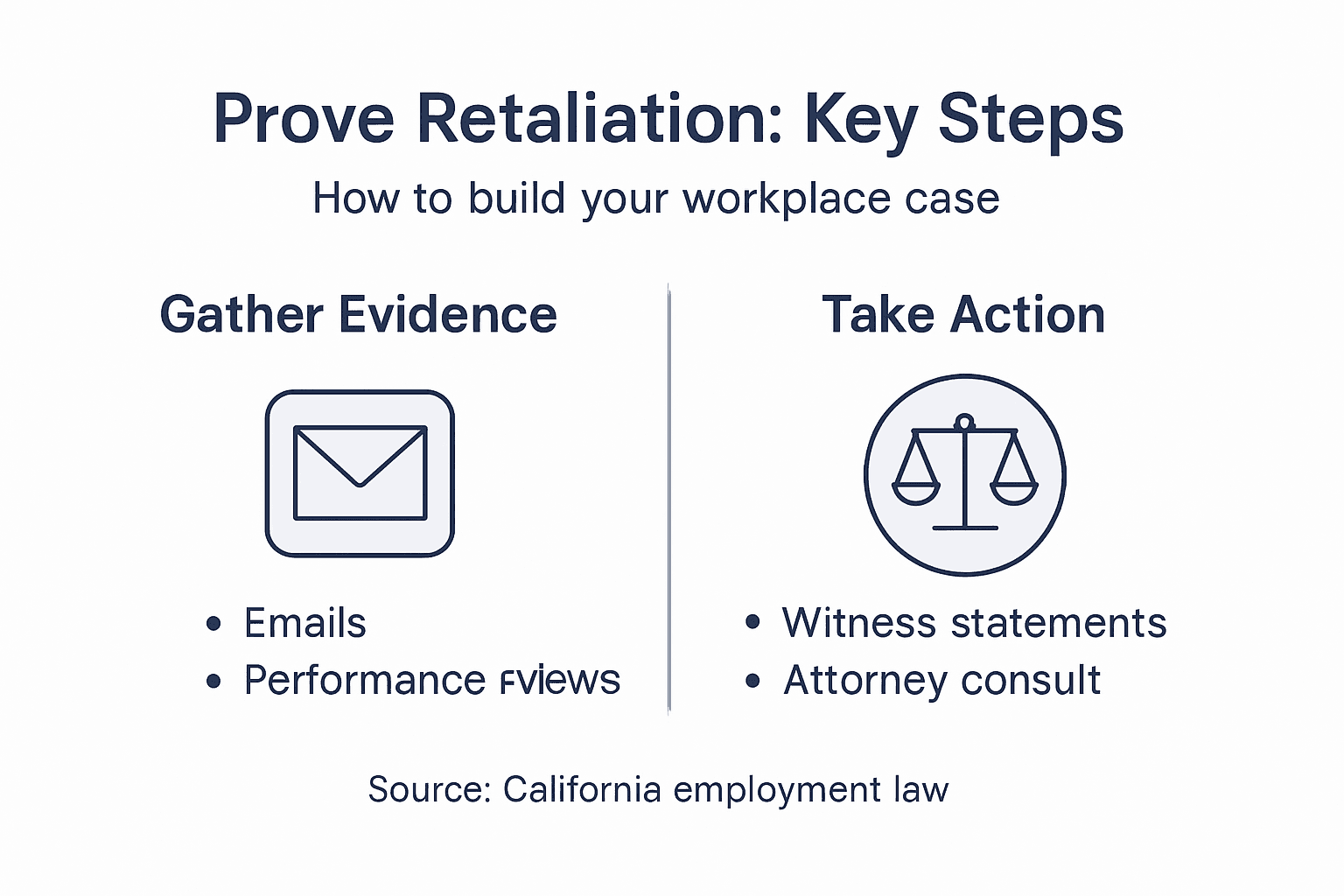
Investigating workplace retaliation often requires employees to compile testimony from witnesses, collect written communications, and document the temporal proximity between protected leave and negative employment consequences. Potential remedies may include reinstatement, back pay, compensatory damages, and legal mandates requiring employers to implement policy changes to prevent future discriminatory practices.
Pro tip: Preserve all original documentation, create digital and physical backups, and avoid discussing your potential case with current workplace colleagues to maintain the integrity of your potential legal claim.
The table below summarizes key documentation strategies for proving retaliation claims:
| Documentation Type | Purpose | Example Use |
|---|---|---|
| Written Correspondence | Tracks employer communications | Emails about leave approval |
| Performance Records | Identifies changes after leave | Pre- and post-leave reviews |
| Witness Testimony | Supports claims with third-party views | Colleague statements |
| Incident Timeline | Establishes causation between events | Dates linking leave to actions |
| Journal/Diary | Captures daily interactions | Log of meetings or comments |
Protect Your Career and Fight Back Against Retaliation After Medical Leave
If you have faced retaliation or unfair treatment after exercising your right to medical leave in Los Angeles you are not alone. The pain of being targeted at work for taking protected leave under FMLA or CFRA can threaten your career and your peace of mind. With tactics like demotion exclusion from opportunities or even termination it is critical to understand your rights and how to protect yourself.
At Shirazi Law Office we specialize in handling cases of workplace retaliation including unlawful adverse actions following medical leave. Our expert team is dedicated to defending employees executives and senior management against retaliation and helping you build the strong evidence needed to assert your rights. You deserve to return to work without fear and safeguard your professional reputation. Don’t wait until the situation worsens. Visit Shirazi Law Office today to learn how our tailored legal solutions can help you take back control and secure the justice you deserve. Secure your future now before retaliation takes an irreversible toll.
Frequently Asked Questions
What constitutes retaliation after medical leave?
Retaliation after medical leave occurs when an employer takes adverse actions against an employee specifically linked to their use of protected medical leave, such as termination, demotion, or creating a hostile work environment.
How can I prove that I faced retaliation after taking medical leave?
To prove retaliation, you must demonstrate that you engaged in a protected activity (taking medical leave), experienced an adverse employment action, and establish a clear causal connection between those events, supported by thorough documentation and evidence.
What legal protections are available for employees who take medical leave?
Legal protections, including those provided under the Family and Medical Leave Act (FMLA) and the California Family Rights Act (CFRA), ensure that employees can take up to 12 weeks of job-protected unpaid leave without the risk of retaliation from their employer.
What should I do if I suspect I am facing retaliation for taking medical leave?
If you suspect retaliation, document all interactions with your employer, gather evidence of adverse actions, and consider consulting an employment attorney to explore your options for legal recourse.





[…] Retaliation After Medical Leave: Protecting Your Career in Los Angeles […]
[…] WARN remedies, you may also have claims related to retaliation after layoffs if your termination was connected to a protected activity. California prohibits employers from […]