

Most American companies in Downtown Los Angeles underestimate the risks of worker misclassification, yet improper classification led to over $137 million in California penalties last year alone. With tighter enforcement and evolving legal standards, executives face a complex web of federal and state requirements that can lead to devastating fines and legal action. This guide brings clarity to employee and contractor status so leaders can make informed workforce decisions and safeguard their organizations from costly mistakes.
Table of Contents
- Defining Employee and Contractor Status
- California’s ABC Test and Legal Standards
- Key Differences in Work Relationships
- Penalties and Risks of Misclassification
- Protecting Your Rights and Remedies
Key Takeaways
| Point | Details |
|---|---|
| Employee vs. Independent Contractor | Understanding the legal distinctions is crucial for compliance and avoiding penalties. Employees operate under employer control, while independent contractors maintain autonomy. |
| California’s ABC Test | This test requires employers to prove a worker’s independent status, significantly impacting workforce classification standards. Non-compliance can lead to severe financial repercussions. |
| Consequences of Misclassification | Misclassifying workers can result in back taxes, unpaid benefits, and legal actions, threatening the financial stability of businesses. |
| Protecting Workers’ Rights | Workers can file wage claims and collect evidence to challenge misclassification, offering avenues for recovering lost compensation and legal protections. |
Defining Employee and Contractor Status
Understanding the legal distinctions between employees and independent contractors is critical in Downtown Los Angeles, where complex workplace relationships can create significant regulatory challenges. The Department of Labor’s new rule provides a comprehensive framework for determining worker classification, focusing on economic realities rather than contractual labels.
Legal classification hinges on several key factors that demonstrate the true nature of the working relationship. Employees typically work under direct employer control, receive consistent wages, have taxes withheld, and are economically dependent on a single organization. In contrast, independent contractors operate with significant autonomy, set their own schedules, use their own tools, work for multiple clients, and bear more financial risk in their business operations.
The economic reality test evaluates multiple dimensions of worker status, including the degree of control, opportunities for profit or loss, worker’s investment in equipment, specialized skills, permanency of the working relationship, and whether the work performed is integral to the employer’s business. Courts and regulatory agencies examine these factors holistically, recognizing that no single criterion definitively determines worker classification.
Companies misclassifying workers face substantial legal and financial consequences, including potential back taxes, penalties, and mandatory benefit payments. Workers incorrectly labeled as contractors may be denied critical protections like minimum wage, overtime compensation, unemployment insurance, and workplace safety regulations.
Pro tip: Consult an employment law specialist to conduct a comprehensive review of your current worker classifications and ensure compliance with California’s stringent labor regulations.
California’s ABC Test and Legal Standards
California’s employment classification framework stands as one of the most stringent in the United States, with the ABC Test establishing clear worker classification standards. This comprehensive legal approach shifts the burden of proof onto employers, requiring them to demonstrate that a worker is truly an independent contractor rather than an employee.
The ABC Test comprises three critical criteria that must be simultaneously satisfied for a worker to be classified as an independent contractor. First, the worker must be free from the company’s control and direction in performing work. Second, the work performed must be outside the usual course of the hiring entity’s business. Third, the worker must be independently established in a trade, occupation, or business of the same nature as the work performed.
These rigorous standards significantly impact businesses across Downtown Los Angeles, particularly in industries with complex workforce arrangements like technology, creative services, and professional consulting. Companies must carefully evaluate each working relationship, considering factors such as the worker’s economic independence, investment in their own business, opportunity for profit or loss, and the specific nature of their professional engagement.
Non-compliance with the ABC Test can result in substantial legal and financial consequences, including back taxes, penalties, and potential litigation. Employers face potential liability for unpaid wages, benefits, and penalties if workers are found to be misclassified, making it crucial for organizations to conduct thorough, proactive assessments of their workforce classification practices.
Pro tip: Conduct a comprehensive internal audit of all current contractor relationships, documenting each worker’s specific role, independence, and alignment with the ABC Test criteria to mitigate potential misclassification risks.
Key Differences in Work Relationships
Employment relationships are defined by complex legal and financial distinctions that significantly impact workers’ rights and organizational responsibilities. Behavioral and financial control factors play a crucial role in determining whether a worker is classified as an employee or an independent contractor in Downtown Los Angeles.
Employees typically experience extensive employer oversight, receiving structured compensation, benefits, and consistent work assignments. Their taxes are automatically withheld, and they enjoy legal protections like minimum wage guarantees, overtime compensation, and unemployment insurance. Employers provide necessary equipment, training, and direct supervision, creating a relationship of economic dependence and ongoing commitment.

Independent contractors, conversely, operate as autonomous business entities with significant professional independence. They control their work process, invest in their own tools and resources, bear financial risks, and have the flexibility to work with multiple clients. Legal protections differ substantially between these classifications, with contractors lacking many standard employee benefits and assuming greater personal liability for their professional outcomes.
The financial implications of misclassification can be substantial, with potential penalties including back taxes, benefit reimbursements, and legal damages. Businesses must carefully evaluate the nature of working relationships, considering factors like degree of control, economic independence, and integration into the company’s core operations to ensure accurate worker classification.
Here’s a clear comparison of employee and independent contractor relationships in Downtown Los Angeles:
| Aspect | Employee | Independent Contractor |
|---|---|---|
| Level of Control | Employer makes key decisions | Worker controls work process |
| Tax Withholding | Taxes withheld by employer | Worker pays own taxes |
| Equipment Provided | Employer supplies tools | Worker provides equipment |
| Benefits Received | Insurance, overtime, protections | Usually lacks employee benefits |
| Economic Dependence | Relies on one employer | Works for multiple clients |
Pro tip: Maintain detailed documentation of each working relationship, including contracts, scope of work, payment structures, and operational independence to substantiate proper worker classification.
Penalties and Risks of Misclassification
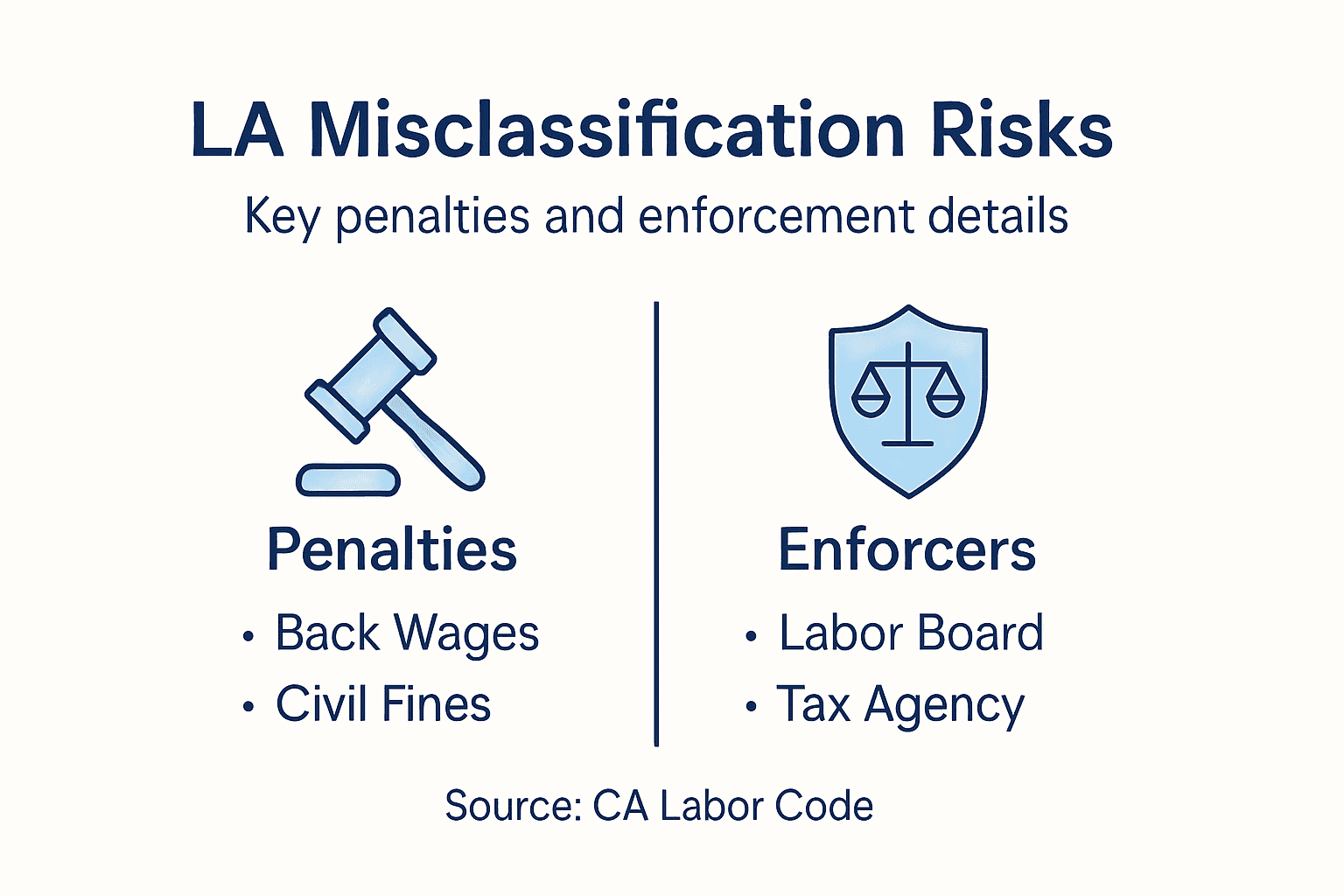
Misclassifying workers carries substantial legal and financial consequences that can devastate businesses across Downtown Los Angeles. Employers face significant Department of Labor penalties for improperly categorizing employees as independent contractors, potentially exposing themselves to extensive financial and legal repercussions.
The financial risks extend beyond immediate monetary penalties, encompassing comprehensive back wage requirements, unpaid tax liabilities, and potential civil litigation. Companies may be required to retroactively provide benefits, compensate for unpaid overtime, and cover missed payroll tax contributions. These penalties can accumulate rapidly, transforming a seemingly minor classification error into a potentially bankrupting legal challenge.
Systematic misclassification undermines workers’ fundamental protections by denying them critical benefits like health insurance, workers’ compensation, unemployment coverage, and legally mandated wage standards. Government agencies at federal and state levels actively investigate and prosecute such violations, recognizing the broader economic implications of worker exploitation and tax revenue loss.
Beyond direct financial penalties, businesses risk reputational damage, potential criminal charges for intentional misclassification, and increased scrutiny from regulatory agencies. The cumulative impact can include heightened audit risks, mandatory compliance monitoring, and substantial legal defense costs that far exceed the initial savings sought through improper worker classification.
This table summarizes common penalties and risks for misclassifying workers in California:
| Risk Type | Potential Impact | Enforcement Agent |
|---|---|---|
| Back Taxes | Owed payroll and income taxes | IRS, California tax agencies |
| Unpaid Benefits | Retroactive health, overtime, leave | Labor Commissioner |
| Civil Litigation | Lawsuits and financial settlements | Courts, legal representation |
| Reputational Damage | Loss of business trust and clients | Public perception, media |
Pro tip: Conduct regular, comprehensive internal audits of worker classifications with assistance from employment law specialists to proactively identify and rectify potential misclassification risks before they escalate into costly legal challenges.
Protecting Your Rights and Remedies
Workers in Downtown Los Angeles have multiple powerful mechanisms to challenge worker misclassification and protect their legal rights. Filing wage claims with labor authorities represents a critical first step for employees seeking to address potential classification violations and recover lost compensation.
Building a robust case requires systematic documentation of work conditions, demonstrating the true nature of the employment relationship. Employees should collect comprehensive evidence including work schedules, communication records, equipment usage, degree of supervision, and financial dependency. This documentation becomes crucial when challenging misclassification through administrative agencies or legal proceedings.
Workers can challenge contractor status by filing complaints with the California Labor Commissioner, seeking legal representation, or initiating administrative hearings. The burden of proof often falls on employers to demonstrate that a worker genuinely meets independent contractor criteria, providing significant leverage for misclassified employees seeking reclassification and retroactive benefits.
Potential remedies include recovering unpaid wages, overtime compensation, missed benefits, tax contributions, and potential additional damages for intentional misclassification. Employees may also pursue civil litigation to address systemic workplace violations, with potential outcomes including financial compensation, mandatory policy changes, and enhanced workplace protections.
Pro tip: Preserve all communication, payment records, and work-related documentation, as these materials become critical evidence when challenging worker misclassification.
Protect Your Rights Against Employee Misclassification in Downtown Los Angeles
Misclassifying workers as independent contractors instead of employees creates serious risks for your workplace rights and financial security. If you feel controlled yet denied benefits or if wage and hour violations have left you vulnerable, understanding the complexities of classification under California law is essential. The ABC Test and economic reality factors are not just legal jargon but the foundation for ensuring you receive fair treatment, proper wages, and access to vital protections.
At Shirazi Law Office, we specialize in guiding Downtown Los Angeles workers through these challenges. Whether you suspect wage theft, wrongful termination related to misclassification, or need clarity on your employment status, our focused expertise in Downtown Los Angeles employment law and Wage and Hour Disputes empowers you to take action confidently. Do not wait for penalties or lost benefits to deepen your hardship. Visit Shirazi Law Office now to secure a detailed consultation and protect the rights you have earned under California law.
Frequently Asked Questions
What is the legal distinction between an employee and an independent contractor?
Employees work under employer control, receive consistent wages, have taxes withheld, and are economically dependent on a single organization, while independent contractors operate autonomously, set their own schedules, and work for multiple clients.
What is the ABC Test for worker classification?
The ABC Test requires that to be classified as an independent contractor, the worker must be free from control by the employer, the work must be outside the usual course of the employer’s business, and the worker must be independently established in a trade or business of the same nature as the work performed.
What are the penalties for misclassifying workers?
Misclassification can lead to significant penalties such as back taxes, unpaid benefits, and potential civil litigation, along with reputational damage and increased scrutiny from regulatory agencies.
How can workers challenge their misclassification?
Workers can file wage claims with labor authorities, collect documentation of their work conditions, and challenge their status through administrative hearings or legal representation to seek reclassification and recover lost compensation.





[…] employees who’ve been misclassified for years, this recovery can be significant. Understanding employee contractor misclassification specifically clarifies your rights and what legal options exist if you’ve been wrongly […]
[…] Employee vs Contractor Misclassification in Downtown LA […]
[…] the nature of the work closely mirrors traditional employment. You can find deeper context on misclassification guidance in Downtown LA that covers how these claims play out […]