
False statements at work can cost an American executive in Beverly Hills far more than lost income—they can shatter hard-earned reputations. In today’s workplace, professional slander affects careers at every level, leaving respected professionals struggling to recover from the damage. If you are concerned about the risks and realities of workplace defamation, you will gain practical clarity on the true definitions, critical legal misconceptions, and concrete steps to defend your reputation and career.
Table of Contents
- Defining Workplace Defamation and Misconceptions
- Types of Defamation: Libel and Slander Explained
- Legal Standards for Defamation Under California Law
- Protecting Employee Reputation in Beverly Hills
- Employee Rights, Risks, and Legal Remedies
Key Takeaways
| Point | Details |
|---|---|
| Understanding Defamation | Workplace defamation involves false statements that harm an employee’s reputation, requiring proof of falsity, malice, and damage. |
| Types of Defamation | Slander is spoken, while libel is written; each has different legal implications and evidentiary challenges. |
| Legal Standards in California | Defamation claims necessitate proving a false statement, publication, negligence, and actual harm to the reputation. |
| Employee Rights | Employees can seek compensatory damages for reputational harm, but must meticulously document evidence to support their claims. |
Defining Workplace Defamation and Misconceptions
Workplace defamation represents a serious legal issue where false statements intentionally damage an employee’s professional reputation and career prospects. Academic research from Nova Southeastern University defines workplace defamation as a specific tort involving deliberate communication of harmful, untrue statements about an individual’s character or professional capabilities.
Understanding the nuanced legal landscape of workplace defamation requires distinguishing between slander and libel. Slander refers to spoken false statements, while libel involves written or published false claims. In employment contexts, defamation can manifest through various communication channels, including email, performance reviews, verbal statements to colleagues or potential employers, and social media platforms. The key elements that must be proven include the statement’s falsity, malicious intent, and demonstrable harm to the employee’s professional standing.
Crucial misconceptions often complicate workplace defamation claims. Many professionals misunderstand that not all negative statements constitute defamation. The statement must be objectively false, not merely an opinion or substantially truthful critique. Moreover, certain communications receive qualified privilege – such as references provided in good faith or internal performance evaluations – which can provide legal protection for employers making statements about an employee’s performance or conduct.
Pro tip: Document every instance of potentially defamatory communication and gather evidence of professional damage, including lost job opportunities or career advancement impediments, to strengthen a potential workplace defamation claim.
Types of Defamation: Libel and Slander Explained
In the complex realm of workplace communication, libel and slander represent two distinct yet equally damaging forms of defamation that can significantly impact an employee’s professional reputation. Academic research exploring legal publication standards reveals critical distinctions between these two types of defamatory communication that professionals must understand.
Libel specifically refers to false statements that are permanently recorded or published in a tangible medium. This includes written documents such as emails, performance reviews, social media posts, letters, blog entries, and printed publications. The permanence of these statements creates a more substantial legal record and often makes libel claims easier to prove. Key characteristics of libel include the ability to demonstrate the exact wording, distribution channels, and potential audience reach of the defamatory statement.

In contrast, slander involves spoken or transient verbal statements that are not permanently recorded. These can include verbal comments during meetings, conversations with colleagues, telephone discussions, or any unwritten communication that damages an individual’s professional character. While slander can be more challenging to substantiate, it remains equally harmful. Workplace slander might manifest through malicious verbal statements about an employee’s performance, integrity, or professional capabilities that are intentionally designed to undermine their reputation.
Here’s a comparison of slander and libel in the workplace:
| Aspect | Slander (Spoken) | Libel (Written) |
|---|---|---|
| Communication Method | Verbal statements | Written, published materials |
| Proof Difficulty | Harder to substantiate | Easier to prove with records |
| Common Media | Meetings, phone calls, gossip | Emails, social media, reviews |
| Legal Permanence | Typically transient and fleeting | Usually permanent and documented |
| Audience Reach | Limited, depends on hearsay | Wider, potentially very broad |
Pro tip: Maintain a contemporaneous log of any potentially defamatory communications, including dates, witnesses, and specific language used, which can serve as crucial evidence if you need to pursue a legal claim for libel or slander.
Legal Standards for Defamation Under California Law
Under California law, workplace defamation claims require a nuanced understanding of legal standards that go beyond simple false statements. Recent legal analyses examining harm and damages highlight that merely proving a statement is untrue is insufficient to establish a successful legal claim. Employees must demonstrate several critical elements to substantiate a defamation lawsuit in the professional context.
The legal threshold for defamation in California involves proving four fundamental components: a false statement of fact, publication to a third party, fault amounting to at least negligence, and actual harm to the plaintiff’s professional reputation. This means the statement must be objectively false, not merely an opinion, and must be communicated to someone other than the subject of the statement. The negligence standard requires showing the speaker failed to exercise reasonable care in determining the statement’s truthfulness, which creates a meaningful legal burden for the plaintiff.
California courts recognize specific nuances in workplace defamation claims that distinguish them from other jurisdictions. For instance, statements made during privileged communications – such as performance reviews or internal HR investigations – receive heightened legal protection. This means not all negative statements constitute actionable defamation. The courts carefully balance an employer’s right to provide honest feedback with an employee’s right to be protected from malicious, demonstrably false statements that could irreparably damage their professional standing.
Pro tip: Collect comprehensive documentation including emails, witness statements, and performance records that can objectively demonstrate the falsity of defamatory statements and substantiate the actual professional damage you have experienced.
Protecting Employee Reputation in Beverly Hills
In the competitive professional landscape of Beverly Hills, protecting one’s reputation requires strategic and proactive approaches to managing potential workplace defamation. Professional legal sources detailing defamation prevention strategies emphasize the critical importance of understanding and responding to harmful communications that could compromise career prospects.
Executives and professionals in high-stakes industries must develop a comprehensive defense strategy against potential reputational damage. This involves meticulously documenting workplace interactions, identifying potentially defamatory statements, and understanding the nuanced legal standards that differentiate between protected opinions and actionable false claims. Practical guidance on workplace reputation management suggests that professionals should maintain detailed records of communications, performance evaluations, and any instances of potentially damaging statements.
Specifically for Beverly Hills professionals, reputation protection requires a multifaceted approach. This includes understanding the legal thresholds for defamation claims, recognizing the difference between actionable false statements and protected opinions, and being prepared to take swift legal action when necessary. The unique professional ecosystem of Beverly Hills demands a sophisticated approach to reputation management, where personal and professional brands are intrinsically linked and can be significantly impacted by unsubstantiated or malicious statements.
Pro tip: Consult with an employment law specialist immediately upon identifying potentially defamatory communications, and preserve all relevant documentation, including emails, performance reviews, and witness statements that could substantiate your claim.
Employee Rights, Risks, and Legal Remedies
Employees facing potential workplace defamation encounter a complex legal landscape that demands strategic understanding of their rights and potential risks. Comprehensive legal analyses examining harm and damages reveal the intricate challenges of proving reputational injury and pursuing legal remedies in employment contexts.
The primary legal rights of employees in defamation cases center on demonstrating three critical elements: the falsity of statements, publication to third parties, and tangible professional harm. This means employees must prove that defamatory statements were not only untrue but also communicated beyond the immediate workplace, causing demonstrable damage to their career prospects. Potential risks include the substantial burden of proof, which requires detailed documentation and often expert testimony to substantiate claims of reputational damage.
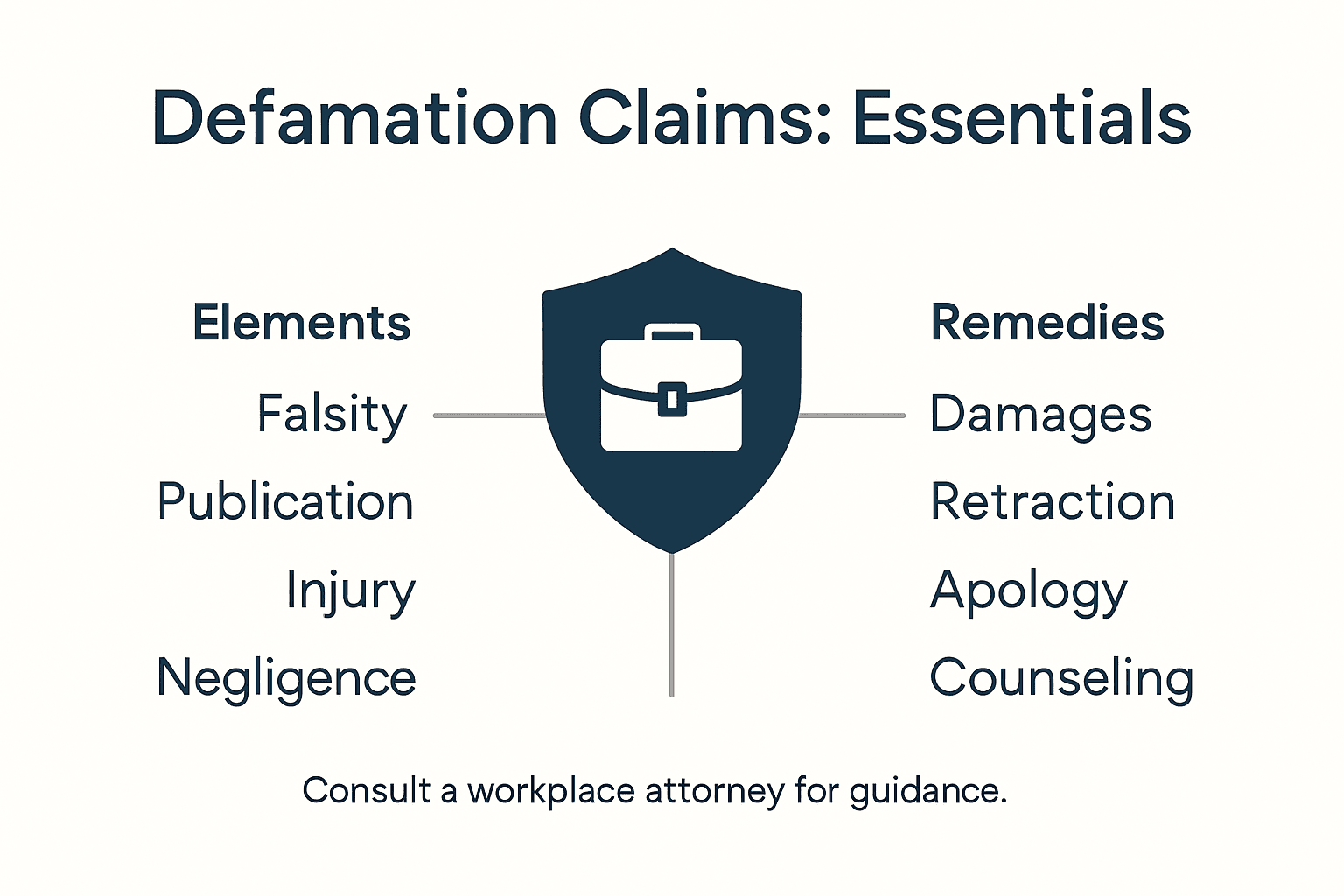
Legal remedies for workplace defamation typically involve seeking compensatory damages that can address both economic losses and emotional distress. These may include lost wages, diminished earning potential, costs associated with job search efforts, and compensation for psychological impact. However, employees must navigate complex legal standards that balance protection against false statements with employers’ rights to provide legitimate performance feedback. The legal system requires a nuanced approach that distinguishes between actionable defamation and protected statements of professional opinion.
Below is a summary of employee legal remedies and associated challenges in workplace defamation cases:
| Remedy Type | Description | Key Challenge |
|---|---|---|
| Compensatory Damages | Monetary compensation for losses | Proving actual harm and causation |
| Emotional Distress | Damages for psychological impact | Requires documented evidence |
| Injunctive Relief | Court order to stop further defamation | Meeting strict legal requirements |
| Reputation Repair | Legal steps to restore professional status | Publicizing correction can be hard |
Pro tip: Maintain a comprehensive and organized record of all communications, performance evaluations, and potential evidence of defamatory statements, as meticulously documented information can significantly strengthen your legal claim.
Protect Your Professional Reputation with Expert Legal Support
Workplace defamation can cause profound harm to your career and personal life. Whether facing false libelous emails, malicious slander during meetings, or damaging performance reviews, you are not without options. The complex California legal standards require proven falsity, publication, and real harm — challenges best navigated with skilled representation. If you are dealing with workplace defamation or fear your reputation is at risk, you need a trusted ally who understands the nuances of employment law and the high stakes involved.
At Shirazi Law Office, we specialize in protecting employees, executives, and senior management throughout Los Angeles. Our focused expertise in employment disputes and workplace defamation means we take your concerns seriously. From documenting incidents and evaluating your claim to enforcing your rights and pursuing damages, we offer personalized strategies tailored to your situation. Do not wait until your professional future suffers irreversible damage. Visit Shirazi Law Office now to learn how we can help you take control of your reputation and workplace rights.
Frequently Asked Questions
What constitutes workplace defamation?
Workplace defamation occurs when false statements are intentionally made that damage an employee’s professional reputation and career prospects.
What are the key elements required to prove a defamation claim?
To prove a defamation claim, an employee must establish that the statement is false, published to a third party, negligent in nature, and has caused actual harm to their professional reputation.
How do slander and libel differ in a workplace context?
Slander involves spoken false statements that are not permanently recorded, while libel refers to written or published false statements, which are typically easier to prove due to their tangible nature.
What can employees do to protect their reputation against potential defamation?
Employees can protect their reputation by documenting all communications, recognizing the difference between opinion and actionable false claims, and consulting with legal specialists if they encounter potentially defamatory statements.